Beyond AI Readiness
Why AI Stewardship Will Define the Next Generation of Leadership

Artificial Intelligence has rapidly become one of the most transformative forces in modern business. Across industries, leadership teams are exploring how AI can improve efficiency, accelerate decision-making, and create competitive advantage. The conversation often centers on deployment speed, automation opportunities, and return on investment.
While those are important considerations, I believe many organizations are asking the wrong question.
The question is not simply, "How quickly can we adopt AI?" — The more important question is,
"Are we prepared to steward AI responsibly?"
Over the last several years, I have worked with organizations across nonprofit, government, workforce development, and enterprise environments. Regardless of industry, I consistently observe a common challenge. Leaders are eager to leverage AI, yet many organizations continue to struggle with operational inconsistency, fragmented processes, unreliable data, low system adoption, and governance practices that have not evolved alongside emerging technologies.
AI does not eliminate these challenges. — It amplifies them.
An organization with inconsistent workflows does not suddenly become efficient because it implements AI. An organization with unreliable data does not produce trustworthy insights simply because a new AI platform has been deployed. And organizations that struggle to engage employees with existing systems should not expect AI-generated recommendations to create meaningful outcomes when the underlying information remains incomplete or inaccurate.
The reality is that AI learns from and scales the environment in which it operates.
If that environment lacks consistency, trust, or accountability, AI will accelerate those conditions rather than correct them.
This is why I believe the conversation must evolve beyond AI readiness and toward AI stewardship.
The Emergence of AI Stewardship
AI stewardship is the organizational responsibility to ensure that artificial intelligence is implemented within an environment capable of producing trustworthy, sustainable outcomes.
While AI readiness focuses on preparation, AI stewardship focuses on leadership responsibility.
It asks organizations to evaluate not only whether AI can be implemented, but whether it should be implemented in its current state and what conditions must exist for success.
This perspective shifts the conversation away from technology alone and toward the broader systems that support organizational performance.
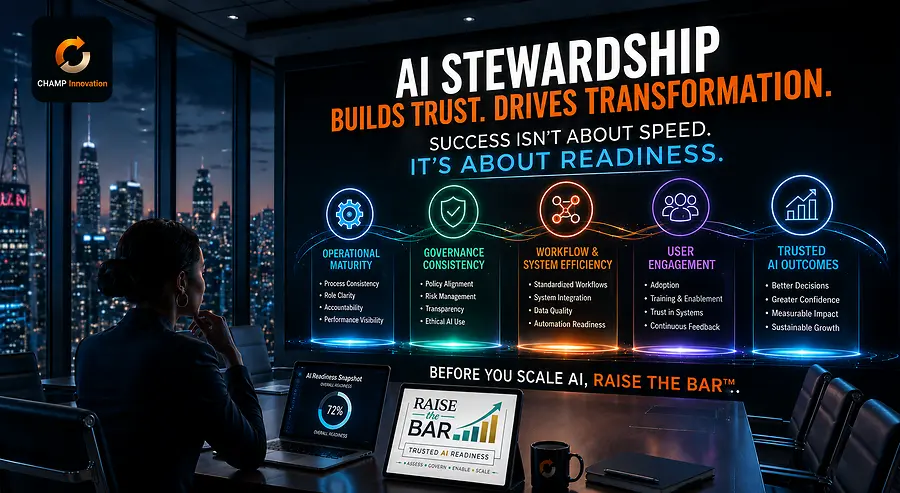
Successful AI stewardship requires leaders to examine the operational foundations that influence every AI-driven outcome. These foundations include operational maturity, governance consistency, workflow efficiency, data confidence, and user engagement.
Together, they determine whether AI becomes a strategic asset or an accelerated source of risk.
Operational Maturity Matters More Than Most Leaders Realize
Many organizations pursue AI while still navigating operational challenges that existed long before AI entered the picture.
Processes may vary from one department to another. Critical knowledge may reside with a handful of experienced employees. Teams may create workarounds because formal workflows no longer reflect how work is actually performed.
These conditions create organizational friction. AI simply makes that friction move faster.
Operational maturity requires organizations to understand how work flows across departments, where decisions are made, how accountability is maintained, and whether systems support consistent execution. Without this foundation, AI often introduces additional complexity rather than greater clarity.
Before organizations ask what AI can do for them, they should first understand how effectively their business already operates.
Governance Consistency Creates Organizational Confidence
As AI becomes increasingly integrated into business operations, governance can no longer be viewed as a compliance exercise.
Governance provides the framework for trust.
Leaders must establish clear expectations around decision-making, accountability, data management, risk management, and human oversight. Employees need confidence that AI-supported processes align with organizational values and strategic objectives. Stakeholders need assurance that decisions remain transparent and explainable.
Without consistent governance, organizations risk creating uncertainty around how AI is used and who remains accountable for outcomes.
AI stewardship recognizes that responsible innovation requires responsible oversight.
Workflow Efficiency and System Adoption Are Strategic Assets
One of the most overlooked realities of AI implementation is that technology adoption has always been a human challenge before it becomes a technical one.
AI is only as effective as the systems and processes feeding it.
When workflows are fragmented, undocumented, or dependent upon individual interpretation, AI can unintentionally scale inefficiency. Likewise, when employees are not consistently engaging with organizational systems, the quality of information available to AI declines significantly.
Trusted AI depends on trusted participation.
Organizations that prioritize workflow alignment and system adoption create stronger foundations for future AI capabilities. Those that ignore engagement challenges often discover that AI-generated insights become disconnected from operational reality.
Redefining Success in the AI Era
Today, many organizations measure AI success through implementation speed, automation rates, or projected cost savings.
While these metrics may demonstrate activity, they do not necessarily demonstrate readiness.
A more meaningful measure of success may be an organization's ability to create trust:
- Can leaders trust the information driving AI-generated recommendations?
- Can employees trust the systems supporting their work?
- Can stakeholders trust the governance structures guiding decisions?
- Can customers trust the outcomes being produced?
These questions sit at the heart of AI stewardship.
Organizations that can answer them confidently are far more likely to achieve sustainable results than those focused solely on deploying technology as quickly as possible.
The Future Belongs to Responsible Leaders
As artificial intelligence continues to reshape the future of work, leadership itself must evolve. The organizations that achieve lasting success will not necessarily be those that adopt AI first. They will be the organizations that build the strongest foundation for responsible adoption.
The future belongs to organizations that understand a simple but powerful truth: AI is not merely a technology investment. It is a stewardship responsibility.
Before accelerating AI initiatives, leaders should take time to evaluate the foundations that support them. Operational maturity, governance consistency, workflow efficiency, data confidence, and user engagement all influence whether AI becomes a strategic advantage or a source of amplified risk.
Because the most important question is no longer whether your organization is using AI — The question is whether your organization is prepared to steward it.
That is where trust begins. And trust is what will ultimately determine whether AI delivers transformation or simply accelerates existing dysfunction.
If you are unsure where your organization stands, start by measuring the foundations that matter. The Raise the BAR™ Trusted AI Readiness Snapshot provides leaders with a practical way to assess organizational readiness across the critical areas that support Trusted AI Stewardship, including executive alignment, data governance, workflow efficiency, AI governance, and system adoption.
In just a few minutes, you can gain insight into the strengths, gaps, and opportunities that may impact your organization's ability to scale AI responsibly and effectively.
Take the Raise the BAR™ Trusted AI Readiness Snapshot and discover where your organization stands on the path to Trusted AI Stewardship.
Visit CHAMP Innovation — Before You Scale AI, Raise the BAR™.


