
Beyond Chatbots: The Next Wave of Artificial Intelligence and the Technologies That Could Change Our World
How Agentic AI, Robotics, and Emerging Technologies Will Transform Business, Healthcare, and Investment Opportunities in the Next Decade.

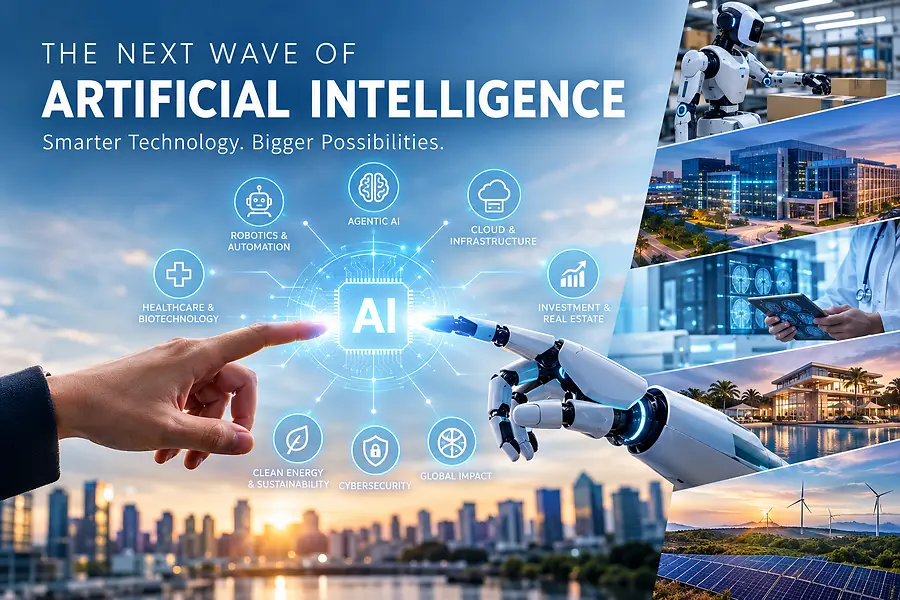
Artificial intelligence is moving into a new phase. What began as a technology that could answer questions, write articles, generate images, and analyze information is evolving into something much more powerful. The next generation of AI is expected to do more than respond to commands. It will increasingly be able to plan, make decisions, coordinate tasks, interact with the physical world, and help solve complex problems.
The question is no longer simply what AI can create. The bigger question is what happens when AI can take action, learn from its environment, and work alongside humans to accomplish real-world goals?
As we look toward the future, several emerging technologies stand out as potential drivers of the next major transformation in business, healthcare, finance, manufacturing, and real estate.
1. Agentic AI: From Answering Questions to Taking Action
One of the most important developments is agentic AI. Unlike a traditional chatbot that primarily responds to individual prompts, an AI agent can be designed to pursue a goal through multiple steps.
Imagine asking an AI system to research a commercial real estate acquisition. Instead of simply providing information, it could help identify properties, organize financial statements, compare operating expenses, calculate potential returns, prepare a preliminary investment analysis, and flag missing documents.
With appropriate software access and human authorization, it could also coordinate communications and update project records.
Businesses could eventually use teams of specialized AI agents to manage different parts of their operations, from customer service and market research to accounting support and project management.
However, these systems still have limitations. They can make mistakes, misunderstand instructions, or take inappropriate actions if their permissions and safeguards are poorly designed. Human oversight will remain essential, particularly when financial transactions, contracts, and sensitive information are involved.
The competitive advantage may belong to businesses that learn how to combine human judgment with AI-driven execution.
2. Physical AI and Humanoid Robots
The next frontier is moving beyond computer screens and into the physical world.
Physical AI combines artificial intelligence with machines that can perceive their surroundings, interpret information, and perform actions. This includes industrial robots, autonomous vehicles, warehouse systems, and humanoid robots designed to work in environments built for people.
Manufacturing and logistics are among the areas where robotics is already making progress. The next challenge is expanding these capabilities into more complicated environments, including construction sites, hospitals, hotels, and eventually homes.
Consider the possibilities for real estate and hospitality. AI-powered robots could assist with cleaning, inventory management, deliveries, maintenance inspections, and repetitive operational tasks. Construction technology could also use intelligent machines to improve productivity and monitor job-site conditions.
The opportunity is not necessarily to replace every worker with a robot. It is to identify tasks that are repetitive, physically demanding, time-consuming, or difficult to staff consistently.
Widespread adoption will depend on cost, reliability, safety, and the ability of robots to operate in unpredictable environments.
3. Multimodal AI: Technology That Understands More Than Words
Today's AI systems are increasingly capable of processing multiple forms of information, including text, images, audio, video, and other data.
This is known as multimodal AI.
Instead of analyzing a written report alone, a multimodal system might examine photographs, review a video, interpret a spreadsheet, and summarize a conversation within a single workflow.
In healthcare, these capabilities could help professionals analyze medical images alongside patient information. In manufacturing, AI could interpret camera footage and equipment sensor readings to identify potential problems. In real estate, it could help review property photographs, inspection reports, floor plans, leases, and financial records.
Imagine evaluating a hotel acquisition. An AI system could assist in organizing room-condition photographs, reviewing maintenance records, comparing revenue and expenses, and identifying inconsistencies that deserve further investigation.
It would not eliminate the need for qualified inspectors, accountants, attorneys, or investment professionals. Instead, it could help them process more information and focus their attention on the decisions that matter most.
The real breakthrough will come when AI can connect different types of information and produce more reliable, context-aware analysis.
4. World Models: AI That Learns How the Real World Works
Another promising area is the development of AI world models.
A world model attempts to represent how an environment works and how it might change when different actions are taken. Rather than merely generating an answer, a system can use a model of its environment to predict possible outcomes and support planning.
This capability could have major implications for robotics, autonomous driving, engineering, and scientific research.
For example, an AI system might simulate how a robot should navigate a warehouse before it moves through the actual facility. Engineers could test different designs in a simulated environment. Urban planners could evaluate potential changes to traffic flow before implementing them in a city.
Real estate investors could eventually benefit from more advanced simulation tools that evaluate alternative renovation plans, operating costs, energy improvements, or property-management strategies under different assumptions.
These applications are still developing, and simulations are only as useful as their assumptions and underlying data. Nevertheless, the ability to test decisions virtually before committing real money could become increasingly valuable.
5. AI-Driven Scientific Discovery and Healthcare
Artificial intelligence could also change the way new medicines, materials, and treatments are discovered.
Traditional scientific research can require years of experiments, significant funding, and extensive testing. AI can help researchers analyze large datasets, identify promising patterns, generate hypotheses, and narrow the number of possibilities that require physical testing.
In drug discovery, for example, AI can help researchers investigate potential drug candidates and predict how biological systems might respond. Combined with laboratory automation, these capabilities could accelerate portions of the research process.
AI may also help scientists develop new materials, improve battery technology, discover more efficient industrial processes, and better understand complex biological systems.
However, identifying a promising candidate is not the same as proving that a treatment is safe and effective. Clinical trials, regulatory review, and independent scientific validation remain necessary.
The long-term opportunity is a research process in which AI helps scientists move from a question to a testable hypothesis more quickly, allowing human expertise and experimental evidence to guide the results.
6. AI Infrastructure: The Technology Behind the Technology
While AI applications attract public attention, another important investment area is the infrastructure required to operate them.
Advanced AI systems depend on computing power, specialized chips, data centers, networking equipment, electricity, cooling systems, and reliable connectivity.
As more businesses use AI agents, robotics, and advanced models, the demand for efficient computing infrastructure could continue to create opportunities across several industries.
This also introduces constraints. Data centers require substantial capital, access to power, cooling capacity, suitable sites, and dependable infrastructure. Electricity availability and operating costs can influence where new facilities are developed.
This is where AI intersects with physical assets.
Industrial properties, power infrastructure, data-center sites, energy systems, and certain telecommunications assets may benefit from growing demand, depending on their location, capabilities, lease structures, and market conditions.
For investors, the important distinction is that growing demand for AI does not automatically make every AI-related investment profitable. Valuation, financing costs, competition, energy availability, and execution risk still matter.
The opportunity lies in understanding which assets are positioned to support the expansion of the digital economy.
7. Personalized AI Assistants and Digital Workforces
Another emerging development is AI that can maintain useful context, adapt to individual preferences, and assist with ongoing projects.
Rather than starting from scratch with every request, future assistants may be better equipped to understand a user's objectives, preferred workflows, schedule, and recurring responsibilities, subject to the permissions and privacy protections in place.
For entrepreneurs, this could mean having a digital assistant that helps organize leads, prepare correspondence, monitor deadlines, summarize research, and coordinate business processes.
For a real estate investment company, specialized AI assistants might support acquisitions, underwriting, due diligence, marketing, and investor communications.
For a small business, similar tools could make certain administrative capabilities more accessible without requiring a large staff.
The challenge will be ensuring that these systems protect confidential information, distinguish verified facts from assumptions, and request approval before taking consequential actions.
Businesses that implement AI responsibly may be able to operate more efficiently while allowing their teams to concentrate on relationships, negotiations, strategy, and decision-making.
8. AI Security, Governance, and Trust
As AI becomes more capable, security and accountability will become increasingly important.
AI systems may handle confidential documents, access business software, communicate with customers, and assist with financial or operational decisions. Each additional capability creates new opportunities as well as new risks.
Companies will need safeguards to prevent unauthorized access, protect sensitive data, verify important outputs, and control what AI agents are permitted to do.
Businesses will also need to consider fraud, synthetic media, inaccurate information, cybersecurity threats, and the potential consequences of automated decisions.
Trust could become a competitive advantage. Organizations that can demonstrate strong security practices, clear accountability, and responsible AI governance may be better positioned to earn customer and investor confidence.
The next stage of AI development will therefore depend not only on intelligence and speed, but also on reliability, transparency, and the ability to operate safely.
What Does This Mean for Investors and Entrepreneurs?
The next AI opportunity may not be limited to the companies developing the most advanced models. It may also involve the businesses and physical assets that make those technologies useful.
Potential areas to watch include:
- AI software and agents: Tools that automate meaningful business processes.
- Robotics and automation: Systems that improve productivity in manufacturing, logistics, construction, and hospitality.
- Computing infrastructure: Data centers, specialized chips, networking, cooling, and supporting equipment.
- Energy and utilities: Infrastructure capable of meeting the power demands of expanding digital services.
- Healthcare and biotechnology: Applications that help accelerate research and improve certain clinical workflows.
- Cybersecurity: Technologies that protect organizations as AI becomes more integrated into business operations.
- Physical real estate: Carefully selected properties that support data infrastructure, industrial operations, logistics, energy systems, and other growing business needs.
These are areas to research, not guaranteed investment winners. Each has its own risks, capital requirements, competitive pressures, and time horizons.
For investors, the key is to distinguish between a compelling technological story and a business capable of generating sustainable cash flow.
Are We Approaching the Next Stage of AI?
Artificial intelligence is not following a single, universally accepted development ladder. There is no official sequence that determines exactly when AI moves from one stage to another.
Nevertheless, the direction of progress is becoming clearer: AI is moving from generating content toward completing tasks, from processing primarily digital information toward interacting with the physical world, and from supporting individual activities toward coordinating more complex workflows.
These developments are advancing at different rates. Some are already commercially useful, while others remain experimental or face significant technical and economic barriers.
The next major breakthrough may not be one invention that changes everything overnight. It may be the convergence of several technologies: advanced reasoning models, AI agents, robotics, simulation, specialized computing, and scientific discovery.
When these capabilities work together, they could change how businesses operate, how products are manufactured, how buildings are managed, and how capital is deployed.
Final Thoughts: The Future Belongs to Those Who Prepare
Every major technological shift creates both opportunities and uncertainty. The internet transformed communication and commerce. Cloud computing changed how businesses access technology. Artificial intelligence is now creating another transition, one that could influence nearly every industry.
The next wave will likely be defined less by what AI can say and more by what it can reliably accomplish.
For business owners, the priority is to understand where AI can improve productivity and strengthen operations. For investors, it is to identify companies and assets with sound fundamentals that may benefit from the transition. For professionals, it is to develop the judgment and skills needed to work effectively alongside increasingly capable systems.
The future will not reward every company that adopts AI, nor will every promising technology become commercially successful. The strongest opportunities will emerge where genuine technological progress meets real customer demand, sound economics, and responsible execution.
AI is evolving from a tool we use into a capability that can help operate entire systems. The question for entrepreneurs and investors is whether they will recognize the opportunities early enough to prepare for what comes next.

Gladys Yarbrough is CEO of KD Bar Investments and Private Money Lending Manager at Blue Horizon Capital Group. With over two years in real estate and private lending, she specializes in helping distressed homeowners and structuring profitable transactions. Certified Project Money Lender with cosmetology and business education, Gladys received Outstanding Leader of the Year Award for 4-H mentorship. She excels at…





