Beyond the Referral: Building a Community Around Families in Crisis
Moving Beyond Referrals to Build Wraparound Communities That Support Families Through Crisis

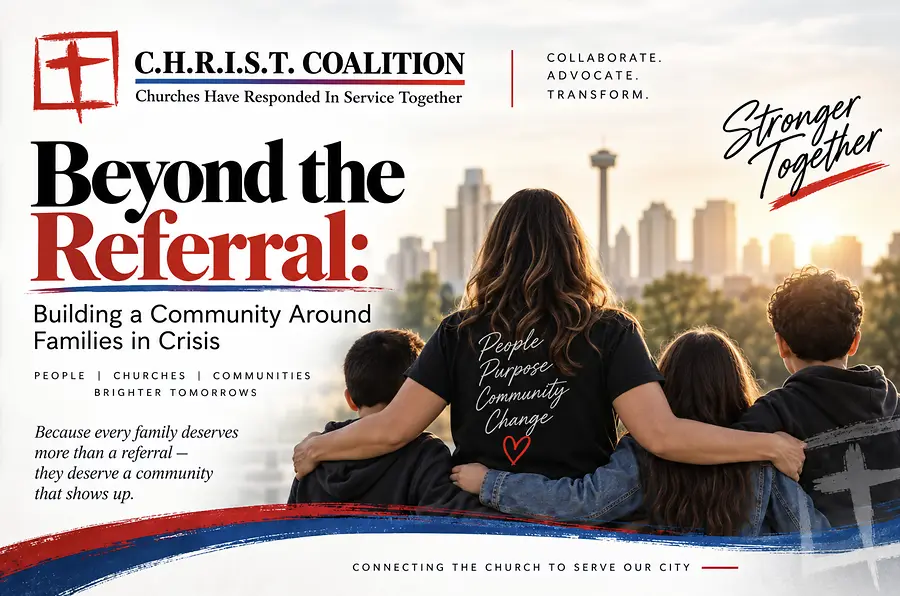
For years, we have built systems designed to respond to crisis.
A child enters foster care. A teenager needs placement. A parent struggles with addiction. A family loses housing. A young person ages out of care.
And almost immediately, we begin asking the same question:
What service can we refer them to?
We find a program. We make a referral. We provide a phone number. We complete another assessment. We connect them to another agency.
Those services matter. Programs matter. Providers matter.
But after years of working alongside children and families, I have become convinced of something:
A referral is not the same thing as a relationship.
And sometimes what a family needs most cannot be placed on a resource list. They need people. They need community. They need someone willing to walk with them long enough for stability to become sustainable.
The Family Is in Crisis, Not Just the Child
One of the greatest mistakes we can make when responding to crisis is treating the person experiencing the most visible symptoms while overlooking everyone around them.
When a young person is struggling, the family struggles. When addiction enters a home, the entire family feels its effects. When a child enters foster care, there are parents, siblings, grandparents, and relatives experiencing that separation, too. When a teenager is homeless, unemployed, or disconnected from school, there is often a much larger story behind what we see.
Crisis rarely happens in isolation.
Yet our systems are often structured to address one need, one diagnosis, one case, or one person at a time. We may stabilize the immediate situation without strengthening the environment that person will eventually return to.
That is why I believe we must begin changing the question.
Instead of only asking:
"What service does this person need?"
We also need to ask:
"What does this family need around them so they can thrive?"
Beyond the Program
I have had the privilege of working across residential care, youth services, peer support, family support, workforce development, community partnerships, and faith-based initiatives.
Across those spaces, I continue to see the same truth:
Programs can open doors, but relationships help people walk through them.
A teenager may need housing, but they also need someone who believes in their future. A young adult may need employment, but they may also need transportation, professional clothing, encouragement, and someone willing to teach them how to navigate a workplace. A parent may need supervised visitation, but that visit can also become an opportunity to strengthen the parent-child relationship and connect a family to long-term support.
A young person leaving foster care may receive a list of resources, but what happens when the first three numbers don't answer? Who do they call then? Who notices when they stop showing up? Who celebrates when they get their first job? Who helps when the car breaks down? Who answers when the crisis happens at 8:00 on a Saturday night instead of during business hours?
Those questions reveal the difference between providing a service and building a community.
We Already Have Much of What We Need
Texas is filled with extraordinary organizations, churches, nonprofits, businesses, government agencies, educators, workforce leaders, and individuals who care deeply about children and families.
The problem is not always that resources don't exist. Sometimes the problem is that they exist in silos.
- One organization has housing.
- Another has employment opportunities.
- Another has counseling.
- Another has mentors.
- Another has transportation assistance.
- A church has volunteers and unused classrooms.
- A business owner is willing to hire young people.
- A community organization knows the neighborhood.
- A state agency understands where the greatest needs exist.
Each holds a piece of the solution. But families should not have to become professional system navigators just to access those pieces.
Our responsibility as leaders is to build the bridges between them.
The Church Has a Role to Play
For those of us in the faith community, I believe there is also an important question we must confront.
What would happen if churches saw families in crisis not simply as people to invite to Sunday service, but as families to surround throughout the week?
Churches already possess something incredibly valuable: community.
They have people. They have buildings. They have children's ministries. They have business owners, teachers, mechanics, nurses, counselors, mentors, retirees, and families sitting in their congregations every week.
Imagine mobilizing those resources alongside, not instead of, professional services.
A caseworker should not have to become someone's entire support system. A provider cannot be a permanent family. Government was never designed to replace community. And the Church should never assume that prayer eliminates the need for practical action.
We need both. Faith and service. Compassion and accountability. Prayer and presence. Professional systems and personal relationships.
From Wraparound Services to Wraparound Community
We often talk about providing "wraparound services." I believe we need to go further.
We need wraparound communities.
Imagine a young person leaving foster care who already knows where they can find employment, mentorship, transportation assistance, educational support, and a church or community where people know their name.
Imagine a parent completing services who isn't simply handed a certificate and wished good luck, but is connected to people who will continue encouraging that family long after the case closes.
Imagine churches opening their doors for supervised family visits. Imagine businesses intentionally creating employment pathways for young adults transitioning from care. Imagine nonprofits sharing resources instead of competing for ownership of the solution.
Imagine state and community leaders identifying gaps together and then asking:
Who already has what is needed to fill this gap?
That changes the model. Instead of constantly building another program, sometimes we simply connect the people who are already carrying pieces of the answer.
No One Organization Gets to Be the Hero
This work requires humility.
Government cannot do it alone. Providers cannot do it alone. Nonprofits cannot do it alone. Businesses cannot do it alone. And the Church cannot do it alone.
But together, we can build something stronger than any one organization could create independently.
The goal should never be for one organization to become the hero. The goal is for the family to become stronger.
That requires us to stop protecting silos and start building bridges. It requires collaboration that goes beyond exchanging business cards at networking events.
Real collaboration asks: What do you have? What do we have? What is still missing? And who else needs to be at this table?
The Measure of Success
We often measure success through numbers. How many youth were served? How many families completed services? How many referrals were made? How many placements were stabilized?
Those metrics are important. But I believe we also need another set of questions.
Who stayed?
Who remained in that young person's life after the program ended? Who does that mother call when she feels overwhelmed? Who is teaching that teenager how to become an adult? Who knows that family's story without needing to pull up a case file? Who will notice if they disappear?
Because ultimately, sustainable change is not only about the services people receive. It is also about the relationships they leave with.
Beyond the Referral
Our communities do not lack compassion. They often lack connection.
The next evolution of child and family welfare will require us to become better at connecting the people, institutions, and resources that already exist.
That means moving beyond referrals. Beyond programs. Beyond organizational logos. Beyond asking who gets credit. And toward building communities where families know they do not have to navigate crisis alone.
Because the question we should ultimately be asking is not simply:
"Did we provide the service?"
It is:
"Did we build enough support around this family that when the crisis comes again, they will not face it alone?"
Imagine what could change if every child and family leaving one of our systems didn't simply leave carrying a folder filled with resources, but left surrounded by actual people committed to walking with them.
That is the community I believe we can build. And it begins when we stop asking only where we can refer people and start asking how we can come together to serve them.
Vanessa Munoz is a child and family welfare leader, entrepreneur, author, and community collaborator whose work focuses on strengthening the connections between youth-serving organizations, community partners, workforce leaders, and the faith community. She serves as CEO of Divine Youth Care, Co-Founder of Divine Youth Services, and Chief Operating Officer of Christ Coalition.


