Compliance Is Not Culture: The HR Leader’s Role in Ethical Security Operations
Why Ethical Culture Matters More Than Compliance in Security Operations

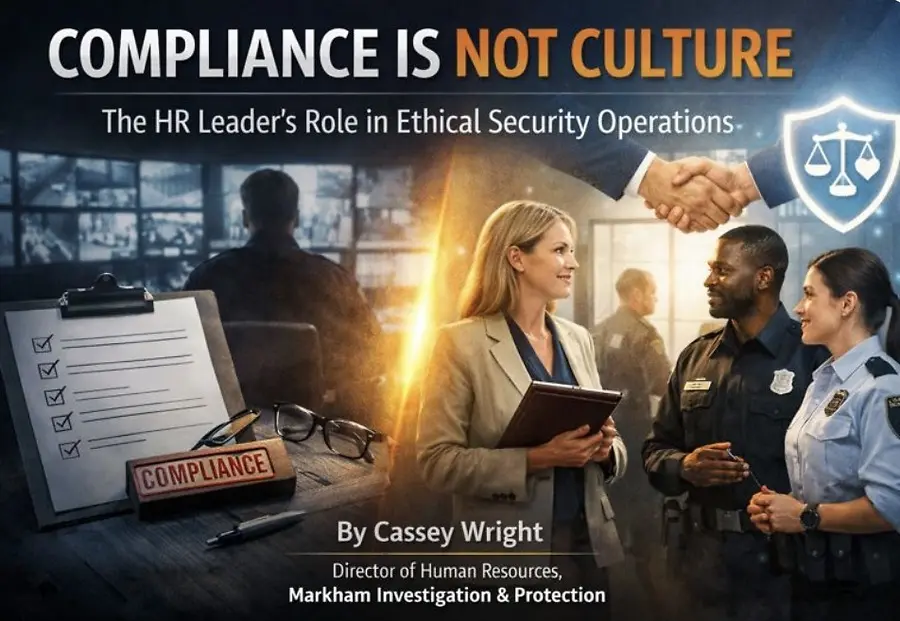
By Cassey Wright
Director of Human Resources, Markham Investigation and Protection
In the security industry, compliance is often treated as the finish line. Policies are signed, training is completed, certifications renewed, and audits passed. On paper, everything looks right.
But compliance alone does not create ethical behavior. In security operations—where authority, discretion, and public trust intersect—ethical behavior is not optional. It is foundational.
As an HR leader in security, I have learned this truth firsthand: compliance may protect the organization legally, but culture protects it operationally and reputationally.
The Illusion of “Being Covered”
Compliance answers the question: Are we meeting the minimum requirements?
Culture answers the far more important question: How do our people behave when no one is watching?
Security professionals operate in environments where judgment matters more than checklists. They make split-second decisions, handle sensitive information, and interact with the public in ways that directly shape trust in the organization. When behavior is guided only by policy, the result can be rule-following without accountability, silence instead of reporting, and authority without integrity.
A compliant organization can still be unethical. It can still fail its people and the communities it serves.
Why HR Must Lead the Ethical Conversation
Ethical security operations cannot be delegated solely to leadership training or internal investigations after something goes wrong. They must be intentionally built—and that responsibility sits squarely with Human Resources.
HR is uniquely positioned to influence ethics at every stage of the employee lifecycle:
- Hiring: Are we screening for values, judgment, and emotional intelligence—or just credentials and availability?
- Onboarding: Do we communicate how we expect people to show up, not just what rules they must follow?
- Training: Are ethics and decision-making treated as ongoing skills, or one-time compliance modules?
- Leadership Development: Are supervisors trained to model accountability, transparency, and restraint?
- Reporting & Accountability: Do employees feel safe speaking up without fear of retaliation?
Ethical culture is not built in policy manuals—it is reinforced in daily behaviors, leadership responses, and HR’s consistent action.
From Checkbox Compliance to Values-Driven Behavior
Values-driven security organizations do not ask, “Is this allowed?”
They ask, “Is this right?”
This shift requires HR leaders to move beyond enforcement into influence. It means partnering with operations to align expectations, holding leaders accountable for how results are achieved—not just whether they are achieved—and addressing misconduct proactively rather than reactively.
Most importantly, it means understanding that silence is a warning sign. When employees stop reporting concerns, disengage, or rely solely on “policy” to justify questionable behavior, culture has already begun to erode.
Ethics as a Strategic Advantage
Organizations that embed ethics into their culture experience stronger retention, better decision-making, and fewer high-risk incidents. Trust—both internally and externally—becomes a competitive advantage.
In the security industry, where reputation is everything, ethical culture is not a “soft” HR initiative. It is a strategic imperative.
The HR Leader’s Responsibility
As HR leaders, especially in security operations, we must challenge the idea that compliance is enough. Our role is not simply to ensure rules are followed—it is to ensure people understand why those rules exist and how their actions reflect the organization’s values.
Compliance keeps you out of trouble.
Culture determines who you are when it matters most.
And in security, it always matters.
References & Resources
- Society for Human Resource Management (SHRM): Ethics & Compliance in the Workplace
- Harvard Business Review: How Leaders Build Ethical Cultures
- U.S. Equal Employment Opportunity Commission (EEOC): Best Practices for Employers
- OSHA: Whistleblower Protection Programs
- Center for Ethical Leadership: Values-Based Leadership Models


