Defining Moments and the Women Who Inspired Them
How the Women Who Believed in Us Shape the Leaders We Become

Defining Moments and the Women Who Inspired Them
By Lizzie Bailey, Hobby Farmers’ Daughter
There are moments in life that do not announce themselves as history while they are happening. They arrive quietly in living rooms, classrooms, kitchens, and ordinary conversations. At the time, they seem small enough to overlook. Yet years later, we realize those moments changed the direction of our lives because someone believed in us, challenged us, encouraged us, or helped us find our voice before we even knew we had one.
When I look back across my own life, I can trace many of those turning points to the influence of women. Some were nationally known. Others never traveled farther than the boundaries of a small town or a humble kitchen table. Yet each of them left fingerprints on the woman, writer, communicator, agricultural advocate, and mentor I eventually became.
In 1972, a young girl sat on the floor in front of a television that barely pulled in three channels. The set was large, and the picture sometimes wavered depending on the antenna signal. One of those channels opened a window into a much bigger world.
That little girl was me.
One evening, my mother placed me on the floor in front of the television because she knew Gloria Steinem was about to speak. At 9 years old, I did not fully understand the women’s movement unfolding across the country, but I understood enough to sit a little closer and listen.
On the television screen was a woman speaking with confidence about dignity, equality, and the importance of women finding their voices. Looking back now, I realize that evening was about far more than politics or social change. It was one of the first moments in my life when I recognized that women could lead conversations, shape communities, and influence the world around them.
But Gloria Steinem was not the first strong woman to shape my life.
Long before I understood national movements or public leadership, I had already witnessed strength inside my own family through my grandmother, Grammy Leighton.
Grammy Leighton raised a large family during the hardest years of the Great Depression in a tiny two-room home. Her leadership never came from a podium or public office. It appeared quietly through hard work, creativity, sacrifice, and resilience.
As a child, I sat beside her while she folded paper and carefully cut intricate designs with a pair of scissors. When she unfolded the paper, delicate chains of figures appeared like magic. Years later, I learned those paper creations were called scherenschnitte, but to me, they represented something much larger. They taught me that beauty and creativity could still exist during difficult times.
Grammy Leighton could take discarded fabric and turn it into clothing. She cooked meals from whatever was available, tended gardens, canned food, made soap, and found ways to stretch resources during years when very little was wasted. Those were not hobbies. They were survival skills—quiet acts of determination that helped hold families together.
My mother carried many of those same values into our own home. She believed in hard work, resourcefulness, and caring for others, but she also understood something deeper. She had grown up during a time when women’s opportunities were often limited and independence was not always encouraged.
Perhaps that is why she intentionally placed me in front of that television set in 1972. Maybe she wanted her daughter to see possibilities she herself had not always been given.
Years later, another important turning point arrived in the form of an eighth-grade English teacher named Mrs. Robinson.
At the time, I was painfully shy. Speaking in front of people terrified me. Our assignment was to prepare and deliver a persuasive speech to the class. While other students selected broad topics, Mrs. Robinson quietly pulled me aside and asked a question that would stay with me for the rest of my life.
"What interests you?"
I told her I wanted to speak about CB radios because my father belonged to a local CB club, and I had grown up around radio conversations and community events. Instead of steering me toward a safer or more traditional topic, she encouraged me to speak about something I genuinely cared about.
That simple moment mattered.
For the first time, I discovered the power of communication, storytelling, and using my own voice. Mrs. Robinson did more than assign a speech project. She helped a quiet rural girl discover confidence in herself.
Looking back now, I can clearly see how those experiences shaped the direction of my life.
Today, I write the Hobby Farmers’ Daughter column, which appears in publications across Central Pennsylvania. My work centers on leadership through stories rooted in agriculture, rural heritage, family, and community.
Agriculture is not only about production. It is also about preserving the human side of rural life—the values, resilience, creativity, relationships, and traditions that sustain communities across generations.
I serve as Executive Director of the Pennsylvania State Council of Farm Organizations, where advocacy and communication help strengthen agriculture across the Commonwealth.
I also serve as Vice Chairman of the Friends of the Pennsylvania Farm Show Foundation, Inc., helping preserve and promote Pennsylvania’s agricultural traditions while encouraging future generations to remain connected to farming and rural life.
As President of the Cumberland Valley Grange, I continue learning the value of service, advocacy, quilting, sewing, leadership, and community involvement. Those experiences reinforce something I first began learning as a little girl: leadership often grows from ordinary people willing to invest in others.
I am also the owner of Lizzie’s Ink LLC.
Stitching Together More Than Quilts
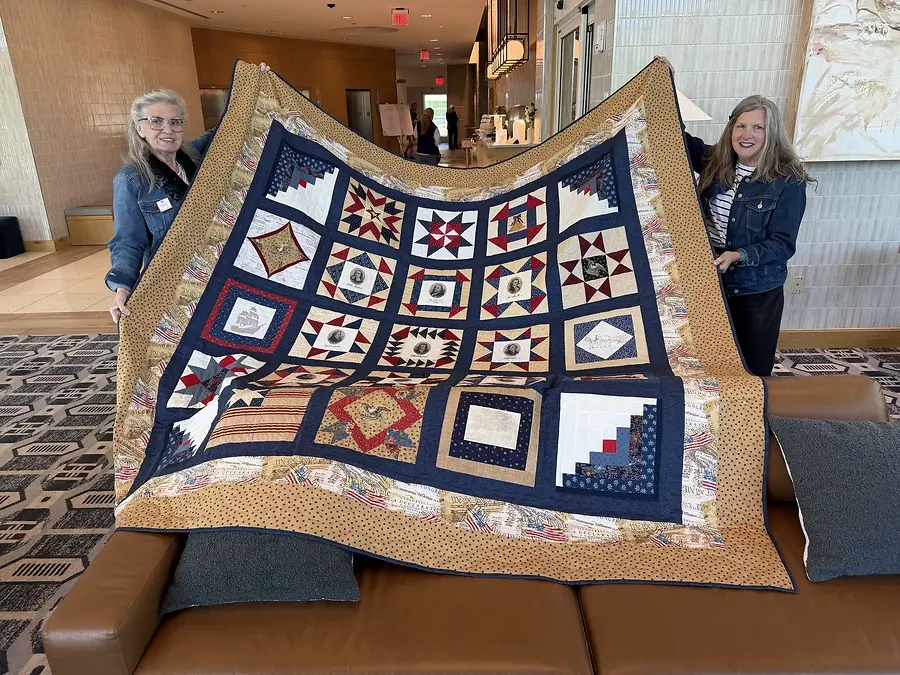
Over the past few years, one of the projects closest to my heart involved helping create and travel with a historical quilt honoring the nine Pennsylvania men who signed the Declaration of Independence.
What touched me most was not simply the project itself, but the people sitting beside me. Children, teenagers, parents, and grandparents continually sat down to quilt, stitch, laugh, and share stories. Many young people would unzip their backpacks to proudly show me embroidery, crochet work, and needlecraft projects they were creating with their own hands.
These experiences taught me something important.
Younger generations are not disconnected or uninterested, as many people assume. They are searching for creativity, authenticity, purpose, and meaningful connection—just like every generation before them.
Now in my 60s, I have embraced allowing my hair to naturally turn gray. Somewhere along this journey, I realized many people now see me as a quilting granny, and honestly, I treasure that role.
Because every time I sit beside someone at a quilt frame, I carry pieces of my own grandmother with me. She taught me patience, kindness, creativity, listening, and encouragement.
Perhaps that is why I still believe the most meaningful leadership rarely happens behind a podium. It happens when someone pulls up a chair beside another person, listens to their story, and helps them believe their voice matters too.
That lesson became especially meaningful while traveling across Pennsylvania with the Friends of the Pennsylvania Farm Show Foundation’s America250PA quilt project honoring the nine Pennsylvania men who signed the Declaration of Independence.
As we visited fairs across the Commonwealth, I spent countless hours sitting beside the quilt frame teaching children, teenagers, and adults how to stitch.
What surprised me most was not the interest shown by older generations. It was the excitement of young people eager to learn something meaningful with their own hands.
Again and again, children returned to the quilt frame asking questions about history, embroidery, quilting, and Pennsylvania agriculture.
In a fast-paced world filled with technology and distractions, I watched young people slow down, connect, create, and take pride in learning something rooted in patience and tradition.
One little girl especially touched my heart.
After learning a few simple stitches at the quilt frame, she returned the very next day proudly carrying her own embroidery kit, excited to show me what she had chosen.
Watching her enthusiasm reminded me so much of my own Grammy Leighton and the patience she once showed me while teaching beside her kitchen table.
At some point during those miles traveled across Pennsylvania, I realized something deeply personal.
The same encouragement, kindness, and confidence influential women once poured into me had quietly become part of how I now try to encourage others.
Perhaps that is how influence truly continues across generations.
One woman teaches another.
One voice encourages another.
One pair of hands patiently guides the next.
And somewhere along the way, the little girl who once sat on the floor in front of a television in 1972 became a woman helping others find their own voices—one conversation, one story, and sometimes one careful stitch at a time.


