Misconceptions About Growth: How Market-Leading Companies Build Measurable, Profitable, and Repeatable Revenue Engines
Why alignment between marketing and sales is the real engine behind sustainable growth.

Everyone wants growth.
Boards want it. Investors expect it. Leadership teams chase it. Entire industries have been built around the promise of more leads, more pipeline, and more revenue.
But somewhere along the way, we confused measuring activity with generating growth.
Over the course of my career, I've had a front-row seat to growth in almost every form: acquisitions, integrations, startups scaling from nothing, established organizations trying to reinvent themselves, companies that grew fast, and companies that grew well. The difference between those last two is significant.
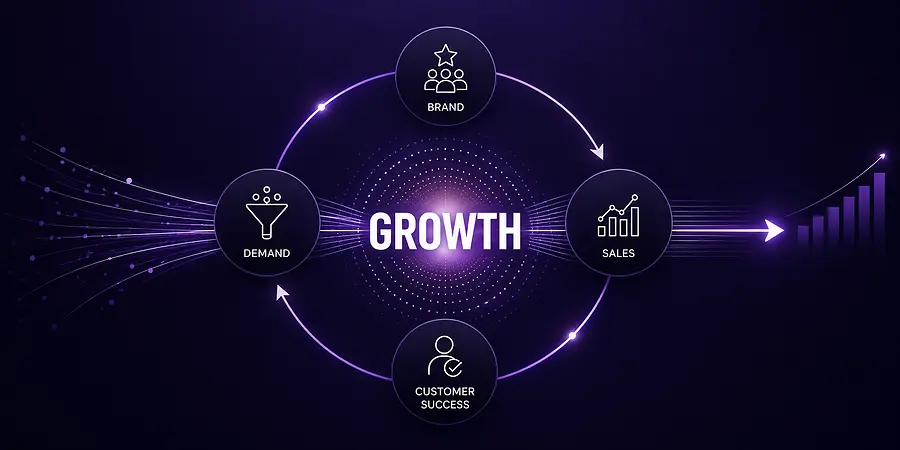
What those experiences taught me is this: growth isn't a tactic. It's a system. And systems break when the people running them aren't aligned around the same outcomes.
The Misalignment Tax
One of the fastest ways to quietly kill a growth engine is to make marketing and sales responsible for different things.
Marketing gets measured on leads. Sales gets measured on revenue. Both teams can hit their numbers, and the business can still miss its targets.
I've sat in those rooms. Marketing is celebrating campaign performance, email open rates, and webinar attendance. Sales is frustrated by pipeline quality and deal velocity. Leadership is asking why pipeline isn't converting into bookings. Everyone has a dashboard proving they're winning, yet growth remains elusive.
That's the moment the real problem becomes clear.
It was never execution.
It was alignment.
One Journey. One System.
At Forrester's B2B Summit earlier this year, one concept stayed with me above everything else: the idea of the "House Divided."
For years, B2B organizations have treated brand, demand, and sales as separate motions. Brand owns awareness. Demand owns lead generation. Sales owns quota. Each team optimizes for its own lane.
The buyer experiences none of those silos.
They experience one journey. Increasingly, they're forming opinions and making decisions long before they ever raise their hand.
I've never believed brand and demand should operate independently. Brand creates trust. It makes people feel something before they're ready to buy. Demand converts that trust into opportunity. Sales turns momentum into revenue. Customer success transforms customers into advocates who fuel the next cycle.
These aren't separate functions.
They're one growth system.
What We Actually Did at Malbek
Malbek is a market-leading contract lifecycle management (CLM) platform that helps enterprises transform how they create, negotiate, manage, and gain intelligence from contracts.
When I joined Malbek, we weren't a market leader. We had a strong product, a clear vision, and a genuine opportunity to earn our place in a crowded and competitive market.
We also had 0.4x pipeline coverage.
Let that sink in. For every dollar of revenue target, we had forty cents of pipeline. That's not just a gap—it's an entirely different conversation.
The easy path would have been to chase every lead, every channel, and every growth tactic promising fast results. More volume. More noise. More activity masquerading as progress.
We didn't do that.
Instead, we asked a harder question: Who do we actually win with?
We became rigorous about our ideal customer profile (ICP). Not just demographics or firmographics presented on a slide, but real pattern recognition around the industries where we excel, the buyers who understand our value fastest, and the accounts where we had the right to win. We stopped trying to be relevant to everyone and started becoming undeniable to the right people. Then we doubled down.
Next, we rebuilt our account-based experience (ABX) motion with 6sense, and what happened became one of the most significant operational transformations in our company's history.
We also made a deliberate bet on AI—not as a layer of technology bolted onto existing processes, but as a primary workforce multiplier. We call it FT(AI)E: Full-Time AI Employees.
The philosophy is simple: Process. Technology. People.
Redesign the process first. Deploy the right technology to power it. Then allow your human team to focus on the work that actually requires human judgment.
Think about it through the lens of MNE: Minimized Necessary Evils—the repetitive, low-value tasks that drain capacity without driving outcomes. AI handles those tasks. People drive the strategy, relationships, and judgment calls.
The results weren't incremental.
We increased BDR capacity by 14 times. We scaled campaigns. We expanded from 500 actively worked accounts to more than 2,000. We achieved a 22x ROI through AI-powered email alone.
We also invested heavily in the brand. What had once been a whimsical, purple identity that didn't resonate with the enterprise buyers we were targeting evolved into something entirely different: elevated, credible, and distinctly Malbek. Today, others in the space are working hard to remain relevant and are mimicking elements of what we've been building.
But the biggest win of all?
Marketing and sales aligned around the same outcomes.
Not MQLs.
Not vanity metrics.
Pipeline coverage. Revenue. Bookings. Retention.
Today, we consistently operate at 3-5x pipeline coverage. We're growing 60% year over year. We're profitable at Series A. We maintain a 120% retention rate and have customers who enthusiastically advocate for us.
We've established market leadership in CLM.
That's what alignment looks like when it compounds.
The Hot Take Marketers Don't Always Love
Marketing should be accountable for revenue outcomes.
Not because marketing owns every deal, but because marketing influences those outcomes. Influence without accountability is just activity.
A thousand leads that never convert don't help the business. A webinar with strong attendance but no pipeline impact doesn't help the business. A campaign generating clicks but failing to influence revenue doesn't help the business.
The best growth marketers aren't just marketers.
They're operators.
They understand customer acquisition costs (CAC), conversion rates, retention, expansion, and the economics behind the growth model. They think beyond campaigns.
They think about the business.
What the Market Is Actually Asking For
Growth at all costs had its moment.
That moment has passed.
What today's market demands is different—and, frankly, harder:
- Measurable growth.
- Profitable growth.
- Repeatable growth.
Because if growth isn't measurable, profitable, and repeatable, it isn't growth.
It's noise.


