
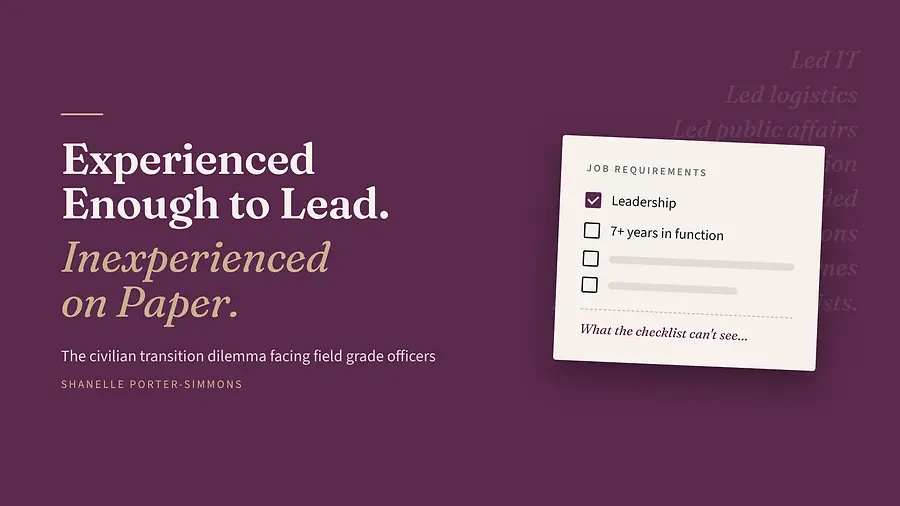
Experienced Enough to Lead. Inexperienced on Paper.
How military leadership experience translates—and why civilian employers often miss it.

"I used to have people for that."
I'd say it with a laugh when I entered civilian work after retiring from the Marine Corps.
I was willing to learn the task. What I struggled to explain was the work I already knew how to do: lead the people responsible for it.
How do you demonstrate years of leadership experience when the hiring process is looking for years spent performing a particular function?
That question captures a part of military transition I did not feel prepared for.
I am talking about the experience of field grade officers: majors, lieutenant colonels, and colonels, along with their Navy and Coast Guard counterparts. We can leave the military with years of organizational responsibility and still struggle to find a civilian role that recognizes what that work required.
Veterans across ranks face this challenge. Enlisted members and warrant officers bring substantial leadership experience, too. My perspective comes from the particular gap I encountered as a retired lieutenant colonel.
Setting the conditions was the work
Across my Marine Corps career, I worked in IT, logistics, public relations, and administration. I also served as a commander.
Each assignment required me to enter an environment, understand what needed to happen, and learn from the people who knew the work. I had to understand enough to make decisions, recognize problems, and help the organization accomplish its mission.
The specialists brought expertise I depended on. My responsibility was to make sure their efforts could come together.
Were priorities clear? Did people have what they needed? Were different sections working toward the same result or getting in one another's way?
Setting those conditions was my work. I remained accountable for the outcome even when I was not the person performing each task.
That kind of leadership takes practice. So does learning an unfamiliar function quickly enough to lead responsibly. I had spent years doing both.
The experience that became difficult to explain
When I retired, director and management roles seemed like reasonable places to apply that experience.
I encountered a difficult mismatch. I had experience leading across functions, but I did not always have the years of hands-on experience within a particular civilian function that an employer wanted.
The breadth that had been useful in uniform became harder to explain outside it.
I understand why employers want relevant experience. Industry knowledge matters. A military rank does not automatically qualify someone to run a company. Civilian organizations have customers, financial pressures, and workplace cultures that a transitioning officer may need to learn.
I expected to have things to learn.
What I struggled with was finding an opportunity where I could learn those things while contributing at the level of responsibility I had already practiced.
There is a difference between needing to learn a new environment and needing to develop leadership capability from the beginning.
A hiring process needs a way to assess both.
Having a job does not settle the question
Research offers some context for this experience. A 2022 study of post-9/11 veterans found that participants described underemployment through a mismatch between their civilian jobs and the skills, education, or leadership experience they gained in service. The finding does not establish a problem unique to field grade officers. It does help explain why employment alone may not resolve the difficulty of transition.
You can have a job and still struggle to find a place for the experience you bring.
You can be willing to learn and still wonder why so much of what you already know seems to have disappeared from consideration.
You need an opportunity to demonstrate your capability. Getting that opportunity can depend on already having the civilian experience you are trying to gain.
Starting over felt different this time
I had experienced a major professional transition before.
Before joining the military, I was an elite athlete. I went from the top of one field to the beginning of another. At about 30, I could see years ahead of me to build something new.
Retiring from the military brought a different calculation.
I still wanted to learn and grow. I also had decades of experience I wanted to use. Spending years rebuilding credibility from the ground up carried a different cost at that stage of my life.
My Transition Readiness Seminar did not leave me prepared for that feeling.
I knew I would need to explain my military experience in civilian language. I did not anticipate how difficult it could be to find an opportunity to demonstrate the leadership behind that experience.
Translation is only half the job
"Translate your experience" is useful advice. We have a responsibility to explain our work in terms an employer can understand.
We also need a meaningful way to demonstrate it.
For employers evaluating a transitioning officer, that could look like this: Ask what changed under our leadership. Ask how we learned an unfamiliar function and how we worked with people whose technical expertise exceeded our own. Give us a realistic problem to work through, and examine how we approach it.
Those conversations can reveal where our experience transfers and where further learning is necessary. They give both sides more useful evidence than a title alone.
Those of us transitioning have work to do here, too. We need to connect our experience to the specific problems an organization needs solved. We also need to ask whether solving those problems is how we want to spend our next chapter.
Choosing where that experience belongs
I initially looked toward roles that resembled the responsibility I had held. I now see the importance of asking whether the work fits the life I want.
Consulting may offer one way to use the ability to enter an unfamiliar situation, understand what is happening, and help people move toward a result. Operations leadership, program management, or another direction may fit someone else.
Each possibility deserves investigation. We need evidence about what we can contribute, what we need to learn, and whether we actually want the work.
This experience helps explain my focus on field grade officers navigating what comes next. Through The Fifth Path, I help people examine the experience they bring, explore what they want next, and test possible directions before making a larger commitment.
If you left the military as a field grade officer, what was hardest to get others to recognize about the work you had actually done?
Research reference: Davenport, K. E., et al. (2022). "The subjective underemployment experience of post-9/11 veterans after transition to civilian work." Work, 72(4), 1349–1357. https://doi.org/10.3233/WOR-210029

Shanelle Porter-Simmons is a retired Marine Corps Lieutenant Colonel and founder of The Fifth Path LLC, an executive coaching firm. With two decades of military service and seven years as a professional athlete, she now coaches high-achieving professionals through career transitions. She authored Try a New Path and holds multiple advanced degrees in leadership, organizational studies, and project management. Her…





