From Floppy Disks to Flying Cars: Are We Ready for What Comes Next?
From Floppy Disks to Flying Cars: How Organizations Can Lead Through Transformation

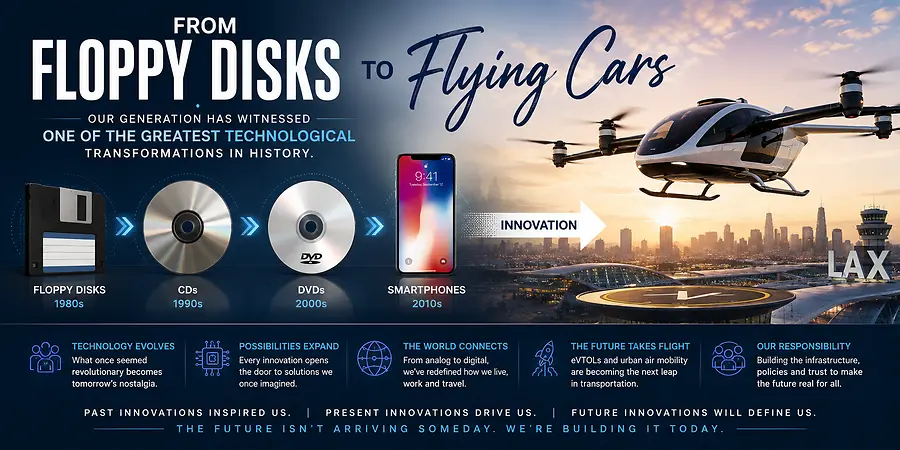
I still remember when saving a document required a floppy disk.
At the time, that small plastic square represented progress. It allowed us to carry information from one computer to another, store our work, and access it again without starting over. Then came CDs, DVDs, flash drives, smartphones, cloud computing, and artificial intelligence.
Each innovation seemed remarkable until the next one arrived.
Today, floppy disks have become symbols of another era. Many young people recognize them only as the icon used to save a file. Yet those of us who worked through these transitions have experienced something extraordinary: we have watched technology move from physical storage to an almost invisible digital world, and we are now witnessing the possibility of vehicles taking flight above our cities.
The journey from floppy disks to flying cars is not simply a story about how far technology has advanced. It is a reminder of how quickly the impossible can become ordinary and how important it is for people, organizations, and communities to be prepared for what comes next.
The Future Rarely Arrives All at Once
When we imagine the future, we often picture a dramatic moment when everything changes. In reality, transformation usually happens through a series of smaller shifts.
We did not move from floppy disks directly to the cloud. We passed through many technologies, each one building on what came before it. We learned new terminology, changed familiar habits, adapted our workplaces, and gradually developed confidence in capabilities that once felt unfamiliar.
The same will likely be true of flying cars or, more accurately, advanced air mobility and electric vertical takeoff and landing aircraft.
They may not immediately appear above every neighborhood. Their adoption will require infrastructure, regulation, safety standards, operational planning, public confidence, and integration with existing transportation systems.
Technology may make flight possible, but an entire ecosystem will be required to make it practical.
That is true of almost every meaningful innovation. The invention receives attention, but the surrounding transformation determines whether it succeeds.
Innovation Moves Faster Than Organizations
Technology can be developed rapidly. Organizations and communities cannot always adapt at the same pace.
A new platform may be ready before the workforce has been prepared to use it. Artificial intelligence may provide answers before leaders have determined how those answers should be evaluated. A new mode of transportation may be technically viable before cities have decided where it should operate or how it will connect with existing infrastructure.
This gap between technological capability and organizational readiness is where many transformations struggle.
The question is no longer simply, "Can we build it?"
We must also ask:
- Does it solve a meaningful problem?
- Do people understand its purpose?
- Is the surrounding infrastructure ready?
- Have safety, access, and operational realities been considered?
- Can the organization support and sustain it?
- Will the public trust it?
Progress is not measured only by the sophistication of an invention. It is measured by whether that invention can be responsibly integrated into people's lives.
Every Innovation Eventually Becomes Infrastructure
Yesterday's breakthrough often becomes today's expectation.
Internet access was once considered an advantage. Today, it is essential infrastructure. Mobile applications were once a novelty; now, customers expect to manage nearly every part of their lives through a phone. Cloud computing, digital communications, and real-time information have followed similar paths.
This transformation is especially visible in aviation.
Passengers increasingly expect connected journeys, real-time updates, intuitive navigation, personalized information, and a consistent experience across physical and digital environments. Behind these seemingly simple interactions are complex networks of systems, infrastructure, operational teams, and decision-makers.
When emerging technology becomes part of daily life, it must do more than impress us. It must be dependable, understandable, accessible, and resilient.
The flying car captures our imagination, but its real value will not be determined by how futuristic it appears. Its value will depend on whether it improves mobility, connects communities, reduces friction, and operates within a system people can trust.
Experience Is an Advantage—but Only If We Remain Curious
Those of us who remember floppy disks have a unique perspective. We know how quickly something essential can become obsolete.
That experience can make us more adaptable, but only if we resist the temptation to judge every new idea through the limitations of the past.
It is easy to dismiss emerging technology because it is imperfect, unfamiliar, or not yet ready for widespread adoption. It is equally risky to embrace innovation without questioning its purpose, consequences, or readiness.
Leadership requires us to hold both ideas at once: optimism about what technology can make possible and responsibility for how it is introduced.
We must remain curious enough to imagine what comes next while being disciplined enough to ask difficult questions about implementation.
The Future Needs Translators
As technology becomes more complex, organizations need leaders who can connect innovation with human understanding.
They need people who can translate technical possibilities into business and public value. They need leaders who can bring executives, engineers, operators, regulators, customers, and communities into the same conversation.
This work is not always visible, but it is essential.
The future will not be shaped only by those who invent new technology. It will also be shaped by those who help people understand it, trust it, and use it responsibly.
That is the leadership opportunity within transformation: not simply managing the implementation of something new, but building the alignment that allows it to create lasting value.
What Will Become the Next Floppy Disk?
One day, the technologies we currently consider advanced will seem ordinary or even outdated.
Future generations may be surprised that people once drove themselves, carried physical identification, waited in long lines, or manually searched through enormous amounts of information. They may look at today's smartphones the way we now look at floppy disks: important for their time, but almost unimaginable as a permanent solution.
We cannot know exactly which technologies will define the next era. But we can prepare for it by developing organizations that are curious, adaptable, responsible, and centered on people.
The future is not only about what we are capable of building.
It is about what we are prepared to understand, embrace, and sustain.
We have traveled from floppy disks to a world where flying cars are moving from imagination toward possibility. The distance between those two ideas is remarkable, but the most important transformation has not occurred inside our machines.
It has occurred in our willingness to imagine that something more is possible.


