From Skills to Systems: Designing Talent Pathways That Actually Work
How to Transform Skills Initiatives From Static Lists Into Dynamic Systems That Drive Real Organizational Change

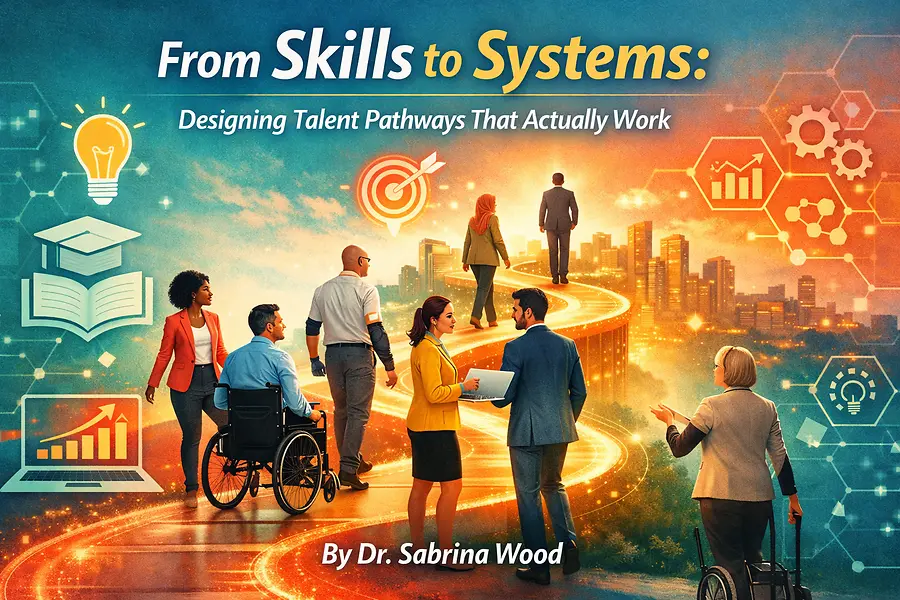
Building Talent Pathways That Work: Why Skills Strategies Fail Without Systems
By: Dr. Sabrina Wood
Organizations love to talk about becoming "skills-based." It has become the new strategic north star—a promise of agility, internal mobility, and a workforce ready for whatever the future demands. But here's the uncomfortable truth: most skills initiatives fail not because the idea is flawed, but because organizations treat skills as a list rather than a system.
A skills strategy only works when it is embedded throughout the entire talent lifecycle: hiring, learning, performance, mobility, and leadership. When skills exist in isolation, they become static, outdated, and disconnected from real work (Bersin, 2022). When they operate within a system, they become the engine of organizational capability.
Drawing on organizational psychology, capability mapping, and real-world Workday implementations, here's what it takes to design talent pathways that actually work.
1. Start With Capabilities, Not Skills
Skills are the building blocks, but capabilities are the architecture. A capability answers a different question: What must the organization be able to do to achieve its strategy?
Research shows that high-performing organizations anchor their talent systems in capabilities because capabilities create clarity, alignment, and prioritization (Ulrich et al., 2017). Skills then become the measurable components that bring those capabilities to life.
For example:
- Strategic thinking is a capability.
- Skills such as data interpretation, scenario planning, and decision modeling support that capability.
When organizations skip directly to skills lists, they often create noise. When they begin with capabilities, they create coherence.
2. Build a Skills Framework That Reflects Real Work
A skills framework should be:
- Evidence-based (grounded in research and validated models)
- Employee-informed (reflecting the lived experience of work)
- Business-aligned (connected to strategy and outcomes)
Too often, organizations adopt generic skills libraries that feel disconnected from actual roles. Research shows that employees are more likely to engage with skills tools when they see themselves reflected in the content (Gartner, 2023).
This is where methods such as behavioral event interviewing, job-task analysis, and employee voice data become powerful. They reveal the skills that truly differentiate performance—not just the ones that sound good on paper.
3. Integrate Skills Into the Talent Lifecycle
A skills strategy fails when it becomes a side project. It succeeds when it becomes the operating system.
Skills must be integrated into:
- Hiring (skills-based job descriptions and assessments)
- Learning (personalized pathways and recommendations)
- Performance (skills-based feedback and development conversations)
- Mobility (matching people to opportunities based on capability signals)
- Leadership (building future-ready skills into leadership development programs)
Workday's Skills Cloud and AI-driven inference capabilities make this integration possible. However, technology alone does not create adoption. Leaders and employees must understand how skills frameworks make their work easier, clearer, and more meaningful.
4. Address the Real Adoption Challenges
Most organizations underestimate the human side of skills transformation. The biggest barriers are not technical—they are psychological and cultural.
Common challenges include:
- Low employee trust ("Will this be used to judge me?")
- Manager uncertainty ("How do I coach to skills?")
- Change fatigue ("Another new framework?")
- Lack of clarity ("What do I actually do with this?")
Research in organizational psychology shows that adoption increases when employees understand the why, see personal value, and experience early wins (Kotter, 2012). Skills initiatives must be paired with change enablement, communication, and leadership modeling—not just system configuration.
5. Turn Skills Data Into Actionable Insights
Skills data becomes powerful when it informs decisions such as:
- Where to invest in learning
- Which teams need capability enhancement
- How to design succession pipelines
- Where internal mobility can reduce hiring costs
- How to identify emerging talent
AI-driven skills inference can accelerate visibility, but organizations must pair it with governance, validation, and ethical oversight (World Economic Forum, 2023). Skills intelligence is only as strong as the system that interprets it.
6. Build Talent Pathways That Are Personalized and Practical
A talent pathway should feel like a GPS, not a maze. Employees need:
- Clear expectations
- Personalized learning recommendations
- Opportunities to practice skills
- Continuous feedback loops
- Visibility into future roles and career opportunities
Psychological research consistently shows that people are more motivated when they can see progress, understand purpose, and experience autonomy (Deci & Ryan, 2000). Skills-based pathways deliver all three when designed effectively.
Conclusion: Skills Become Powerful Only When They Become a System
A skills strategy is not simply a framework, a library, or a technology implementation. It is a system—one that connects people, processes, and purpose.
When organizations shift from skills lists to capability-driven systems, they unlock mobility, readiness, and resilience.
The future of talent is not about having the right skills. It is about having the right system to develop, apply, and continuously grow those skills.
References
Bersin, J. (2022). The Rise of the Skills-Based Organization. Josh Bersin Company.
Deci, E. L., & Ryan, R. M. (2000). The "what" and "why" of goal pursuits: Human needs and the self-determination of behavior. Psychological Inquiry, 11(4), 227–268.
Gartner. (2023). Building a Skills-Based Talent Strategy. Gartner Research.
Kotter, J. P. (2012). Leading Change. Harvard Business Review Press.
Ulrich, D., Kryscynski, D., Ulrich, M., & Brockbank, W. (2017). Victory Through Organization: Why the War for Talent Is Failing Your Company and What You Can Do About It. McGraw-Hill.
World Economic Forum. (2023). Future of Jobs Report. World Economic Forum.


