Fueling America’s Growth: The Opportunity Ahead for Small Businesses
How Small Businesses Can Capitalize on America's Infrastructure and Energy Boom

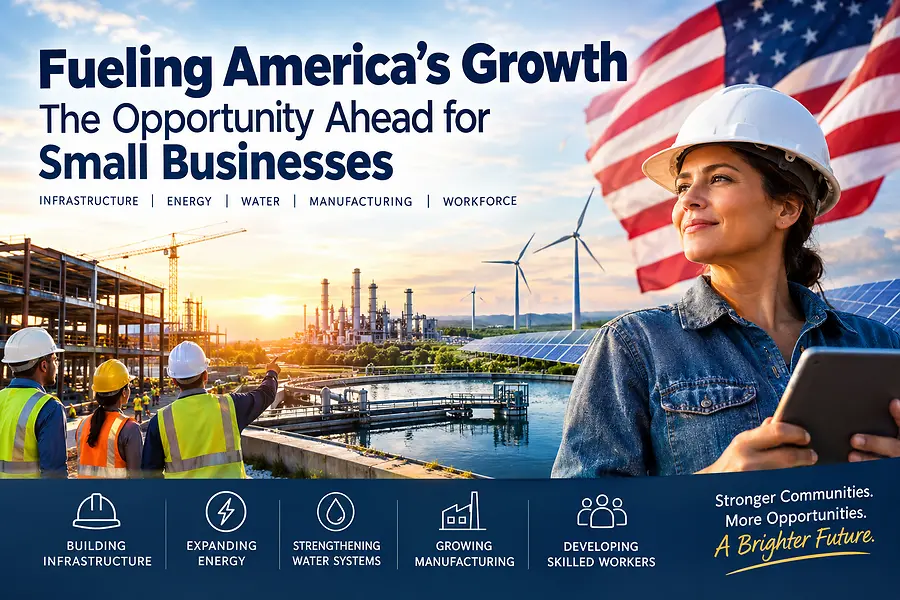
America is entering a period of significant growth in manufacturing, technology, energy, and industrial development—and small businesses could play a major role in building the infrastructure needed to support it.
On September 2, 2026, the U.S. House Committee on Small Business Subcommittee on Rural Development, Energy, and Supply Chains held a hearing titled "Fueling the Golden Age: Future Resource Needs and Small Business Opportunity." The hearing focused on a critical question: How can America expand its energy, water, infrastructure, and workforce capacity while ensuring that small businesses and local communities benefit from that growth?
Small Businesses Are Positioned to Build America's Future
Chairman Jake Ellzey emphasized that America must build the infrastructure necessary to support increasing demands for energy and water without placing the entire burden on families, farmers, and small businesses.
That message is particularly important because large-scale development creates opportunities far beyond the major corporations leading these projects.
Local contractors, manufacturers, construction companies, electricians, welders, plumbers, pipefitters, water operators, and other skilled businesses will be needed to design, build, operate, and maintain the infrastructure supporting America's next generation of growth.
The opportunity for small businesses is therefore not simply about winning individual contracts. It is about becoming part of the broader economic ecosystem created by new manufacturing facilities, technology projects, data centers, energy projects, and infrastructure investment.
Texas Highlights the Workforce Challenge
The hearing also brought attention to a major obstacle: America needs more skilled workers.
State Representative Harris of Texas discussed the growing demand for workers in rural communities, particularly water operators. Many rural areas operate multiple water systems, but finding qualified operators can be extremely difficult.
Texas is working with education agencies and career and technical colleges to create pathways that allow students to obtain certifications and enter skilled occupations directly after high school.
The same challenge exists in electrical work.
As data centers and other technology-intensive developments continue to expand, the demand for electricians and other skilled tradespeople is increasing. Developing these workers quickly will be essential if communities want to take advantage of new investment rather than simply watch projects move elsewhere because the necessary workforce is unavailable.
This represents a tremendous opportunity for small businesses already operating in the skilled trades—and for entrepreneurs willing to build businesses around these growing workforce needs.
Infrastructure Is Becoming an Economic Opportunity
Energy and water are not merely government infrastructure issues. They are foundational to economic development.
Manufacturing facilities, data centers, technology companies, industrial operations, and other major projects cannot operate without reliable access to electricity and water.
That means communities capable of expanding their infrastructure and developing a qualified workforce can become significantly more attractive to investors.
For small businesses, this creates opportunities in construction, engineering, equipment, maintenance, transportation, manufacturing, environmental services, utilities, and numerous supporting industries.
The businesses that position themselves early could benefit as investment moves into communities that are prepared for growth.
Repurposing America's Industrial Sites
Another important point raised during the hearing was the potential to redevelop brownfield and former industrial sites.
Rather than starting every major development project from scratch, communities can potentially take advantage of existing industrial locations and infrastructure.
This approach can help reduce development barriers while putting existing buildings, land, infrastructure, and local workforces back to productive use.
For communities with former manufacturing facilities or industrial properties, this could represent an opportunity to attract a new generation of businesses without abandoning the economic assets already in place.
It also creates opportunities for small businesses involved in construction, redevelopment, environmental remediation, property management, manufacturing, and industrial services.
The Energy Boom Could Create a Small-Business Boom
One of the broader themes coming out of the hearing is that America's increasing energy needs will require an equally significant expansion of supporting infrastructure.
The discussion included the growing importance of electricity generation, nuclear energy, water infrastructure, and the permitting process necessary to move projects forward.
If these projects accelerate, the economic impact will extend well beyond the companies generating the energy.
Every major project requires suppliers, contractors, transportation providers, maintenance companies, professional services, construction firms, equipment providers, and skilled workers.
That is where small businesses can become essential participants in America's growth.
The Real Question: Who Will Benefit?
Perhaps the most important takeaway is that economic growth does not automatically guarantee that local communities and small businesses will benefit.
The infrastructure must be built.
The workforce must be trained.
The permitting process must allow projects to move forward efficiently.
And small businesses must have the opportunity to compete for the work created by these investments.
Chairman Ellzey specifically emphasized the importance of ensuring that small businesses have the training, certifications, and opportunities necessary to compete for these projects, keeping more of the economic benefits within the communities where development occurs.
That is an important message for entrepreneurs and business owners across the country.
Looking Ahead
America's next phase of economic development will require more than capital.
It will require infrastructure, energy, water, skilled labor, manufacturing capacity, and entrepreneurs willing to build businesses around these needs.
The House Small Business Subcommittee hearing demonstrates that policymakers are paying attention to the challenges—and opportunities—created by this growth.
For small businesses, the message is clear: the next major wave of American infrastructure and industrial investment could create opportunities across virtually every sector of the economy.
The businesses that prepare now—by developing their workforce, obtaining the necessary certifications, strengthening their operations, and understanding where major investments are occurring—may be in the best position to participate.
America's future growth will need people and businesses capable of building it.
And that could make small businesses one of the most important pieces of the country's next economic chapter.
Source: U.S. House Committee on Small Business, "Subcommittee on Rural Development, Energy, and Supply Chains Holds Hearing on Energy, Water, and Workforce Needs," September 2, 2026.


