
Growing Future Engineers in the AI Era
Rethinking Early Education to Foster Curiosity, Critical Thinking, and Resilience in an AI-Driven World

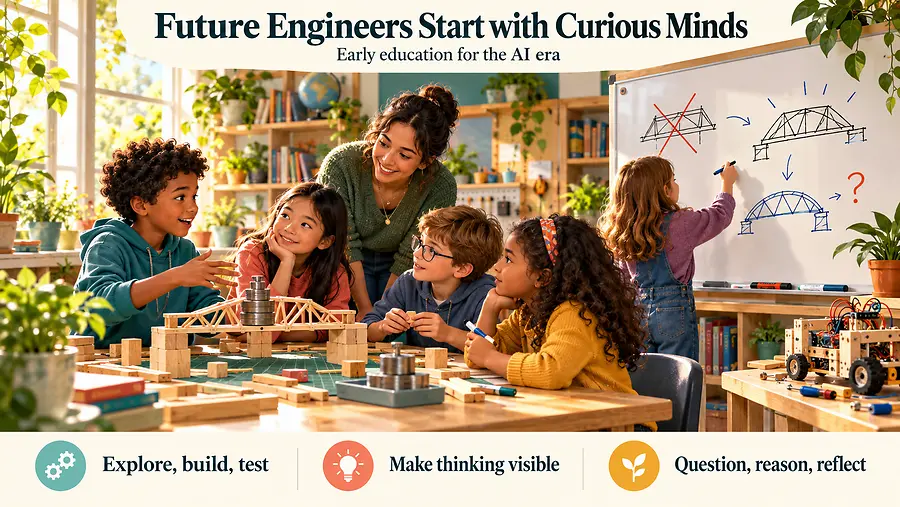
Preparing children for an AI-shaped future begins with nurturing curiosity, independent thinking, exploration, and the confidence to work through unfamiliar problems.
Public schools should rethink early education to give children more opportunities to build, question, explain, and revise their ideas. That means placing less emphasis on worksheets and tests, using physical whiteboards to make thinking visible, and setting meaningful learning goals children can understand. Above all, classrooms should help children feel safe making mistakes, learning from them, and trying again.
Provide a Calm and Safe Classroom Environment
Meaningful learning requires a classroom where children feel safe, can hear clearly, and have time to think. Crowded rooms, excessive noise, and frequent interruptions deserve attention alongside curriculum reform. Schools should consider class size, staffing, and scheduling so teachers can support active exploration and protect time for focused learning. Children need space to be curious and to follow a thought without constant interruption.
Teaching should help children build understanding through clear explanations, guided activities, play, and practice. Explaining something once and repeatedly testing children provides too little support. Constant correction can also interrupt learning when children need time to think independently, try an approach, and work through a mistake.
For four-, five-, and six-year-olds, teachers should balance guidance with patient observation, allowing children time to explain their reasoning before stepping in. Meaningful learning goals should encourage children to question, connect ideas, and create.
Assessment should help teachers decide what to do next. A mistake may call for another explanation, different materials, more guided practice, or simply more thinking time. It should lead to useful support rather than just another score.
The question to ask a school or educator is: "How do you help children develop understanding, and how do you decide when to offer guidance and when to give them more time to think for themselves?"
Children should hear and experience a simple message: It's okay to make mistakes—we all do. A mistake does not make them less capable or less valued. When adults respond with patience and curiosity, children can feel safe asking for help, trying again, and learning from what happened.
Set Purposeful Learning Goals Children Can Understand
"Finish the worksheet" describes a task. Children should understand why they are learning something. Connect each skill to a purpose they can recognize before turning those purposes into goals children can demonstrate through meaningful activities:
- Letter sounds help us unlock the secret code of books and signs.
- Writing helps us share great ideas and interesting stories.
- Math helps us understand and figure things out.
- Art helps us show what we imagine and how we feel.
These goals give teachers something concrete to observe while allowing children to explore different approaches and learn from mistakes.
They also make room for respectful disagreement. Children should feel comfortable questioning an explanation, including one offered by a teacher or an AI tool. Give them opportunities to explain their thinking, listen to others, and change their minds when they discover something new.
Give Children Meaningful Problems to Explore
Worksheets and tests can serve a purpose, but I would give them a smaller role in the classroom. Completing a page should be one way to practice, alongside opportunities to investigate something real.
Imagine asking children to plan a pizza party. They decide whom to invite, when and where to hold it, where to order pizza, and what activities to include. They work out the headcount, estimate how much food they'll need, and create a budget. As they explore these questions, they uncover trade-offs and have meaningful reasons to revisit their plan.
The teacher can help children make their thinking visible by asking: "Why did you choose this approach? What happened when you tried it? What would you change, and how could you tell whether that change helped?"
Those questions make room for reasoning, persistence, and different approaches. The finished bridge matters, and so does the thinking that produced it.
Bring Back the Whiteboard
If we want to limit young children's screen time, we should also reconsider how screens are used at school. Large touchscreens often serve as the main teaching surface, while worksheets dominate quizzes and assessments. Physical whiteboards deserve a central place in early classrooms, with screens used selectively for a clear learning purpose.
A whiteboard gives children space to sketch an idea, explain a calculation, or solve a problem together. It also makes thinking visible: an unfinished drawing can invite questions, and a revised answer can open a conversation about what changed and why.
Teachers can encourage children to preserve parts of that process—the first attempt, the question it raised, and the next idea—while giving them time to think before offering corrections. Children should feel comfortable saying, "This is what I thought, and here is why I changed my mind."
Technology can support learning, but classroom time should also make room for conversation, hands-on materials, and independent thinking without a device.
Make Inquiry Part of Everyday Learning
Young children do not need advanced technology to begin practicing the thinking that underlies STEM. A ramp invites questions about motion. A puddle becomes an opportunity to observe change. A cardboard structure introduces balance, materials, and constraints.
The educator's role is essential: introduce vocabulary, offer relevant knowledge, ask a productive question, and help children extend an investigation.
"What did you notice?"
"What do you think will happen?"
"Why did we choose this approach?"
"How could we find out?"
These exchanges connect curiosity with disciplined exploration. Children begin to learn that an idea can be tested and that changing their minds is part of making progress.
Homework Shouldn't Shift Teaching Responsibilities to Parents
When worksheet-heavy classrooms send heavy homework loads home, families can become responsible for teaching concepts children still need help understanding. Parents have different levels of familiarity with the curriculum, teaching experience, and available time. A child's progress should not depend on whether their family can provide a second school day at the kitchen table.
Homework should reinforce learning with clear, manageable practice. When it requires parents to become substitute teachers, it risks widening learning gaps and adding pressure to family life. For young learners, this can turn family time into another stressful school session and make progress depend on the support available at home. Preparing children for the AI era calls for thoughtful instruction, meaningful exploration, and effective support within the school day.
Mental Health Matters More Than Test Scores
When public schools are judged heavily by test scores, ratings, and rankings, the pressure can travel from administrators to teachers—and ultimately to children and families. In TK, kindergarten, and first grade, that can mean more worksheets, repeated assessments, and anxiety about falling behind before children have had enough room to develop at their own pace.
What gets measured can overshadow what matters: whether children feel safe asking questions, enjoy learning, build friendships, and gain confidence through mistakes. Assessment should help teachers understand and support children. When it dominates the school experience, we need to question the priorities driving it.
The AI era makes this rethink urgent. Preparing future STEM engineers means nurturing curiosity, independent judgment, and the confidence to navigate uncertainty. Those habits need encouragement from the earliest classrooms through meaningful challenges, exploration, and supportive relationships.
Children's mental health must be central to how we define school success. A strong education should help children grow into capable, thoughtful learners while protecting their well-being along the way.
My Final Thoughts
Early education should help children discover the purpose and joy of reading, writing, creating, and using math. It should also give them space to explain their thinking, question answers, and learn from mistakes.
Learning is a lifelong marathon, not a sprint. As technology evolves, children need to feel encouraged to learn new skills, empowered to explore new ideas, and confident enough to make mistakes and try again.
A strong foundation can prepare them to engage with AI thoughtfully—drawing on the skills they have built and bringing their own curiosity, judgment, and imagination to explore what they can learn and create.
Above all, mental health and emotional well-being serve as the absolute foundation of any strong, effective education system.

Catherine is a Cloud Solutions Architect at Oracle with over 15 years of experience helping organizations transform complex business challenges into opportunities for innovation, growth, and lasting impact. As a Data, Analytics & AI Specialist, she partners with organizations of every size - from Fortune 500 enterprises and public sector agencies to mid-market businesses and emerging startups—to unlock the full…





