Honoring Marian Croak: An Engineer’s Mind, an Executive’s Reach
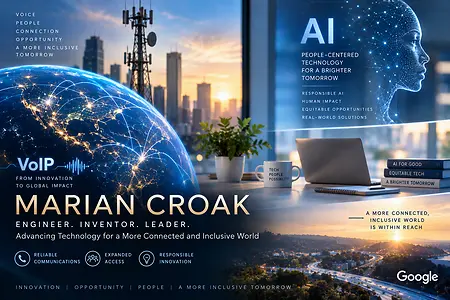
How a Bell Labs and AT&T engineer built reliable internet communications and shaped responsible AI innovation at Google.

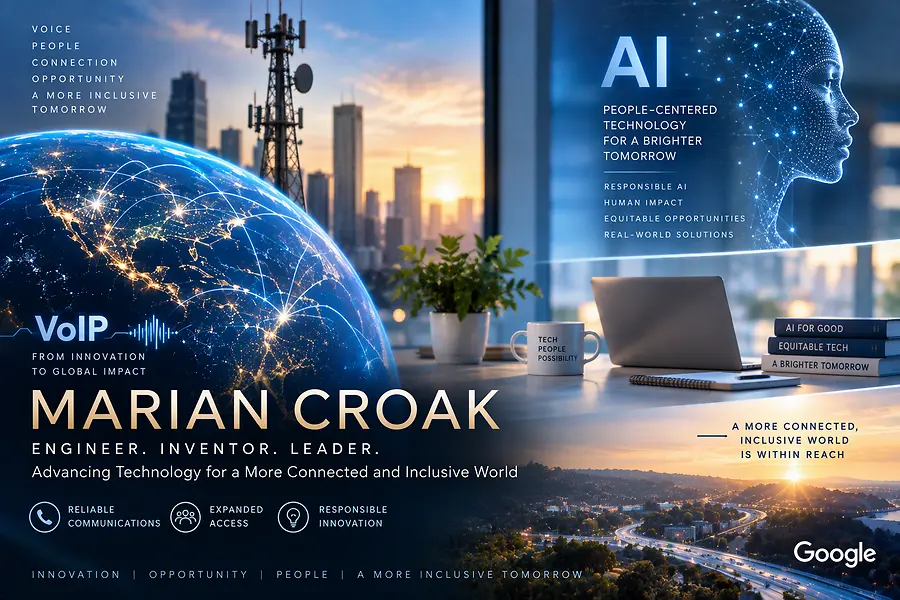
From Human Behavior to Communications Engineering
Croak’s engineering career reflects her grounding in human behavior. She earned a bachelor’s degree from Princeton University in 1977 and a doctorate from the University of Southern California in 1982, where her graduate studies focused on quantitative analysis and social psychology. In Google’s 2021 announcement of her responsible AI role, she explained that she had “always approached engineering with that kind of mindset, looking at the impact of what we’re doing on users in general.” [5] [20]
She began her career at Bell Labs in 1982, working in the Human Factors research division to study how technology could improve people’s lives. She later moved into network engineering, helping advance reliable, high-quality voice communications over the internet. [3]
In her earlier role as Vice President of the Services Network in Research and Development at AT&T Labs, Croak managed more than 500 engineers and computer scientists responsible for more than 200 programs supporting wired and wireless services. That role included project management, service planning, development, and testing. In 2012, she became AT&T’s Senior Vice President of Applications and Services Infrastructure, leading more than 2,000 developers, engineers, and program managers responsible for more than 500 programs supporting the company’s enterprise, consumer, and mobility services. [19]
Her career has spanned Bell Labs, AT&T, and Google, which she joined in 2014. According to the National Inventors Hall of Fame, she holds more than 200 U.S. patents—a record of invention that complements her leadership of large engineering organizations. [3]
Making Internet Voice Reliable at Scale
Croak’s work on Voice over Internet Protocol (VoIP) addressed a practical engineering problem: making internet-based voice dependable enough for large-scale use. The National Inventors Hall of Fame, which inducted her in 2022, states that her work furthered audio and video conferencing capabilities. [3] NCWIT reports that nearly half of the more than 200 patents she earned during her Bell Labs and AT&T career focused on VoIP technologies. [1]
Delivering that technology at scale also took organizational change. IEEE credits Croak with re-engineering AT&T’s Time-Division Multiplexed network to support billions of VoIP calls daily. [2] Reflecting on the effort in Google’s 2021 announcement of her responsible AI role, Croak said it “required such a huge organizational and business shift in the company I was working for,” and that bringing teams with very different approaches together allowed VoIP to “handle billions and billions of calls in a very robust and resilient way.” [5]
The sections that follow trace how that reliability work developed, from early VoIP problems to network-scale deployment, and how Croak later carried an engineering focus on dependable systems into responsible AI.
Advancing VoIP at AT&T: Patents and Network Engineering
Croak’s patent work tackled practical problems in internet phone services: locating call failures, providing alternative network routes, and connecting systems that use different communications rules. Working with co-inventors, she also contributed designs for managing conference-call demand and supporting emergency calls. The patent records describe the intended functions of these inventions; they do not, by themselves, establish how each design was deployed. [15]
Making Early VoIP Reliable for Business Use
In a 2025 interview with Communications of the ACM, Croak clarified that she did not invent VoIP, which she described as an international standard. Her team focused on the difficulties companies encountered when putting it into practice: dropped calls, choppy audio, and limits on reliability and scale. She recalled spending about a year and a half addressing reliability and voice-quality problems, testing the work with business customers, and refining it through repeated experimentation. [4]
Turning Technical Failures Into Engineering Progress
That experimentation turned failures into opportunities for invention. Croak linked many of her patents to the problems her team learned to solve, including detecting call failures and processing signals. She also described how criticism from established network teams sharpened the work by emphasizing demanding reliability requirements and the need to reroute calls around congestion. [4] NCWIT reports that she earned more than 200 patents during her Bell Labs and AT&T career, nearly half of them focused on VoIP technologies. [1]
Re-engineering AT&T’s Network for VoIP
Croak’s work also extended to network-wide transformation. NCWIT reports that she and her team helped pioneer the use of TCP/IP to carry voice, data, and video over unified networks, and that she later led improvements in VoIP reliability, performance, and quality. [1] IEEE credits her with re-engineering AT&T’s Time-Division Multiplexed network to support billions of VoIP calls daily. [2]
Interoperability: A Common Architecture Across Networks
An access-independent architecture is designed to support the same real-time communications services across different access technologies and call-control protocols. Croak contributed to such a design as a member of the inventor team. [15]
She is one of eleven named inventors on U.S. Patent 7,797,459, “Access independent common architecture for real-time communications services for networking environments,” filed on December 30, 2003, and granted on September 14, 2010. The listed assignee is AT&T Intellectual Property II, L.P. The design provides shared infrastructure rather than tying services to a single access technology or call-control protocol. [15]
The architecture connects external networks to a common internal network through border elements, or gateways. External networks may use different technologies and protocols, while the internal network uses a single protocol, such as Session Initiation Protocol (SIP). Call-control elements coordinate communications through that shared infrastructure. [15]
A related continuation, U.S. Patent 8,625,578, carries the same title and lists the same eleven inventors. It was filed on October 29, 2007, and granted on January 7, 2014. [15]
Call Signaling and Media Control
The patents in this area address connecting networks that use different call-control protocols and handling media functions within the network. Signaling comprises the messages used to establish and manage a call; media processing handles functions such as keypad-tone detection and conversion between audio formats. [15]
The patent records describe challenges familiar to anyone who uses phone services:
- Connecting different networks — Phone services had to link networks using different communications rules, including traditional telephone systems and internet-based systems. [15]
- Supporting services through one shared design — Building a cost-efficient system for audio, video, and data that accommodated different call-control rules was difficult. [15]
- Processing more than the conversation — The network needed to recognize keypad tones during a call and convert media formats, rather than relying only on devices at each end to perform that processing. [15]
Connecting H.323 and SIP Networks
Croak also worked with Siroos K. Afshar, Radhika R. Roy, and Ralph Utano on U.S. Patent 7,715,412, “Decomposed H.323 network border element for use in a voice-over-internet protocol network,” filed November 15, 2004, granted May 11, 2010, and assigned to AT&T Corp. Their design provides a gateway between H.323 and SIP networks—systems using different communications rules—and separates call signaling from the components handling the media, allowing one signaling component to control several media components. [15]
The design also separates security functions, including the firewall and network address translation, from media control, and separates media conversion from media control. Rather than combining these tasks in one unit, the gateway assigns them to distinct components while linking the two types of network. [15]
Monitoring Call Performance from End to End
A provider’s core network can appear healthy even when customers experience problems with internet calls. Monitoring only the core can overlook faults in customer equipment or the links connecting it to the provider. Croak and Hossein Eslambolchi co-invented a monitoring approach designed to capture that broader, end-to-end view. [15]
The invention is documented in U.S. Patent 7,599,359, “Method and apparatus for monitoring end-to-end performance in a network.” The application was filed on December 14, 2004, and the patent was issued on October 6, 2009, with AT&T Corp. listed as the assignee. [15] The National Inventors Hall of Fame identifies this patent in its recognition of Croak’s VoIP work. [3]
The design uses components at the edge of the provider’s network to collect performance data from connected devices—including customer gateways, IP phones, and telephone adapters—and their access links. A central repository combines and analyzes the data, then maps call defects to the network segments where they occur. This allows operators to distinguish customer-equipment, access-link, customer-gateway, and voicemail errors instead of relying on a generic “resource unavailable” message. [15]
By extending monitoring beyond the core network, the approach gives operators a clearer picture of the service customers experience. Its purpose is to help them identify where faults occur and resolve network problems more quickly. [15]
Network-Based Keypad-Tone Detection and Media Conversion
With Hossein Eslambolchi, Croak co-invented the design in U.S. Patent 7,881,294, “Method and apparatus for enabling network based media manipulation,” filed December 21, 2004, issued February 1, 2011, and assigned to AT&T Intellectual Property II, L.P. It describes network components examining information carried in call-setup messages so that the network can handle keypad-tone detection and conversion between media formats before or during call establishment. [15]
For the caller, keypad tones are the sounds produced when pressing numbers during a call. The patent describes detecting those tones and translating them into messages or requests for network features. It also describes converting media from one encoding format to another. These tasks can be handled within the network rather than only by the devices at either end. [15]
Service Continuity: Forwarding Calls During Disruptions
Croak and Eslambolchi are also named inventors on US 2006/0251053 A1, “Method and apparatus for routing calls to an alternative endpoint during network disruptions.” Filed on April 19, 2005, and published on November 9, 2006, the application describes forwarding calls to a subscriber’s registered backup number when the original destination cannot be reached because of a service disruption. The backup could be a mobile, work, or relative’s number. In one embodiment, the provider uses the traditional telephone network (PSTN) to forward calls until VoIP service is restored. [15]
Scaling IP Conferencing: Staggering Call Setup
When many participants dial into a conference at once, simultaneous call-setup requests can exceed the capacity of the VoIP infrastructure. Croak and Eslambolchi developed a design that spreads those requests over time rather than sending them all to the conference bridge at once. [15]
Their approach appears in U.S. Patent 8,411,668, “Method and apparatus for staggering internet protocol teleconferencing calls,” filed on September 30, 2005, and granted on April 2, 2013. The patent lists Croak and Hossein Eslambolchi as inventors and AT&T Intellectual Property II, L.P. as the assignee. [15]
The design enables a traditional telephone-network switch to limit how many call-setup messages it sends to an IP conference bridge during each predefined time interval. Remaining calls are held in a queue, where callers may hear recorded announcements or music. This controlled flow is intended to manage a surge in demand; the patent does not establish a particular commercial deployment or a specific number of participants served. [15]
Network Reliability: Route Diversity and Bandwidth
Croak and Hossein Eslambolchi are named inventors on U.S. Patent 7,639,793, “Method and apparatus for reconfiguring network routes,” filed on October 31, 2005, and granted on December 29, 2009, with AT&T Corp. listed as the assignee. The patent addresses the dependence of VoIP service on the underlying IP network: faults or insufficient capacity can affect call completion and voice quality. [15]
The design monitors route diversity and available bandwidth between pairs of network elements. Route diversity means that at least two routes are available between the elements; bandwidth is the amount of data a connection can carry. When a single point of failure or inadequate bandwidth is detected, the design calls for an alarm and route reconfiguration. The patent family describes corrective measures such as adding capacity or creating an alternative route. These measures are intended to improve reliability, not to guarantee that every call survives every failure. [15]
Emergency Communications: Routing 911 Calls and Updating Location Information
VoIP customers may use a phone number from outside their local area or move their phone adapter to a new location. These capabilities create challenges for emergency calling, which depends on accurate service-location information. Croak and Hossein Eslambolchi co-invented designs to route calls using a subscriber’s service address and remind customers to update that address when their connection changes. [15]
Two patents document these complementary approaches:
- U.S. Patent 7,734,021, “Method and apparatus for supporting out of area phone number for emergency services,” was filed on December 31, 2005, and granted on June 8, 2010. The design maps the subscriber’s service address to the appropriate Public Safety Answering Point (PSAP), the center that answers emergency calls. A database lookup allows the network to route an emergency call to that center even when the subscriber’s phone number belongs to another calling area. [15]
- U.S. Patent 8,059,645, “Method and apparatus for providing E911 services via network announcements,” was filed on December 26, 2009, and granted on November 15, 2011. It describes detecting a change in the IP address associated with a customer’s connection and sending a reminder to update location information. In one embodiment, the announcement plays when the telephone adapter goes off-hook. The IP-address change prompts a reminder; it does not, by itself, establish the customer’s exact physical location. [15]
The purpose: These designs address service-address-based emergency-call routing and reminders to keep location information current. They describe engineering methods, not a guarantee that every emergency call will reach the correct center under all conditions. [15]
What the Patent Portfolio Shows
Taken together, the patents discussed here illustrate designs for diagnosing service quality, monitoring route diversity and capacity, connecting different network protocols, and controlling conference-call setup. This is a synthesis of the documented inventions, not a claim that every patented design was commercially deployed. [15]
Croak’s Contribution to Reliable, Scalable VoIP
Croak’s VoIP legacy rests on making internet-based communications more reliable and scalable—not on inventing VoIP itself. In her ACM interview, she described VoIP as an international standard and distinguished its development from her engineering contributions. [4] NCWIT credits her innovations with advancing dependable internet communications used in video conferencing, telehealth, remote work, and other forms of digital connection. [1] The National Inventors Hall of Fame recognizes her contributions to audio and video conferencing and identifies U.S. Patent 7,599,359 in its recognition of her VoIP work. [3]
Mobile Giving: Connecting Donations to the Phone Bill
Croak’s inventions also extended to charitable giving. She and Hossein Eslambolchi are named inventors on U.S. Patent 7,715,368, “Method and apparatus for dynamically debiting a donation amount,” filed on October 28, 2005, and granted on May 11, 2010. [15] The USPTO identifies this invention as text-to-donate technology. [18]
The patent describes an interface associated with a network-service bill through which a subscriber designates a donation amount. A dedicated application server receives that information, and the amount is debited from the account associated with the bill. This describes the patented billing method; the broader text-to-donate account comes from institutional descriptions of Croak’s work. [15] [18]
According to the National Inventors Hall of Fame, the text-to-donate technology associated with Croak and her team’s work raised approximately $130,000 after Hurricane Katrina in 2005 and $43 million after the 2010 Haiti earthquake. These are institution-reported fundraising totals, not figures established by the patent itself. [3]
Leading AT&T Through Network Transformation
Croak’s AT&T career combined invention with leadership of major engineering programs. According to the National Inventors Hall of Fame, her roles included Vice President of the Services Network in Research and Development, Senior Vice President of Applications and Services Infrastructure, and Senior Vice President of Domain 2.0 Architecture and Advanced Services Development. Reporting in 2014 identified her as the executive overseeing the Domain 2.0 initiative. [16] [20]
Domain 2.0 was AT&T’s plan to provision and manage network services more like cloud services in data centers. Its November 2013 white paper proposed application programming interfaces (APIs)—software connections through which services could be accessed and managed on demand and in near real time. Services would run on shared infrastructure wherever feasible. Software-defined networking (SDN) would let software direct network behavior, while network functions virtualization (NFV) would move functions from purpose-built equipment to software running on shared infrastructure. Together, these approaches would replace or supplement equipment designed for a single purpose. The plan addressed business models, supplier strategy, and service-delivery practices as well as network architecture. [10]
In May 2014 reporting by Fierce Network, Croak described how the move toward an all-IP network would affect suppliers and AT&T’s culture. Suppliers would need to separate software from specialized, proprietary hardware and run it on less expensive commodity hardware, known as white boxes. AT&T also planned internal training and an “intense hiring program for external people” to support the transition. [17]
The company’s transformation continued after Croak left AT&T in 2014. In a January 26, 2023, company blog post, Mike Satterlee, Vice President of Network Core Infrastructure Services, reported that AT&T had migrated more than 52% of its production traffic to next-generation core routers. He also credited open, disaggregated platforms with improving the efficiency of 5G and fiber rollouts. These were later company-reported outcomes, not results attributable solely to Croak. [11] [16]
Leadership at Google: Expanding Access and Reliability
Croak joined Google in 2014, bringing her focus on dependable communications to efforts to expand internet access. According to IEEE, she founded and led Google’s original Next Billion Users organization, supporting reliable, affordable connectivity in underserved communities. IEEE credits her leadership with enabling millions of people to go online for the first time. [2]
IEEE reports that she oversaw the deployment of public Wi-Fi systems in India, Ghana, and Uganda, as well as middle-mile fiber infrastructure across Africa. This work addressed both local access and the network connections needed to carry traffic beyond local communities. [2]
Google Station illustrates the scale of this access work. Launched in India in 2015 through a partnership among Google, Indian Railways, and RailTel, the program reached more than 400 busy railway stations by June 2018. In its February 2020 update, Google reported that Station had also expanded to thousands of other locations in India and served millions of users through its partnerships. These milestones reflected the combined work of Google, Indian Railways, RailTel, and other program partners. In the same update, Google announced plans to wind down Station globally during 2020 and work with partners to transition existing sites. [12]
Croak also served as Vice President of Site Reliability Engineering for Ads, Corporate Engineering, and YouTube, according to the National Inventors Hall of Fame. [20] IEEE credits her with developing techniques to analyze the reliability of critical systems supporting YouTube and improve the end-user experience. [2]
Taken together, these roles suggest a consistent focus in Croak’s work: expanding access to communications while strengthening the systems people rely on. That concern for the user’s experience provides a useful lens for understanding her subsequent work in responsible AI.
Responsible AI at Google: From Principles to Practice
In February 2021, Google announced that Croak had created and would lead a new center of expertise on responsible AI within Google Research. She emphasized that “any technology that we’re designing should have a positive impact on society.” [5] IEEE credits her with founding Google’s Research Center for Responsible and Human-Centered AI. [2]
Putting Responsible AI Principles into Practice
In a July 2022 update, Croak and Jen Gennai described how Google put its AI Principles into practice through employee education, ethics reviews, and technical tools. Their account outlined reviews intended to identify potential harms before launch and guide teams in addressing risks. These were Google’s reported practices at the time, not a guarantee that every AI system would be free of harm. [6]
Croak’s January 2023 research overview connected foundational and social-context research with applied work and product solutions. It described efforts to improve model robustness, evaluation, fairness, and cultural inclusion, including research on why models that perform well during training may behave differently in new settings. [7]
A Proposed Controller for Context-Specific AI
Croak and Kathleen Susan Meier-Hellstern are named inventors on the published U.S. patent application US20230124288A1, “Responsible Artificial Intelligence Controller,” application number 17/968,391. The application was filed on October 18, 2022, and published on April 20, 2023. It describes a proposed controller for context-specific AI responses that account for differing demographic and societal needs and give users greater control over their interactions. These details establish the application’s publication and proposed design; its current official legal status has not been independently confirmed for this article. [13]
Emerging Practices for Responsible Generative AI
In July 2023, Croak and Gennai outlined three emerging practices for responsible generative AI: design for responsibility, conduct adversarial testing, and communicate simple, helpful explanations. The guidance emphasized identifying potential harms early, testing models for risky behavior, and helping users understand the technology. [8]
Accessibility Through Adaptive Interfaces
In February 2026, Croak and Sam Sepah introduced Google Research’s Natively Adaptive Interfaces framework: an approach to creating applications that adapt their interfaces and information to users’ needs. It uses multimodal AI tools, which can work with different forms of information, such as text, voice, and images. Their article emphasized working with disability communities as co-designers and described prototypes exploring this approach. The framework represents a research direction toward more accessible design, not universal accessibility already achieved. [9]
Evaluating AI by Its Value to People
In her August 2026 TIME profile, Croak called for evaluating AI through user sentiment, cultural intelligence, and lasting value alongside technical benchmarks. She also advocated AI that helps people collaborate rather than defaulting to automation. The profile presents these ideas as her vision for the field, including her desire to make human-centered measures an industry standard. [14]
Her TIME profile captured that goal in her own words:
“I would love to see the human dimension in the way that we compare models.”
— Marian Croak, TIME, August 27, 2026 [14]
Author’s Note: Why Marian Croak’s Influence Matters
I chose Marian Croak for this Influential Women feature because her career combines technical invention with leadership that has widened access to communications. The National Inventors Hall of Fame credits her with advancing reliable, high-quality VoIP communications and records more than 200 patents to her name. [3] IEEE credits her with helping transform AT&T’s network to support billions of VoIP calls daily and with leadership at Google that enabled millions of people to go online for the first time. [2] Her contribution was not the invention of VoIP itself, but helping make it dependable and useful at scale. That combination of achievement and leadership is why I regard her as an influential woman in technology.
I see a consistent concern for people across Croak’s work: how they connect, what they experience, and whether technical progress serves them. In her ACM interview, she described using failures and criticism to improve VoIP reliability. [4] In Google’s 2021 announcement of her responsible-AI role, she emphasized that technology should have a positive impact on society. [5] For me, these examples reveal a continuity of purpose across very different technologies. That interpretation of the documented work guides this feature.
For me, honoring Marian Croak means recognizing both the inventor and the leader: a woman whose collaborative engineering helped advance internet communications and whose later work asks how AI can better serve people. Her influence lies not only in what technology can do, but in her insistence that its value be measured through human experience. [2] [14]
Sources
[1] National Center for Women & Information Technology (NCWIT). “2026 NCWIT Pioneer in Tech: Marian Croak.”
https://ncwit.org/blog/2026-ncwit-pioneer-in-tech-marian-croak/
[2] IEEE. “Marian Rogers Croak.” IEEE Awards, 2026 IEEE Founders Medal recipient profile.
https://corporate-awards.ieee.org/recipient/marian-r-croak/
[3] National Inventors Hall of Fame. “Marian Croak.” 2022 inductee profile; VoIP technology; U.S. Patent No. 7,599,359.
https://www.invent.org/inductees/marian-croak
[4] Hoffmann, Leah. “Embracing Her Critics To Refine VoIP.” Communications of the ACM, posted August 27, 2025. DOI: 10.1145/3743157.
https://cacm.acm.org/careers/embracing-her-critics-to-refine-voip/
[5] Moghadam, Sepi Hejazi. “Marian Croak’s Vision for Responsible AI at Google.” Google, February 18, 2021.
https://blog.google/innovation-and-ai/products/marian-croak-responsible-ai/
[6] Croak, Marian, and Jen Gennai. “An Update on Our Work in Responsible Innovation.” Google, July 6, 2022.
https://blog.google/innovation-and-ai/products/an-update-on-our-work-in-responsible-innovation/
[7] Croak, Marian. “Google Research, 2022 & Beyond: Responsible AI.” Google Research, January 24, 2023.
https://research.google/blog/google-research-2022-beyond-responsible-ai/
[8] Croak, Marian, and Jen Gennai. “3 Emerging Practices for Responsible Generative AI.” Google, July 27, 2023.
https://blog.google/innovation-and-ai/products/google-responsible-generative-ai-best-practices/
[9] Croak, Marian, and Sam Sepah. “How AI Tools Can Redefine Universal Design to Increase Accessibility.” Google Research, February 5, 2026.
https://research.google/blog/how-ai-agents-can-redefine-universal-design-to-increase-accessibility/
[10] AT&T. “AT&T Domain 2.0 Vision White Paper.” November 13, 2013.
AT&T Domain 2.0 Vision White Paper
[11] Satterlee, Mike. “How AT&T Sped up its 5G, Fiber Broadband Rollout and Services with Open, Disaggregated Platforms.” AT&T Blog, January 26, 2023.
AT&T Labs Unlocks Power of Open, Disaggregated Design
[12] Sengupta, Caesar. “Five years, 400+ stations and thousands of locations later; Reimagining our role.” Google, February 17, 2020.
[13] Meier-Hellstern, Kathleen Susan, and Marian R. Croak. “Responsible Artificial Intelligence Controller.” U.S. patent application US20230124288A1, filed October 18, 2022; published April 20, 2023.
Google Patents application record
[14] Stokel-Walker, Chris. “Marian Croak: The 100 Most Influential People in AI 2026.” TIME, August 27, 2026.
TIME100 AI profile of Marian Croak
[15] Patent records supporting the technical sections.
- Monitoring and routing: U.S. Patent 7,599,359 (end-to-end monitoring); 7,639,793 (route reconfiguration); published application US20060251053A1 (backup calling).
- Architecture and media processing: 7,797,459 and 8,625,578 (access-independent architecture); 7,881,294 (network-based media manipulation); 7,715,412 (H.323/SIP interworking).
- Conferencing and emergency communications: 8,411,668 (conference-call staggering); 7,734,021 (emergency-call routing); 8,059,645 (location-update announcements).
- Charitable giving: 7,715,368 (donation billing).
[16] Marek, Sue. “AT&T Labs SVP Croak retires, Fuetsch takes over Domain 2.0 initiative.” Fierce Network, November 11, 2014.
Croak’s Domain 2.0 leadership and departure
[17] Parker, Tammy. “AT&T’s Marian Croak reveals the inner workings of Domain 2.0 and AT&T’s plan for an all-IP future.” Fierce Network, May 21, 2014.
Domain 2.0 and workforce changes
Dano, Mike. “AT&T’s Marian Croak: SDN and NFV will change network suppliers in ‘fundamental ways.’” Fierce Network, May 22, 2014.
[18] United States Patent and Trademark Office. “Positively connected.” Journeys of Innovation, interview with Marian Croak.
VoIP and text-to-donate interview
[19] AT&T. “Marian R. Croak, Senior Vice President – Applications and Services Infrastructure.” Historical executive biography.
[20] National Inventors Hall of Fame. “2022 Inductee Fact Sheet.” Marian Croak entry; education dates and historical leadership roles.
2022 NIHF fact sheet
Carol Griffin is a technology, security, and telecommunications leader with more than two decades of experience guiding large‑scale infrastructure, identity, and cloud modernization programs. She is the Founder of ROSE Tech Academy LLC, a Microsoft Security Advisor in the Microsoft Community’s private NDA program, and a Technical Thought Speaker with the Microsoft Speakers Hub. Carol spent 25 years at AT&T,…