How 9/11 Changed America Forever
How the Terrorist Attacks of September 11, 2001, Transformed American Society, Security, and National Identity

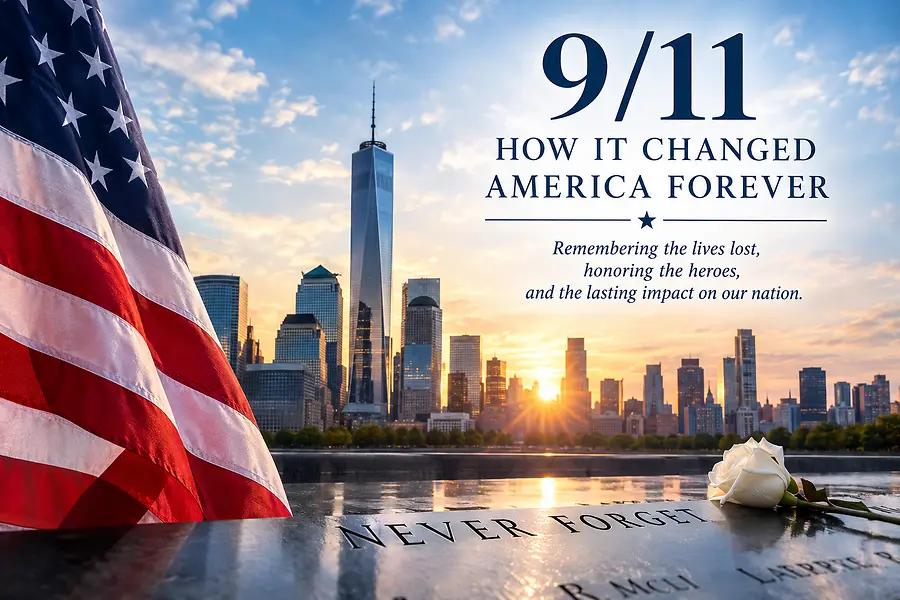
September 11, 2001, is a date permanently etched into the American memory. On that morning, the United States experienced the deadliest terrorist attack on American soil. Four commercial airplanes were hijacked. Two were flown into the World Trade Center towers in New York City, one struck the Pentagon, and another crashed into a field near Shanksville, Pennsylvania, after passengers and crew fought back against the hijackers.
Nearly 3,000 people were killed.
But the impact of 9/11 did not end that day. The attacks changed the United States in ways that continue to affect Americans more than two decades later.
A Nation Changed in a Matter of Hours
Before 9/11, many Americans had grown accustomed to a sense of security that seemed almost permanent. Terrorism existed, and the United States had experienced previous attacks, including the 1993 World Trade Center bombing and the 1995 Oklahoma City bombing. Yet for most Americans, the possibility of a large-scale attack inside the United States seemed distant.
September 11 changed that perception.
Americans watched the attacks unfold on live television. Families waited for loved ones to call. First responders rushed toward buildings that others were desperately trying to escape. Across the country, schools, businesses, airports, and government offices went into a state of uncertainty.
For many Americans, the world suddenly seemed less predictable.
Airport Security Became a Part of Everyday Life
One of the most visible changes following 9/11 occurred at America's airports.
The Transportation Security Administration, commonly known as the TSA, was created in response to the attacks. Airport screening became significantly more extensive, and passengers became accustomed to security lines, identification checks, restrictions on liquids, and increasingly sophisticated screening procedures.
For travelers, these changes became ordinary parts of flying.
The effects extended beyond airports. Security became a much greater consideration at government buildings, sporting events, concerts, schools, and other public gatherings.
The question of how much security is enough-and how much privacy Americans are willing to give up for that security-became a permanent national debate.
The Federal Government Became More Involved in National Security
9/11 also fundamentally changed the structure of the federal government.
The Department of Homeland Security was created in 2002 by combining numerous federal agencies and functions. Its mission included protecting the United States from terrorism and preparing for other threats to national security.
The federal government also expanded intelligence-gathering and information-sharing efforts.
The Patriot Act, passed shortly after the attacks, gave federal authorities additional powers to investigate suspected terrorism and collect certain types of information.
Supporters argued that stronger intelligence and investigative tools were necessary to prevent another attack.
Critics warned that some provisions could threaten Americans' constitutional rights and privacy.
That tension between security and civil liberties remains one of the most important legacies of 9/11.
America's Foreign Policy Changed Dramatically
Perhaps the largest long-term consequence of 9/11 was the transformation of American foreign policy.
The United States launched the war in Afghanistan against the Taliban and al-Qaeda. In 2003, the United States invaded Iraq.
The wars that followed became defining events for an entire generation of Americans.
Thousands of American service members were killed, and many more returned home with physical and psychological injuries. Millions of civilians were also affected by the conflicts.
The financial cost was enormous.
The wars also changed America's relationship with other countries and influenced debates about America's role in the world.
For many Americans, 9/11 created a new awareness that events occurring thousands of miles away could have profound consequences at home.
The Military Became More Visible in American Life
After 9/11, military service took on an even greater presence in American communities.
Americans regularly encountered stories about soldiers serving overseas, families separated by deployments, and communities supporting military personnel.
The phrase "Never Forget" became more than a memorial slogan. It became a reminder of the sacrifices made by military personnel, firefighters, police officers, emergency medical workers, and ordinary citizens.
The attacks also created a renewed appreciation for first responders.
The firefighters, police officers, paramedics, and other workers who entered the World Trade Center and Pentagon became symbols of courage and sacrifice.
The Economic Effects Were Significant
The attacks also had immediate and lasting economic consequences.
The financial markets closed temporarily. Airlines and tourism were severely disrupted. Businesses in and around Lower Manhattan suffered tremendous losses.
The aviation industry faced a particularly difficult period as Americans became fearful of flying and airlines faced new security requirements.
Over time, the economy recovered, but the cost of responding to 9/11 and the wars that followed became substantial.
The attacks also demonstrated how vulnerable a modern economy can be when transportation, financial systems, communications, and public confidence are suddenly disrupted.
Americans Became More Aware of Islamophobia and Religious Tensions
Another difficult consequence of 9/11 was the increase in suspicion and discrimination experienced by many Muslim Americans and people perceived to be Muslim.
The attackers claimed an extremist interpretation of Islam, but the actions of a terrorist organization did not represent the beliefs of America's Muslim population.
Nevertheless, Muslim Americans faced harassment, discrimination, and violence in the aftermath of the attacks.
This became an important part of America's broader conversation about religious freedom, prejudice, and the danger of judging entire communities based on the actions of extremists.
A Generation Grew Up With 9/11
For Americans who were children or teenagers in 2001, the attacks became a defining historical event.
Some remember exactly where they were when they heard the news. Others were too young to remember the day itself but grew up hearing stories from parents, teachers, and grandparents.
For younger Americans, 9/11 is similar to other major historical events that shaped previous generations.
It influenced the movies people watched, the news they consumed, the wars they followed, and the security procedures they experienced.
A generation grew up in a country where terrorism was no longer an abstract threat.
The Internet and News Changed Too
9/11 also occurred at an important moment in the development of the internet.
The attacks demonstrated the power of 24-hour news coverage and helped accelerate the public's reliance on digital information.
Over the years, social media would fundamentally change how Americans received breaking news.
The lessons of 9/11 became increasingly relevant to the modern information environment: people could receive information almost instantly, but they could also encounter rumors, misinformation, and emotionally charged claims just as quickly.
The challenge became not simply obtaining information, but determining what information could be trusted.
A Different Kind of American Patriotism
In the days and weeks following 9/11, displays of American patriotism became widespread.
American flags appeared on homes, cars, and businesses. People gathered for memorials and vigils. Communities donated blood, supplies, and money.
There was a powerful sense that Americans were facing tragedy together.
Over time, political disagreements returned-as they always do in a democracy-but the memory of the unity that followed 9/11 remained.
For many Americans, that period demonstrated the importance of community during a national crisis.
The Meaning of "Never Forget"
More than two decades later, the phrase "Never Forget" continues to carry different meanings.
It means remembering the nearly 3,000 people who lost their lives.
It means remembering the firefighters, police officers, paramedics, and civilians who ran toward danger.
It means remembering the military personnel who served in the wars that followed.
It also means remembering the difficult questions that emerged after the attacks: How should a democracy respond to terrorism? How much government power is appropriate during a national emergency? How can a country protect itself without abandoning the freedoms it was created to protect?
These questions remain relevant.
The Legacy of 9/11
September 11 changed more than America's security policies. It changed the country's psychology.
Americans became more conscious of terrorism, national security, and vulnerabilities that had previously received less attention. Travel changed. Government changed. Military policy changed. Immigration and border-security debates changed. America's relationship with the world changed.
Most importantly, the attacks reminded Americans that history can change in a single morning.
Today, the buildings, memorials, and museums connected to September 11 preserve the physical memory of what happened. But the greatest legacy of 9/11 exists in the lives of people who remember it, the families who lost loved ones, the first responders who sacrificed their health and safety, the veterans who served afterward, and the generation that grew up in its shadow.
Twenty-five years later, America continues to live with the consequences of September 11, 2001.
Remembering 9/11 is not simply about remembering how America was attacked. It is also about remembering how America responded-and considering what lessons should be carried forward for future generations.


