How INDYpendent Bytes Evolved From Restaurant Operations to Regional Infrastructure
How a restaurant operations consultancy evolved into community-owned regional food systems infrastructure.

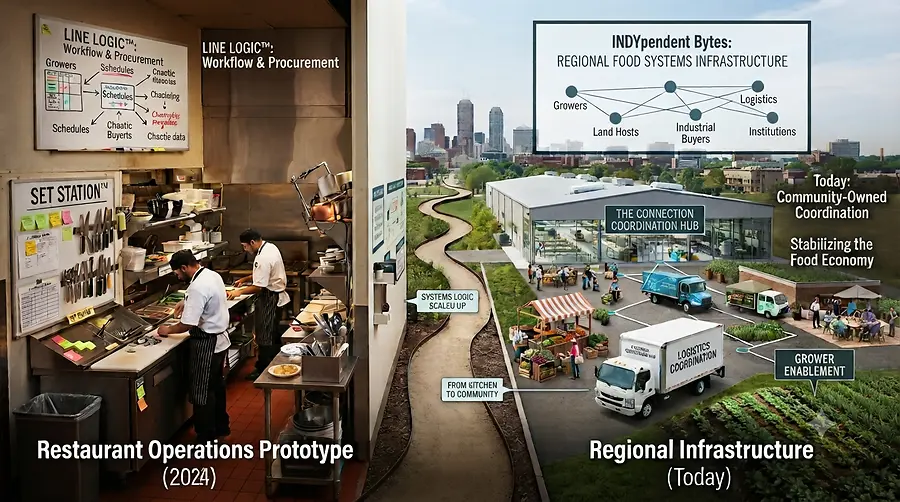
From Restaurant Operations to Regional Infrastructure
When I first launched INDYpendent Bytes, it wasn't a regional coordination engine or a system designed to stabilize an entire food economy. It was a restaurant operations consultancy built around two core frameworks: Set Station™ and Line Logic™. I was helping independent restaurants solve problems within their four walls—workflow breakdowns, inconsistent portioning, chaotic procurement practices, and leadership gaps that made Friday nights harder than they needed to be.
And to be clear, those problems were real. Restaurants don't fail only because of upstream instability. They also fail because of internal systems that never had a chance to mature: unclear workflows, poorly structured stations, inconsistent training, and procurement practices that swing wildly from week to week. I saw firsthand how much stability a kitchen could gain when its internal logic finally made sense.
But as I worked with more restaurants, a deeper truth emerged—one I couldn't ignore. Even the best-run kitchens were being destabilized by forces far beyond their control. Growers lacked access to land and predictable support. Land hosts lacked structured agreements. Industrial buyers lacked reliable regional supply. Logistics partners lacked coordination. Prices fluctuated unpredictably. SKUs weren't standardized. And every restaurant, no matter how well run, was downstream of all of it.
That was the moment INDYpendent Bytes outgrew restaurants.
I didn't pivot because I was restless. I expanded because the architecture demanded it. The problems inside restaurants were symptoms of a much larger system failure, and my work was already drifting upstream whether I intended it to or not.
- Set Station™ evolved into workflow standardization for growers, land hosts, and buyers.
- Line Logic™ evolved into batch-cycle sequencing for regional production and procurement.
- Staff training evolved into grower, land host, and buyer enablement.
- POS data evolved into regional SKU, pricing, and demand intelligence.
- Restaurant marketing evolved into regional economic positioning.
The restaurant version of INDYpendent Bytes wasn't a detour. It was the prototype. It taught me how systems behave under pressure, how people interact with structure, and how much stability can be created when workflows finally make sense. But it also revealed the limits of solving problems at the wrong scale.
Today, INDYpendent Bytes is community-owned regional food systems coordination infrastructure—a system that connects growers, land hosts, industrial buyers, logistics partners, and regional institutions into a single, predictable weekly rhythm. It stabilizes production, procurement, pricing, logistics, and market access. It transforms disconnected resources into coordinated pathways for local business ownership, food access, and community wealth creation.
The truth is simple: I didn't set out to build regional infrastructure. I set out to help restaurants operate more effectively. But once I clearly saw the upstream failures, the architecture expanded naturally. Once it expanded, I followed it.
INDYpendent Bytes is still evolving, still growing, and still revealing new layers. But its lineage is clear. I didn't abandon the restaurant model—I scaled it. I took the same systems thinking, the same commitment to stability, and the same belief in structure and applied them where the underlying problems actually existed.
That's how I got here.
And this is only the beginning.


