
# Humility Does Not Require You to Make Yourself Smaller
Redefining True Humility: The Power of Knowing Your Worth While Remaining Teachable

Humility Does Not Require You to Make Yourself Smaller
For a long time, I thought humility meant keeping my head down, working hard, and trusting that eventually the work would speak for itself.
And to some extent, I still believe that. I believe in doing good work. I believe in listening before speaking. I believe there is always something I can learn from the people around me, regardless of their title. I am still a student—literally, at this point in my life—and I hope I never reach a place where I believe a title means I have nothing left to learn.
But I have also learned something else:
Humility does not require you to make yourself smaller.
That distinction took me longer to understand.
My career has not followed a perfectly straight line. I have led across different industries and functions. I have worked in large corporations, education, nonprofits, and businesses of my own. I have led people, operations, finances, organizational change, and strategy. Sometimes my title accurately reflected the scope of what I was doing. Other times, it did not.
Like many women, I became very good at stepping in.
Something needed to be built? I would build it.
There was a problem no one quite owned? I would help solve it.
A process wasn't working? I would redesign it.
A leader needed someone to think through a problem and then figure out how to actually make the solution happen? I could do that, too.
For years, I saw that simply as doing my job well. What I did not always do was stop and recognize what those experiences were teaching me about my own capacity.
There is a difference between being willing to do the work and being willing to name the level at which you are working.
I think many women struggle somewhere in that space.
We are encouraged to be collaborative, but we can begin confusing collaboration with never taking credit. We value humility, but sometimes turn it into self-minimization. We want to be prepared, so we convince ourselves we need one more credential, one more year of experience, or one more person to validate that we are ready.
Meanwhile, we may already be doing much of the work.
One of the most important lessons I am still learning is that you can be humble and know what you bring to the table.
You can say, “I don't know,” without questioning everything you do know.
You can seek advice and still trust your judgment.
You can listen to people who know more about a particular subject and still be the person responsible for making the decision.
You can be kind, approachable, and deeply human while holding people to high expectations.
And you can want to keep growing without treating the person you are today as somehow unfinished or insufficient.
I am pursuing a doctorate in organizational leadership now, after more than two decades of leadership experience. I did not return to school because those years suddenly stopped counting. Quite the opposite. Education has given me new language, research, and frameworks for things I first learned through experience. It has also challenged some of my thinking, which is exactly what learning should do.
I don't want to reach a point where I stop being teachable.
But being teachable and doubting yourself are not the same thing.
That is something I would tell a woman coming behind me.
Do not wait until you know everything. You never will.
Do not assume the person speaking with the most confidence is necessarily the person who understands the problem best.
Do not dismiss the skills you developed simply because you developed them somewhere unexpected.
And don't let a title become the boundary around what you believe you are capable of doing.
Careers rarely unfold as neatly as they look in a biography. Mine certainly hasn't. Sometimes the experience that prepares you for the next level will come before anyone gives you the title associated with it. Pay attention to those moments. They are evidence.
At the same time, leadership is not about proving that you are the smartest person in the room. Some of the best decisions I have made started with asking questions, listening to people closer to the work, and being willing to change my original thinking.
I have also learned to pay attention when people resist change. My first question is not always, “How do I get them on board?” Sometimes it is, “What are they seeing that I need to understand?”
Resistance can be information.
That philosophy has changed how I lead. People are not obstacles to a strategy. They are part of the system that determines whether the strategy will work.
Maybe that is another form of humility: knowing that leadership requires confidence without certainty.
There are things I would do differently if I were starting my career again. I would recognize my strengths earlier. I would spend less time wondering whether I belonged in certain rooms. I would understand sooner that being unconventional is not necessarily a weakness. And I would stop assuming that acknowledging what I am good at somehow takes something away from being grounded.
It doesn't.
So, to the woman who is doing work beyond her title, applying for the role she isn't completely sure she is ready for, returning to school later than she originally planned, building something that doesn't have a roadmap, or simply beginning to recognize that she may be capable of more:
Keep learning.
Ask questions.
Stay reflective.
Be willing to change your mind.
Give other people credit.
Bring others with you.
But do not disappear from your own story.
You can remain humble and still take up the space your experience has prepared you to occupy.
I am still learning to do that myself.
Kindra Brock, MJur, SPHR
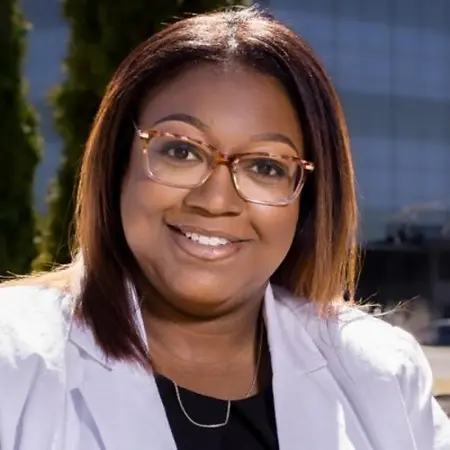
Kindra Brock is an executive leader with 25+ years in management across retail, education, and nonprofits, holding MJur and SPHR credentials. She specializes in people operations, organizational health, and neurodiversity advocacy. At Huntington Learning Center, she led operations and a 30-person team while developing expertise in workplace inclusion. Currently pursuing a PhD in Organizational Leadership, Brock is…





