I Am Disabled. And I Am the Leader.
How living with a disability redefined my understanding of strength, leadership, and what it truly means to belong in positions of power.

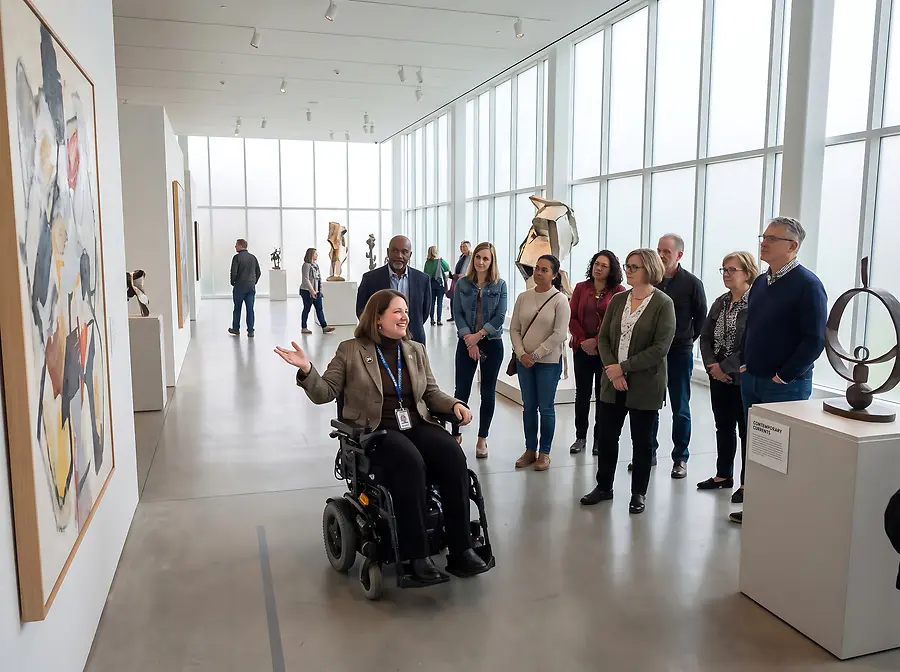
I Am Disabled. And I Am the Leader.
Leadership is often associated with strength, independence, and the ability to carry others. Living and leading with a disability has taught me something different: needing support does not diminish authority, accommodations do not erase ambition, and there is more than one way to be strong.
There is something complicated about being the person others come to for answers while also being someone who sometimes needs help herself.
I can make decisions, manage responsibilities, solve problems, support a team, navigate difficult situations, and carry the weight that comes with leadership. I can also need a cane or walker to safely make it across the room.
Both are me.
For a long time, I struggled with those two realities existing at the same time. Leadership, at least the version many of us are taught to recognize, looks fiercely independent. The leader is the person everyone else relies on. She is composed, confident, available, productive, and seemingly limitless. She handles the crisis. She has the answer. She keeps going.
Then disability entered my life and challenged almost everything I thought I understood about strength.
It also changed the kind of leader I wanted to become.
Rethinking What Strength Looks Like
We have created a strange standard for leadership. We admire the person who never stops. The one answering emails at all hours, pushing through exhaustion, carrying every responsibility, and somehow appearing to need nothing from anyone.
Sometimes we call that dedication. Sometimes it is simply unsustainable.
Living with a disability has made it impossible for me to pretend that human beings are limitless. My body has limits. Some days, those limits barely enter the conversation. Other days, they announce themselves before I have even started my morning.
The responsibilities of leadership do not disappear on those days.
That reality forced me to learn something I wish more leaders understood: needing support and being capable are not opposites.
I can ask for help and still be responsible for making the final decision. I can use an accommodation and still hold others accountable. I can have physical limitations and enormous professional ambitions. I can need someone to help me through a door and then lead the meeting on the other side of it.
There is no contradiction in any of that.
There is simply a different picture of leadership than the one we are accustomed to seeing.
Growing a Career While Adapting to a Changing Body
Perhaps the strangest part of becoming a leader with a disability is experiencing growth and loss at the same time.
Professionally, my world continues to expand. I have pursued my education, accepted greater responsibility, strengthened my voice, learned from mistakes, and become more confident walking into spaces where I once might have questioned whether I belonged.
I am ambitious, and I am nowhere near finished.
I want to keep learning. I want greater responsibility. I want opportunities to influence systems and improve the communities around me. I want to sit at tables where important decisions are being made, and I want my voice to matter when I get there.
At the same time, my body has required me to adapt.
There are appointments, treatments, exhaustion, pain, mobility changes, and days when my body simply does not care what is written on my calendar.
There is an uncomfortable truth in that experience that we rarely talk about: your career can be expanding at the same time your physical independence is changing.
You can become more powerful professionally while learning to ask for more help personally.
At first, that felt impossible to reconcile.
Now I understand that one does not diminish the other.
Not Every Part of Disability Is Inspiring
We tend to tell stories about disability through two extremes. Disability is either portrayed as tragedy or transformed into inspiration.
Actual life is much messier.
There are days when I am genuinely proud of how much I have adapted. There are other days when I am angry that I had to adapt at all. There are days when I feel strong and others when I am simply exhausted.
Sometimes I confidently advocate for what I need. Sometimes needing help still frustrates me.
I do not believe those moments make me less empowered. I think they make the conversation more truthful.
I do not want to pretend disability is beautiful every day in order to write something positive about it. I also do not want my disability treated as something tragic that diminishes the life I am building.
And I am not interested in being considered inspirational simply because I have a disability and a career.
Disabled professionals should not have to transform our lives into motivational stories to justify our presence in professional spaces.
Sometimes disability is empowering. Sometimes it is painful. Sometimes it is frustrating. Sometimes it is inconvenient.
And sometimes it is simply part of Tuesday.
That reality deserves to be represented too.
What "I'm Fine" Can Really Mean
One of the greatest lessons disability has given me as a leader is an awareness of how little we truly know about the people around us.
I know what it feels like to look fine and not feel fine.
I know what it is like to perform well while my body is demanding my attention.
I know that someone's productivity on one particular day does not necessarily tell you everything about their commitment, talent, work ethic, or character.
That perspective has fundamentally changed the way I think about leadership.
It has taught me that compassion and accountability are not opposites.
We can maintain high expectations while recognizing that the people working beside us are human beings. We can offer flexibility without abandoning standards. We can create accommodations without assuming we are giving someone an unfair advantage.
An accommodation is not an advantage. It is often what allows a talented person to fully participate in an environment that was not designed with them in mind.
That distinction matters.
Leadership cannot only be about getting the most productivity possible out of people. It should also be about creating an environment where people can do meaningful work without having to hide their humanity to be respected.
I Don't Want to Earn My Seat Through Suffering
There is a particular pressure that can come with being different in professional spaces.
You start believing you have something to prove.
Work harder. Do more. Never complain. Never allow your disability to inconvenience anyone. Never give someone a reason to wonder whether you can handle the responsibility.
Be so good that nobody can question whether you belong.
From the outside, that can look like ambition.
From the inside, it can become exhausting.
I care deeply about doing excellent work. I want to continue growing, learning, and challenging myself. But I no longer believe I need to be extraordinary simply to deserve the same opportunities as everyone else.
Disabled professionals should be allowed to make mistakes. We should be allowed to learn. We should be allowed to have difficult days. We should be able to ask for accommodations without feeling obligated to compensate for them by working ourselves into the ground.
My seat at the table does not have to be purchased with suffering.
That realization changed something in me.
I became less interested in appearing invulnerable and more interested in becoming an effective leader.
Disability Changed the Way I Lead
Before disability, my definition of strength was relatively simple: keep going.
Push harder. Handle it yourself. Figure it out. Do not let people see you struggle.
I do not believe that anymore.
Sometimes strength is pushing through. Sometimes strength is recognizing that pushing through would be the worst decision you could make.
Sometimes leadership means taking control. Sometimes it means delegating.
Sometimes resilience means showing up. Sometimes resilience means knowing when you need to go home.
There is wisdom in knowing the difference.
Disability has also made me more aware of the invisible battles other people may be fighting. When someone tells me they need something, I understand differently now. I know what pushing through can cost.
That does not mean abandoning accountability. If anything, I think compassionate leadership requires more intentional accountability because it asks us to understand the person while still addressing the responsibility.
People deserve both.
They deserve leaders who believe in what they are capable of and leaders who remember they are human.
Why Disabled Leaders Need to Be in the Room
Representation in leadership matters for reasons that extend far beyond visibility.
When disabled people are absent from leadership, disability can easily become something discussed about people.
Accessibility becomes a policy. Accommodation becomes a procedure. Inclusion becomes a talking point.
Those conversations change when people with lived experience are sitting at the table where decisions are being made.
We understand that accessibility is not theoretical. We know that talent can exist inside bodies and minds that operate differently. We know that independence is not the ultimate measure of someone's value.
And our presence challenges the assumption that professionalism, competence, authority, and leadership are supposed to look a certain way.
I want young women with disabilities to see leaders who make their imagined futures feel possible.
Not because every disabled woman needs to become an executive, manager, entrepreneur, advocate, or public figure.
But because disability should never automatically determine the size of someone's dreams.
The Word That Changed Everything
I am disabled and I am a leader.
Not but.
And.
That distinction has become incredibly important to me.
I am disabled and ambitious.
I am strong and sometimes exhausted.
I am independent and sometimes need help.
I have limitations and enormous goals.
I can be uncertain about what my body will do next and certain that I am not finished building my career.
I can lead other people and occasionally need someone else to steady me.
None of those things cancel each other out.
Perhaps that is the greatest lesson disability has taught me about leadership. We do not need more leaders pretending to be invincible. We need leaders who understand that people are human. Leaders who know when to push and when to adapt. Leaders who can maintain high expectations while making room for compassion. Leaders who understand that asking for help is not surrender.
I do not know exactly what my body will look like five years from now.
I do know what I refuse to do.
I refuse to make my dreams smaller simply because the path toward them may look different than I once imagined.
Maybe I will walk into the rooms where my future takes me. Maybe I will use a cane. Maybe I will use a walker. Maybe I will need someone to hold the door.
But once I am inside, I belong there.
And if one day I roll into a room where people once expected their leaders to walk, I hope nobody calls it inspiring.
I hope they call it what it is.


