I Spent Years Learning How to Lead. Then I Learned to Lead Like Myself.
Forty-five years of building a business taught me that authentic leadership means becoming more fully yourself, not someone else.

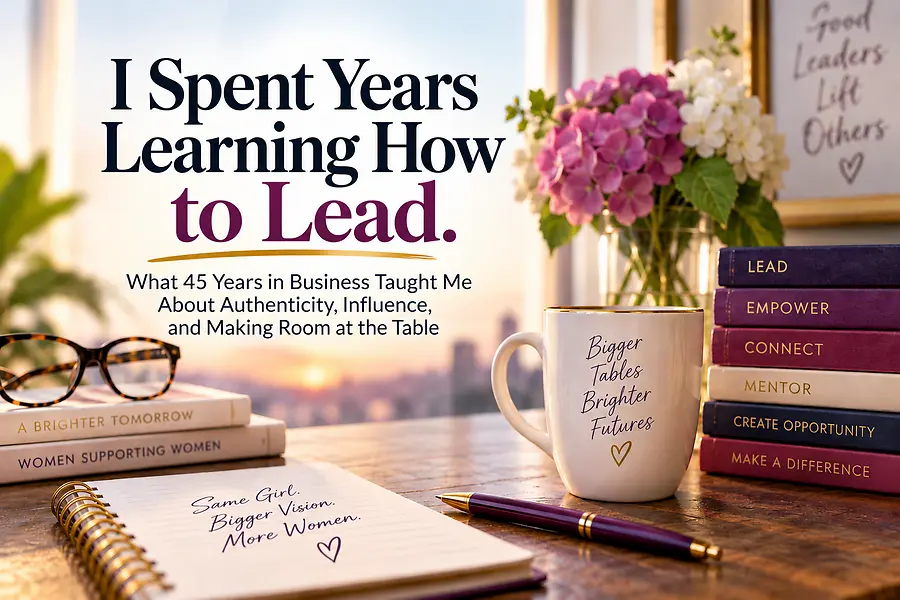
Forty-five years ago, I opened the doors to my flower shop. I wasn't thinking about becoming a leader. I was thinking about whether customers would walk through the door. I wasn't thinking about leadership styles, authenticity, influence, or building a legacy. I was thinking about flowers, customers, bills, vendors, and figuring out how to keep a business alive.
But apparently, I was learning about leadership.
I just didn't call it that yet.
Over the decades that followed, I would become president of professional organizations, found women's business communities, publish magazines, mentor entrepreneurs, speak to audiences, write books, and create platforms designed to help other people become more visible. Along the way, I learned plenty about leadership.
But perhaps the most important lesson was one I didn't learn at a conference, in a book, or around a boardroom table:
You don't become a better leader by becoming more like someone else. You become a better leader by understanding who you are—and having the courage to lead from there. It took me years to understand that.
First, I Thought Leadership Was About Proving Yourself
Starting a business teaches you very quickly that nobody is coming to hand you credibility. You earn it. Customer by customer. Decision by decision. Mistake by mistake.
When I opened Eden Florist in 1981, I didn't have 45 years of experience to point to. I had to prove that I could deliver what I promised. And then do it again. And again.
There is something about entrepreneurship that strips leadership down to its most basic form. Your employees don't particularly care what leadership book you just read when something goes wrong on the busiest day of the year.
Your customers don't care what your title is when their order isn't what they expected. Your vendors don't care how inspirational you are if you don't keep your commitments. Leadership becomes very practical.
- Show up.
- Keep your word.
- Solve the problem.
- Treat people well.
- Take responsibility when you get it wrong.
And come back tomorrow prepared to do it again. Looking back, I realize those early years taught me something I still believe today:
Leadership begins long before someone gives you a title.
Then I Thought Leadership Was About Building Something
Eventually, my world grew beyond the flower shop. I became involved in professional associations and business organizations. I took on leadership positions. I became president of organizations and sat on boards. I launched publications and created programs.
And in 2001, I founded Women in Ecommerce. By then, I understood something I hadn't understood when I first became an entrepreneur:
There are limits to what we can accomplish alone. Leadership wasn't simply about proving that I could succeed anymore. It was about asking:
What could we build together? That changed everything. I discovered how much I enjoyed connecting people. Introducing one woman to another. Creating opportunities for someone to speak, write, teach, collaborate, or be recognized for her expertise.
My definition of influence began to change, too. Influence wasn't about how many people knew my name. It was about what happened because I knew theirs.
The Introvert Who Became a Leader
There is something else that might surprise people who have seen me on stages, leading organizations, publishing magazines, or building communities.
I'm an introvert.
For years, the image we were given of a powerful leader was often the person who walked into the room and immediately commanded it.
I can do that when I need to.
But it isn't where my greatest strength lies. I would rather listen. I like discovering what people do well. I remember things about them. I connect dots. I notice when two people should know one another. I enjoy creating an opportunity and then watching someone else do something wonderful with it.
Eventually, I stopped seeing those qualities as somehow less than leadership. They were simply my way of leading.
That realization gave me permission to stop performing leadership and start practicing it. You don't have to be the loudest person in the room to influence what happens inside it.
Sometimes the most influential person is the one listening closely enough to understand what the room needs.
My Leadership Philosophy Became Surprisingly Simple
Over the years, one sentence has come to represent much of what I believe about people: Either everyone is important, or no one is.
I don't believe leadership should be reserved for the people with the biggest titles, the largest platforms, or the loudest voices. The person answering the telephone matters, just as the new member attending her first meeting matters. The person who hasn't yet found the confidence to raise her hand matters. The customer placing the smallest order matters. The established expert matters, and so does the woman just beginning to wonder whether she has something worth saying.
If we only pay attention to people once they become important enough to help us, we've missed something fundamental about leadership. People don't suddenly become valuable when they become successful. They were valuable before anyone noticed.
Influence Isn't About Creating Copies of Yourself
As I became more involved in women's organizations and communities, I learned another important lesson: mentoring someone doesn't mean teaching her to become more like you. Neither does leadership. One of the dangers of talking about "female leadership" is that we risk replacing one narrow definition of leadership with another. Women don't all lead the same way. Some command a room while others quietly change it. Some build consensus; others challenge it. Some are analytical, some are intuitive, some are extraordinary public speakers, and others influence people one conversation at a time. There isn't one correct way to be a powerful woman.
Perhaps that's what authenticity in leadership really means. It isn't refusing to change because "that's just who I am." It's knowing yourself well enough to recognize the difference between growing and pretending. Authentic leaders understand who they are while remaining willing to become better versions of themselves.
A good leader should grow. She should develop skills that don't come naturally, become more courageous about difficult conversations, listen to criticism, and be willing to change her mind when better information comes along. But growth shouldn't require abandoning the qualities that made her effective in the first place. The goal isn't to become someone else. It's to become more capable of being yourself.
Eventually, Leadership Became About Opening Doors
My understanding of leadership has changed throughout my life. In the beginning, it was about proving myself. Then it became about building something meaningful. Later, it became about connecting people. Today, increasingly, leadership is about opening doors. Perhaps that's one of the privileges that comes with longevity. After 45 years in business, I have relationships, experiences, platforms, and opportunities I didn't have when I started—and I often ask myself, what good are they if I keep them all to myself?
When I publish someone's story, introduce two people who should know one another, invite a woman to share her expertise, recommend someone for an opportunity, or provide a platform where her voice can be heard, I don't lose influence. Influence expands. The more opportunities we create for others, the greater our collective impact becomes.
That's something I wish more women understood: another woman's success does not diminish ours. Her light doesn't make ours darker, and her seat at the table doesn't require us to surrender ours. Sometimes leadership is as simple—and as powerful—as pulling up another chair.
What Wouldn't Be There Without You?
These days, I think we spend far too much time asking women questions that begin with what's missing.
- What skills do you need?
- Where are your weaknesses?
- What credentials don't you have?
- Why aren't you further along?
- What should you improve?
Growth matters. Of course it does.
But I'd like to suggest another question:
What do you bring to the table that wouldn't be there if you weren't sitting at it?
- Maybe you listen differently.
- Maybe you see possibilities other people overlook.
- Maybe you ask the uncomfortable question.
- Maybe you make people feel safe enough to tell the truth.
- Maybe you see connections between ideas—or people—that no one else sees.
- Maybe you are the person who says, "Why not?"
- Maybe you're the one who notices the woman standing just outside the circle and invites her in.
Those things matter.
They are part of your leadership fingerprint.
Leadership Changes Because We Do
The woman who opened a flower shop in 1981 is still very much part of who I am, but she isn't the same leader I am today—and I'm grateful for that. Authenticity doesn't mean discovering one version of yourself and remaining her forever. It means allowing yourself to evolve without losing sight of what matters to you. At one point in life, leadership may be about finding your voice. Later, it may be about using it. And eventually, perhaps it becomes about helping someone else discover hers.
I spent years learning how to lead. Today, I'm much less interested in looking like a leader and much more interested in being useful—creating things that matter, connecting people who can help one another, opening doors, and leaving the rooms I enter a little more welcoming for the women who will walk into them next. To me, that's a different kind of success, and perhaps a more meaningful kind of influence.
Maybe that's what it means to finally lead like yourself. Not to become the leader everyone else expects you to be, but to grow into the person your experiences have prepared you to become—and then use what you've learned to make the path a little easier for someone coming behind you. You don't have to become someone else's idea of a leader. You have to become more fully the leader only you can be.


