
If Everything Is a Priority, Who Is Making the Decisions?
Making the Tradeoffs That Turn Strategy into Action

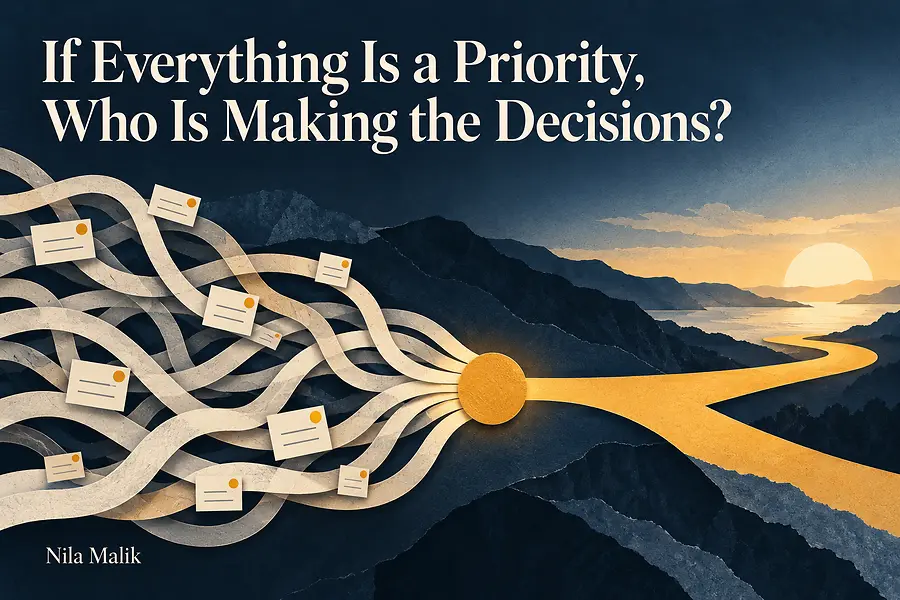
I've led enough complex programs to know that the word "priority" can become surprisingly generous.
Every initiative is critical. Every deadline is urgent. Every stakeholder has a compelling reason their request should move first.
The team leaves with a longer action list and the same unanswered question: What actually comes first?
I understand how this happens. Each person sees the consequences of delay within their own area. Those consequences may be real. But someone still has to consider the whole organization and decide how its commitments fit together.
That is where strategy becomes a leadership responsibility.
The decision still gets made
When leaders leave priorities unresolved, the work does not pause politely.
Teams make choices based on the resources they have, the dependencies they encounter, and the pressure they feel. The most persistent request may receive attention before the most consequential one. A visible deadline may displace work that would prevent a larger problem later.
People can be working exceptionally hard while moving the organization in conflicting directions.
Before adding another commitment, leaders should ask: If we approve this today, what will receive less attention tomorrow?
That question makes the trade-off visible. It also gives the people doing the work permission to explain what a commitment will actually require.
Urgency deserves examination
In complex operating environments, some work genuinely cannot wait. Safety, service continuity, and obligations to the public can demand immediate action.
Other requests become urgent because a decision was delayed, a dependency was missed, or a date was announced before the delivery requirements were understood.
Those situations need different responses.
Before accelerating work, I want to understand what is driving the deadline, what happens if it moves, and what becomes exposed if we proceed too quickly. I also want to hear from the people responsible for operating and supporting the result.
Their concerns can reveal consequences that a project presentation does not show.
Sequencing is a strategic choice
My work in aviation technology has made me attentive to what sits behind an implementation date. Systems need connectivity. Operational teams need preparation. Support responsibilities need owners. Each element affects whether the next one can succeed.
Consider a passenger information system whose software is ready, but whose support arrangements and staff training remain incomplete. Moving ahead might satisfy the implementation schedule while transferring unresolved work to the people expected to operate it.
The leadership decision is whether that exposure is acceptable, what must be resolved first, and who is accountable for the outcome.
An initiative can be valuable and still need to wait. Another investment may need to come first, or the organization may lack the capacity to absorb the change.
Recognizing those conditions requires discipline, particularly when enthusiasm is high.
Make the choice clear enough to act on
People deserve more direction than "everything matters."
They need to understand which outcome takes precedence, what can move, and who has the authority to resolve a conflict. They also need to know when changing conditions justify revisiting the decision.
Priorities will evolve. Explaining why they have changed helps teams adapt without losing confidence in the direction.
Leaders must also stand behind the trade-offs they approve. A team should be able to explain that an agreed priority displaced another commitment without being treated as though it simply failed to deliver.
I measure the usefulness of a strategy partly by what happens after the meeting. Can people make better decisions because of it? Can they explain why one commitment comes before another? Can they raise a concern without having to manufacture a crisis to be heard?
Those are practical tests of leadership.
The next time a discussion ends with everything labeled a priority, I would ask one more question: What have we decided can wait, and are we prepared to stand behind that decision?

Nila Malik is an enterprise transformation leader who brings together people, technology, and strategy to deliver meaningful change. With more than 20 years of experience across aviation, healthcare, and enterprise technology, she is known for aligning executives, operational teams, and technical partners around complex initiatives that deliver measurable results. Today, Nila leads mission-critical aviation…





