If We Don’t Teach AI in Rural Communities, We’re Writing Their Future Without Them
Why Rural Communities Must Not Be Left Behind in the AI Revolution

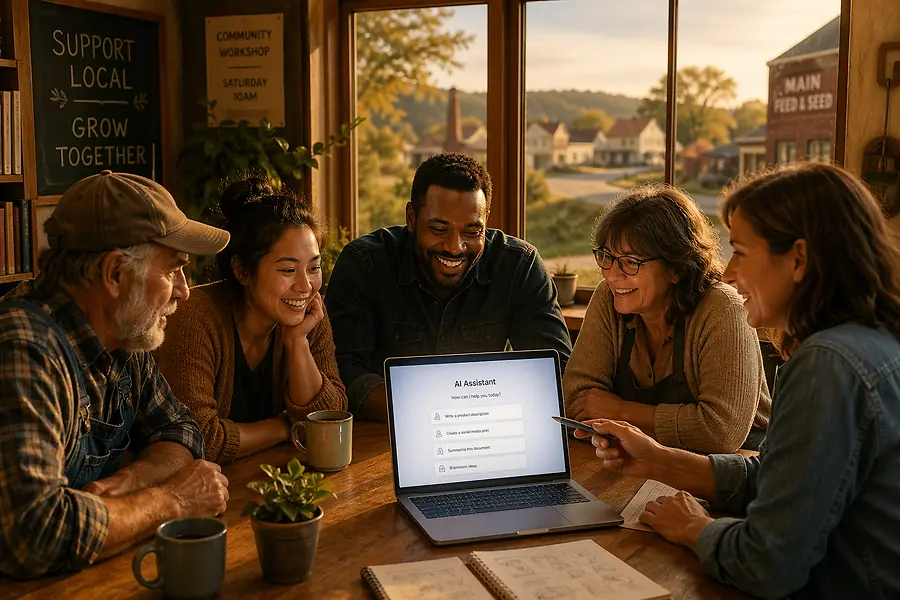
There is a quiet truth we don’t talk about enough:
Innovation doesn’t reach everyone equally.
I’ve spent decades working with businesses, teams, and systems, and I’ve seen how quickly the world shifts when new technology arrives. But I’ve also seen something harder to confront.
The same communities left behind during past technological waves are at risk of being left behind again.
Only this time, it’s AI.
And the stakes are even higher.
The New Divide Is Already Here
We often talk about AI as if it’s reserved for large organizations or highly technical professionals.
But the reality is much simpler.
AI is already changing how people work, communicate, hire, and grow their businesses. If you don’t know how to use it, you’re not just behind—you risk being excluded from opportunities that are quickly becoming the norm.
For rural communities, this poses a very real risk.
Limited access to training, fewer local resources, and less exposure to emerging tools mean entire populations could once again be asked to “catch up” after the fact.
We’ve seen this before.
What I Saw When I Started Teaching AI
When I began teaching AI tools to individuals and small businesses—especially in rural communities—I noticed a pattern immediately.
People weren’t resistant because they didn’t care.
They were hesitant because they didn’t feel it was built for them.
I heard things like:
“I’m not technical.”
“I wouldn’t even know where to start.”
“This feels like something for someone else.”
That hesitation wasn’t about capability.
It was about access—and confidence.
Building Something That Meets People Where They Are
That realization led me to do something different.
Instead of expecting people to adapt to complex tools, I created a simple, beginner-friendly AI platform designed for real people with real responsibilities—not developers or engineers.
Everyday users.
The goal wasn’t to impress anyone with advanced features.
The goal was to remove friction.
To make it easy for someone to sit down, try something new, and experience success quickly.
Because once someone has a small win, everything changes.
What Happens When the Barrier Is Removed
When people use a tool that truly meets them where they are, you can see the shift happen in real time.
They move from uncertainty to curiosity.
From hesitation to engagement.
From “this isn’t for me” to “what else can I do with it?”
That shift matters more than any feature or function.
Because it changes how people see themselves in a rapidly evolving world.
The Ripple Effect in Rural Communities
When one person gains confidence with AI, it doesn’t stop there.
A small business owner becomes more efficient and competitive.
A team leader communicates more clearly and reduces stress within their team.
A job seeker learns to stand out in ways they never could before.
Over time, a community begins to feel included rather than overlooked.
This is how real change happens.
Not through large, abstract initiatives, but through practical tools and human-centered education that people can actually use.
The Risk of Doing Nothing
If we don’t intentionally introduce AI education to rural communities, the gap will widen.
Urban areas will continue to advance.
Large organizations will continue optimizing.
Rural communities will once again be expected to adapt afterward.
But adaptation becomes harder every time the pace accelerates.
What It Looks Like to Do This Well
The good news is that this doesn’t require extensive infrastructure or overly complex systems.
It requires intention.
It looks like:
- Teaching practical, real-world use cases
- Creating tools that are simple and accessible
- Removing the intimidation factor from technology
- Meeting people where they are—not where we think they should be
Most importantly, it requires people willing to show up and say:
“You belong in this future too.”
This Is About More Than Technology
AI will continue to shape the future of work, business, and opportunity.
That part isn’t up for debate.
What remains within our control is who gets included.
If we want stronger, healthier, and more resilient communities, we must ensure that access to these tools isn’t limited by geography.
When we teach people how to use AI, we’re not just teaching a skill.
We’re expanding their sense of what’s possible.
A Call to Leaders and Decision-Makers
If you’re in a position to drive change, this is the moment to act.
Invest in accessible education.
Support tools built for real users.
Bring these conversations to communities that are often overlooked.
Because the future isn’t being built solely by technology.
It’s being shaped by who has the opportunity to use it.
And that’s something we still have the power to change.


