I’ll Take the Hard Days
The invisible work that breaks and fills a teacher's heart

“Why do you teach? Isn’t it exhausting? I don’t know how you do it.”
There are days teaching feels like running a marathon while carrying other people’s backpacks.
You wake up already tired; not because you don’t love what you do, but because the work starts long before the bell and doesn’t end when the building empties. And somewhere in the middle of chasing excellence for your students, you realize how often you’ve poured yourself into other people’s kids with barely anything left when you walk through your own front door.
That truth hurts. Not because your own children aren’t your whole heart, they are, but because teaching asks for your whole heart, too. It asks for your patience when your nerves are shot. It asks for your optimism when the world feels heavy. It asks for your presence when your mind is already racing through the ten things you still have to do tonight. It asks you to keep showing up as the best version of yourself for 160 students, even when you feel like you’re holding yourself together with a coffee with four espresso shots and sheer will.
The Invisible Hours
People see the teaching: the lessons, the worksheets, the classroom, the pacing, the “content.”
What they don’t see is the second shift.
The extra hours after teaching is over: planning with intention, rewriting lessons because what worked last year won’t work for this group, differentiating because one student needs extension and another needs scaffolds, tracking data, contacting families, responding to emails, writing accommodations, writing plans, writing everything.
Then comes feedback: the kind that actually helps kids grow. Not a checkmark. Not a “good job.” The kind of feedback that tells a student, “Here’s what you did well. Here’s where your thinking is almost there. Here’s how to push it further. And I know you can.”
Multiply that by 160.
Class sizes of 32+ mean you’re teaching a small crowd every period. You’re managing personalities, needs, learning gaps, trauma, hunger, confidence, ego, apathy, and brilliance: all in the same room. You’re scanning constantly: Who’s quiet today? Who’s off? Who’s spiraling? Who’s pretending not to care because caring feels risky? Quietly taking mental notes while teaching a Hamlet lesson.
And still, you’re expected to be masterful and measurable. To produce outcomes as if students are machines and teachers are factories. To give everything and then prove you gave it.
The Emotional Labor No One Budgets For
Teaching is hard because it isn’t only academic.
Some days, you are an educator. Some days, you are an emotional support system. Some days, you are the safest adult in the room and maybe the only person a student trusts.
You become the person who notices the small things: the hoodie pulled tighter than usual, the missing assignments that suddenly aren’t just “laziness,” the eyes that won’t meet yours, the laugh that sounds too sharp, the silence that sounds too loud.
And then a student lingers after class, and you already know this isn’t about the essay.
It’s about the fight they heard last night.
The eviction notice.
The phone call from a parent who didn’t come home.
The younger siblings they had to get ready alone.
The crippling anxiety they don’t have words for.
The grief they carry like a backpack they can’t set down.
So you listen. You validate. You problem-solve. You connect them to support. You become the bonus parent when life at home is unstable, unsafe, or simply absent. You show them what consistency looks like. You teach them, quietly, what it means to be cared for without strings attached.
That’s the part that drains you in a way no curriculum ever could. Because you don’t stop being human just because you’re a professional. You take their stories home with you. You wonder if they ate. You worry if they’re safe. You celebrate tiny wins that most people would never notice: a kid who finally comes to school on time, a student who speaks up, a student who turns something in, a student who chooses hope for one more day.
It’s hard because you can’t teach well without loving your students, and love has a cost.
The Weight of Trying for Every Single Kid
The hardest part is wanting it for them sometimes before they want it for themselves.
It’s sitting across from a student who’s capable of greatness and watching them shrink because they’ve been told they’re not enough for too long.
It’s fighting the urge to give up on the ones who push you away, because deep down you know: that’s the test. Will you leave like everyone else?
It’s showing up for the student who makes it difficult to show up for them.
It’s caring about growth when the system is built for compliance.
It’s being held to standards that don’t account for reality while you’re trying to hold students to standards that will set them free.
And then you go home, and you’re still a parent. Still a wife. Still a person. Still someone who wants to have energy left for bedtime stories and dinner conversations and your own kids’ needs after you spent all day meeting everyone else’s.
That’s the part no one prepares you for: loving your students doesn’t subtract love from your own children, but it does subtract hours, energy, and breath.
And Still, the Perks Outweigh All of It
Here’s what people also don’t tell you:
Teaching breaks your heart sometimes, but it also fills it in ways nothing else can.
The perks aren’t small. They’re life-changing. They’re soul-level.
They look like watching your school babies walk across the stage and feeling that lump in your throat because you remember who they were when they walked into your room: unsure, guarded, half convinced they wouldn’t make it or get into their dream school. And now they’re in a cap and gown, standing tall, stepping into a future they didn’t always believe they deserved or could attain.
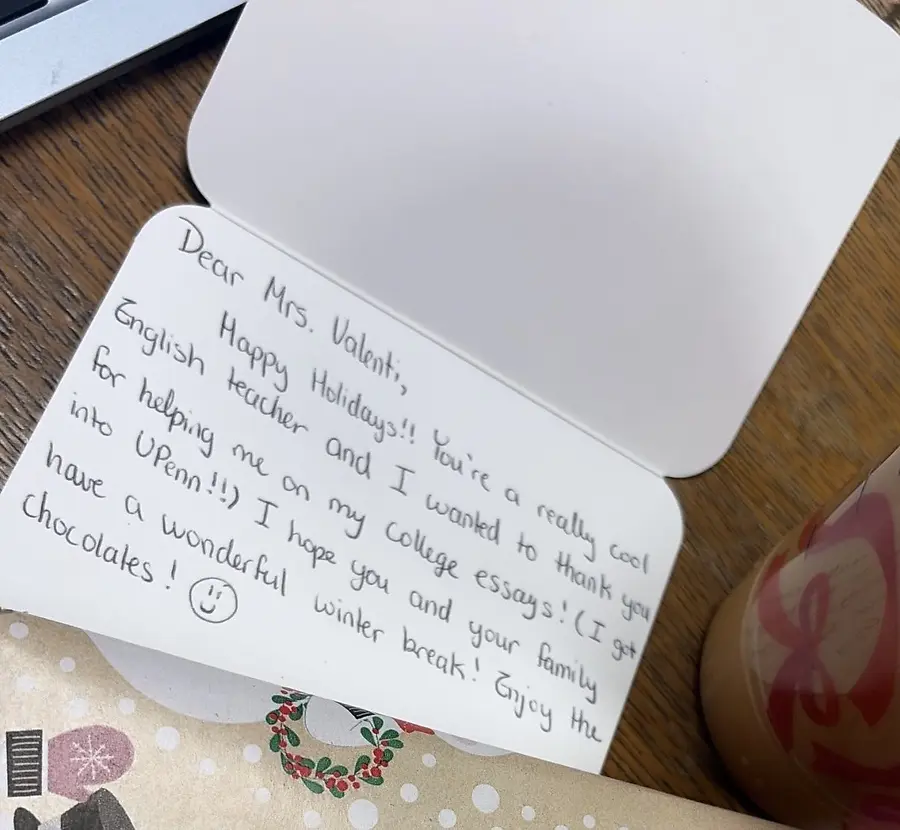
They look like acceptance letters. Dream schools. Scholarships. Students sprinting down the hall to find you because they need you to see their face when they read the words: “Congratulations.”
They look like the lit-up faces of students who realize their voices matter; especially when you’ve spent hours helping them shape an essay until it finally sounds like them. Not a generic perfect student. Not what they think colleges want. But who they truly are: story, scars, brilliance, and all. And when an institution says yes, part of that yes is because your feedback helped them be seen.
They look like students learning to trust you.
Students who used to avoid adults now knocking on your door because you became their person: the safe one, the steady one, the shoulder to cry on, the ear to vent to, the adult who doesn’t laugh, doesn’t dismiss, doesn’t label, and doesn’t disappear.
They look like growth you can’t measure on a rubric: the student who finally believes they’re smart, the student who stops pretending they don’t care, the student who reads something and says, “Wait… I actually get this.” The student who used to explode now taking a breath. The student who used to shut down now asking for help. The student who used to hate school now showing up because your room feels like belonging.
They look like laughter, real laughter, in the middle of a hard day. They look like inside jokes and “Good morning, Mrs. Valenti!” and the way your classroom becomes a small world where kids can breathe.
They look like watching students become who they’re meant to be, right in front of you.
And then, years later, they come back.
They tell you that you were the first teacher who believed in them.
The first adult who didn’t give up.
The first person who made them feel like they mattered.
And you realize: those invisible hours weren’t invisible at all. They landed somewhere. They became something.
Why I’ll Take the Challenges Any Day
I teach because I believe in the power of being the person who stays.
I teach because kids deserve classrooms where they are affirmed, valued, and challenged: where high expectations and love can coexist.
I teach because growth is sacred work, and I get to witness it every year.
Yes, it’s hard. Everyday hard. The kind of hard that asks you to dig deeper than you thought you could. The kind of hard that makes you question whether you have enough to give.
But the benefits, the real ones, are always worth it.
Because the hardest moments don’t define this job.
The faces do.
The breakthroughs do.
The trust does.
The graduations do.
The “I got in!” moments do.
The quiet “Thank you” moments do.
The lives that shift because someone showed up and meant it.
So I’ll take the challenges any day.
Because when a student learns to believe in themselves, when they feel seen, safe, and capable, there is nothing in the world that compares to being part of that.
That’s why I teach.