Invisible Wounds, Unequal Access:
How systemic inequality limits access to mental health treatment for America's most vulnerable populations.

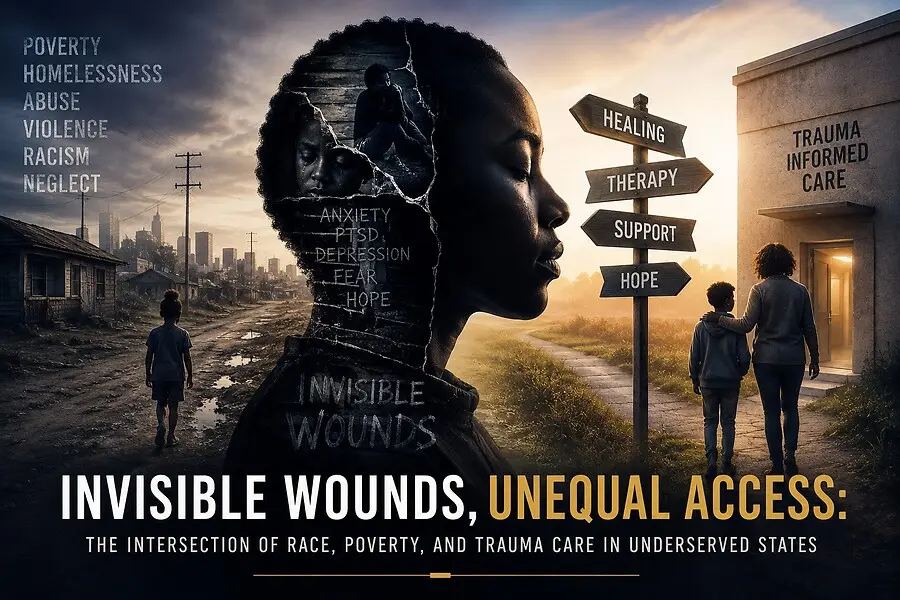
Trauma in America: A Public Health Crisis of Access and Inequality
Across America, trauma is not distributed equally. While traumatic experiences affect individuals from every social and economic background, the burden of chronic trauma falls disproportionately on communities experiencing poverty, racial inequity, housing instability, and limited access to healthcare. Yet the states with the highest rates of trauma exposure are often the same states with the fewest mental health professionals trained to treat it.
The result is a growing public health crisis: millions of Americans living with invisible wounds while lacking access to evidence-based trauma treatment.
Trauma Beyond the Individual
Trauma is often understood as a singular event—a violent assault, a natural disaster, or a serious accident. However, for many individuals living in America's poorest states, trauma is cumulative, chronic, and systemic.
Children raised in persistent poverty experience higher rates of food insecurity, neighborhood violence, parental incarceration, educational instability, and adverse childhood experiences (ACEs). Families experiencing homelessness face ongoing uncertainty, exposure to victimization, and chronic stress. Survivors of domestic violence, child abuse, neglect, community violence, racism, and discrimination frequently carry the psychological consequences long after the events themselves have ended.
Research consistently demonstrates that prolonged exposure to these conditions increases the risk of depression, anxiety disorders, substance use disorders, post-traumatic stress disorder (PTSD), chronic medical illness, and premature mortality.
For many residents of states such as Mississippi, Louisiana, New Mexico, Arkansas, West Virginia, Alabama, and Kentucky—states that consistently rank among the nation's poorest—the question is not whether trauma exists.
The question is whether qualified providers are available to address it.
The Mental Health Workforce Gap
America is experiencing a severe behavioral health workforce shortage. According to federal workforce estimates, more than one-third of Americans live in Mental Health Professional Shortage Areas.
In many of the nation's poorest states, the ratio of mental health providers to residents remains alarmingly inadequate. Numerous rural counties have no licensed mental health providers at all. Even in urban centers, clients often wait weeks or months for appointments.
The shortage becomes even more concerning when examining trauma-specific treatment.
Not all therapists are trained in evidence-based trauma interventions. Effective trauma treatment often requires specialized training in approaches such as:
- Trauma-Focused Cognitive Behavioral Therapy (TF-CBT)
- Eye Movement Desensitization and Reprocessing (EMDR)
- Dialectical Behavior Therapy (DBT)
- Cognitive Processing Therapy (CPT)
- Prolonged Exposure Therapy (PE)
While thousands of clinicians nationwide provide general counseling services, only a fraction have completed advanced certification or formal training in trauma-specific modalities.
Consequently, individuals with severe trauma histories may gain access to counseling but still remain unable to receive the specialized treatment necessary for recovery.
Medicaid, Medicare, and the Access Barrier
Insurance acceptance further complicates access.
The populations most likely to experience chronic trauma are often those most reliant on public insurance programs. Medicaid covers millions of low-income children, adults, and families. Medicare provides coverage for older adults and individuals with disabilities, many of whom have experienced lifelong trauma or complex health conditions.
Yet reimbursement rates in many states remain significantly lower than those offered by private insurers. As a result, many therapists choose not to accept Medicaid or Medicare.
Among those who do accept public insurance, fewer still offer specialized trauma treatment. The financial reality is difficult to ignore. Advanced training in EMDR, TF-CBT, and DBT requires substantial investments of time and money, while lower reimbursement rates create economic barriers for providers seeking additional certification.
The result is a paradox: the populations with the greatest need for trauma-informed care frequently have the fewest options for accessing it.
Race, Geography, and Structural Inequality
The consequences of this shortage are not experienced equally.
Communities of color, particularly Black, Indigenous, and rural populations, often face multiple barriers simultaneously:
- Higher exposure to community violence
- Historical and intergenerational trauma
- Limited transportation
- Fewer healthcare providers
- Higher rates of poverty
- Reduced access to specialty mental health care
Many Southern states carry a unique historical burden shaped by slavery, segregation, economic exploitation, and racialized healthcare disparities. These realities continue to influence contemporary health outcomes and access to treatment.
When trauma services are unavailable, untreated psychological injuries often manifest as school disciplinary problems, substance misuse, family instability, chronic health conditions, unemployment, homelessness, and involvement with the criminal justice system.
What appears to be an individual problem is frequently the predictable outcome of systemic neglect.
The Ethical Responsibility to Expand Access
Addressing trauma disparities requires more than awareness. It requires action.
Mental health professionals, policymakers, educators, healthcare systems, insurers, and community leaders share a collective responsibility to recognize where access gaps exist and why they persist.
This work demands courage.
It requires acknowledging that privilege often determines who receives timely, evidence-based treatment and who remains on waiting lists. It requires confronting reimbursement systems that discourage providers from serving vulnerable populations. It requires investing in rural communities that have historically been overlooked. And it requires expanding trauma-training opportunities for clinicians practicing in underserved regions.
The question is not whether America possesses the knowledge to treat trauma. Evidence-based interventions already exist.
The question is whether society possesses the moral will to make those treatments accessible to those who need them most.
Moving Forward
Expanding trauma care in America's poorest states will require targeted workforce development, increased Medicaid reimbursement, loan repayment incentives for behavioral health professionals, telehealth expansion, community-based partnerships, and greater investment in trauma-specific training programs.
Most importantly, it requires a shift in perspective.
Trauma should not be viewed solely as an individual clinical issue. It is a public health issue, an economic issue, a racial justice issue, and a moral issue.
Invisible wounds do not heal simply because they are unseen.
For millions of Americans living in poverty, homelessness, violence, and chronic adversity, access to trauma treatment can mean the difference between surviving and healing. The measure of our nation's commitment to mental health will ultimately be found not in the services available to the privileged, but in our willingness to extend healing to those who have historically been denied it.
The future of trauma care depends on whether we choose to recognize that healing itself is a matter of equity.


