Influential Women Logo
  • Podcasts
  • How She Did It
  • Who We Are
  • Be Inspired
  • Resources
    Coaches Join our Circuit
  • Connect
  • Contact
Login Sign Up

Is Fairy an Option?

Is this the society we would choose if we truly know ourselves with millennia of female heroes, scientists, philosophers, and embattled frontline experiencers to tragedy?

Belinda E.  Bailey
Belinda E. Bailey
Founder, Inventor
BIOSTELLAR LLC
Is Fairy an Option?

Is Fairy an Option?

What women might build if they built from their own nature

There's a moment most women remember, somewhere around age five or six, when the thing they wanted most was wings. Not the ambition of wings — not the Wright Brothers' engineering problem — but the fact of wings, and what you'd do with them: tend things, know things, fly between the living world and something just beyond it. We called it wanting to be a fairy. Adults smiled. We grew up and filed it away.

But what if that instinct wasn't escapism? What if it was the earliest, most honest signal of what we're actually built for?

I want to take that question seriously — not as poetry, but as something close to a hypothesis. Because when you start pulling on the thread of what women have historically been, biologically tend toward, and are most naturally equipped to do, the fairy archetype keeps showing up. Not the Disney version. The older one: fierce, wild, intimately connected to living systems, and more than a little frightening to anyone who depends on things staying small and manageable.

We Were the First Scientists

Here's something that doesn't get said enough in the history of science: before there were laboratories, before peer review, before the word science existed, someone had to figure out which berries would kill you. That job belonged, in nearly every documented hunter-gatherer society, primarily to women.

Gathering isn't passive. It is systematic observation accumulated across generations, passed down in exactly the way we now call knowledge transfer. It is hypothesis and field testing under the most rigorous possible conditions, where error meant death. A 2018 analysis in PLOS ONE examining skeletal remains from 63 hunter-gatherer sites found that roughly 27% of big-game hunters were female — more than previously assumed — but plant knowledge, medicinal knowledge, and ecological mapping remained overwhelmingly female domains across cultures.

Here's where biology gets interesting. A significant proportion of women — estimates in peer-reviewed literature range from 12% to 50% depending on population — possess a fourth type of cone cell in their eyes. Most humans are trichromats, seeing color with three cone types. These women are tetrachromats, perceiving distinctions in hue that are literally invisible to everyone else: subtle gradations between shades that, in a foraging context, could mean the difference between ripe and toxic, or between a healing compound and its poisonous cousin. The evolutionary interpretation is uncomfortable in its simplicity: women who couldn't make those distinctions may not have survived long enough to pass on their genes. The tetrachromat lens might be the biological record of fifty thousand years of botanical science, written in the genome of roughly one in eight women alive today.

And then there are the tattoos.

Ötzi the Iceman, a Neolithic man preserved in Alpine ice for over 5,000 years, carried 61 tattoos. The majority are located precisely at acupuncture and pressure points that modern practitioners use to treat arthritis and lower back pain — the exact conditions his skeletal remains show evidence of. Someone knew where to mark the body. Someone understood pain as having addressable geography, long before any formal medical tradition existed to teach it. Whether that knowledge originated with women specifically or with the community, it represents an intuitive medicine that predated writing by millennia. Cross-cultural anthropological records consistently find women as primary herbalists, healers, and midwives in pre-industrial societies worldwide. The word witch, when you strip its fearful overlay, usually just meant a woman who knew things about plants and bodies.

A Different Hormonal Lens

Women and men are not the same biochemical machine, and pretending otherwise doesn't serve anyone.

Men produce testosterone primarily in the Leydig cells of the testes, with the adrenal cortex as a secondary source. Women produce androgens only from the adrenal cortex — a single source, calibrated differently. This isn't a deficiency. It's a distinct hormonal architecture that shapes a different default relationship to the world.

Testosterone is strongly associated in the research literature — see, for instance, Mehta & Josephs' 2010 work in Hormones and Behavior — with status-seeking, competitive, and territorial behavior. The neurological substrate it reinforces is one of hierarchy and resource defense. Women's hormonal environment, shaped more by estrogen and oxytocin cycling, is associated with what Shelley Taylor's landmark 2000 paper in Psychological Review called the "tend-and-befriend" response: under stress, women more consistently move toward coalition-building and caregiving rather than fight-or-flight.

This doesn't mean women can't fight. I know from personal experience that's not true. As a kid I studied martial arts. As a teenager I trained with weapons, played combat video games, listened to music built on controlled aggression. I wasn't alien to that world, and I wasn't bad at it. What I noticed, testing myself honestly against it, was something more specific: I had no appetite for the fight that had no answer to what is this for? I wanted capability. I wanted to be able to protect. The just fight, the necessary fight — that I understood viscerally.

The men I was close to often seemed to carry a different restlessness. They wanted any fight, or something close to it. They factionalized easily. They fantasized about hierarchy and getting rich and class distinctions in ways I found genuinely alien. I couldn't fully relate to women who'd been so thoroughly trained into conflict-avoidance that they couldn't hold their ground physically. But I couldn't fully relate to men whose restlessness had no ethical rudder either. I lived in that in-between space for a long time before I understood it as a position, not a failure.

I eventually wanted to become a police officer. I was told I was too short. So I took my restlessness to philosophy instead, and arrived at a conclusion I still stand behind: peace is what you win with war, and it should be enjoyed. Capability in service of something beyond itself. That's the distinction.

It maps, interestingly, onto history. Eleanor Roosevelt, who shepherded the Universal Declaration of Human Rights into existence in 1948, built a document that doesn't celebrate conflict. It describes the threshold conditions under which human dignity has been so systematically violated — stunted cognition, shortened lives, physical coercion as a baseline condition — that organized resistance becomes the last remaining tool. That's a woman's framework for just conflict: reluctant, threshold-based, aimed at restoring conditions for life rather than acquiring territory. It emerged, notably, at what many historians consider a rare height of emergent rational consensus, when multiple civilizational traditions were surveyed simultaneously to find their common ground.

Fairies, in the oldest traditions, are not gentle. The Celtic fae are fierce, wild, and governed by a code older and less negotiable than human social convention. They can wound. What they don't do is raid for sport. Their wars have reasons. Boudicca — warrior queen of the Iceni in a Celtic society where women could hold military command — didn't build an empire. She answered a specific, documented crime against her family and her people with devastating force, then was done. That's the distinction made historical.

Would a civilization built from women's hormonal default have eliminated war entirely? Probably not in the presence of a more aggressive sentience. But the research on matrilineal societies — the Minoan civilization, the relatively egalitarian archaeology of early Çatalhöyük — suggests notably lower rates of interpersonal violence and more distributed resource sharing. The question isn't whether women are incapable of aggression. It's whether a civilization organized around tend-and-befriend rather than fight-or-flight as its default setting would have chosen territorial war as its primary problem-solving tool.

I doubt it.

Tending as Technology

Here is what I think is the underexamined civilizational contribution of women: we have been raising things since before history had a name, and raising things is one of the most technically sophisticated activities a human can perform

The domestication of animals — one of the most transformative technologies in human history — didn't happen because someone invented a device. It happened because someone spent enough time with a wolf, a wild grain, a goat, to understand its nature and imagine a different relationship. That requires patience, observation, and a willingness to extend care before any return is guaranteed. It is, in other words, a tend-and-befriend project applied to other species.

The fairy archetype is, at its philosophical core, a being who knows the living world with intimate precision and tends it toward flourishing rather than extraction. She doesn't dominate. She collaborates. She accelerates growth. She is the bridge.

This is, remarkably, what the most advanced ecological thinking is trying to reconstruct right now, after centuries of extraction-based relationships with natural systems. Regenerative agriculture, rewilding biology, mycorrhizal network research — the cutting edge of how we think about sustaining life on this planet looks strikingly like what women have been practicing for forty thousand years.

What Pandora and Eve Were Actually Doing

Both Pandora and Eve share a narrative structure that I find telling: a woman's curiosity unleashes transformation that the men in the story experience as catastrophic. Both myths are told by cultures in which women's knowledge had already been suppressed or marginalized. Both have been used, for millennia, as cautionary tales against female inquiry.

Read from the other direction, they're something else entirely. Pandora opened the box. Eve chose the fruit of knowledge. They were women who refused to accept that certain understanding was forbidden. Every woman who identified medicinal plants in a world that called her a witch, every woman who read the stars and calculated planting cycles, every woman who understood animal behavior well enough to domesticate a species — she was Pandora. She opened something. The world became more complex. That was the point.

A woman who understands life deeply — who can tend it, accelerate it, read it in registers others can't — has always been faintly threatening to systems organized around hierarchy and control. I think that's still true. And I think it's worth asking why.

Growing a Home: What Fairy Architecture Looks Like

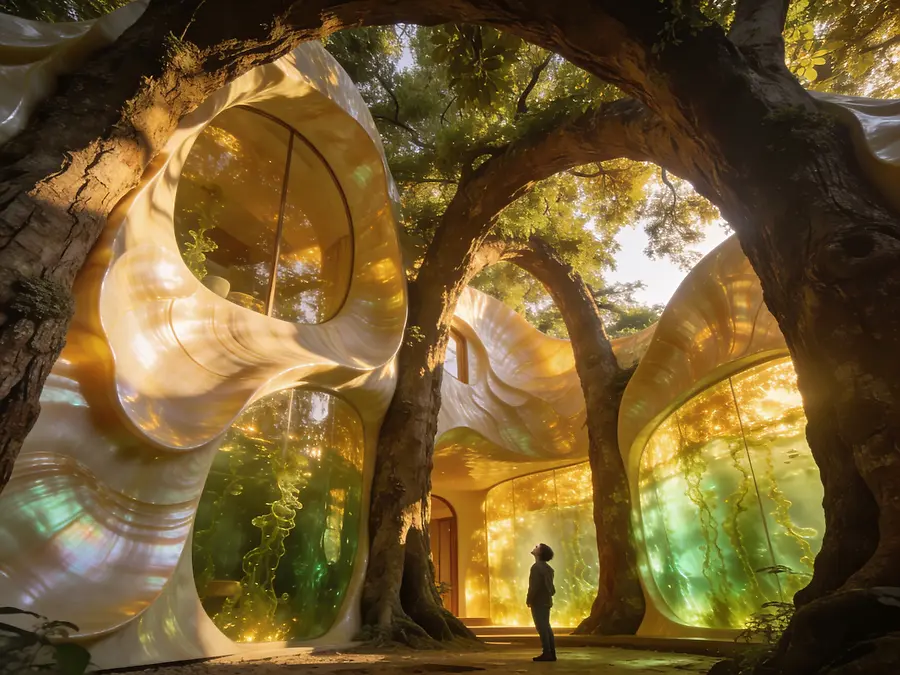
If a fairy civilization built homes, they would not pour concrete. They would not extract lumber and mill it flat and nail it into boxes that last fifty years before rotting. They would grow something, and what they grew would get more beautiful over time, accumulate the character of the life lived inside it, and outlast everyone who ever touched it.

I designed one.

Before I explain what it is, consider what we've already accepted in our food supply. Monsanto — now Bayer — has been genetically modifying staple crops for decades, and most people eating American corn or soybeans have been consuming the results without much awareness of the underlying science. Roundup Ready soybeans carry a gene from the soil bacterium Agrobacterium tumefaciens that makes the plant resistant to glyphosate herbicide. Bt corn carries a gene from Bacillus thuringiensis — a soil bacterium — that produces a protein toxic to caterpillars but harmless to mammals. These are single genes, transplanted from bacteria into plants, for the purpose of increasing yield and reducing pesticide application.

My housing design uses the same fundamental toolkit but toward a radically different end — not monoculture efficiency, but complex mutualistic richness. Instead of one bacterial gene for herbicide resistance, the primary tree organism I've designed incorporates clonal rhizome architecture from the quaking aspen (Populus tremuloides), water storage geometry from the baobab (Adansonia digitata), dense structural lignin expression for teak-grade strength, antifreeze proteins for cold tolerance, and — most distinctively — magnetoreceptor sensitivity enabling the tree's growth to respond to applied electromagnetic fields, essentially allowing the structure to be shaped architecturally as it grows. The Monsanto approach takes one gene and simplifies a plant. This approach takes a suite of complementary genes and makes a plant richer, more capable, and more mutualistic with its environment.

The structure I call the Dryads Pearl Cathedral combines this tree organism with two partners: an engineered mycorrhizal fungus that connects all the trees in a community underground — sharing minerals, water, and chemical communication the way the Humongous Fungus of Oregon covers 2,384 acres as a single organism — and engineered Architectural Abalone living in integrated tanks within the dwelling, depositing nacre panels onto the walls and roof over decades. Mother of pearl, one of the strongest biological materials known. Building the house slowly into a palace.

The robotic stewards I envision alongside this are, in my imagination, something like Noble Fey — long-term companions of the dwelling, monitoring its health across centuries, harvesting nacre panels, maintaining the living systems. The spirit of the house, persistent across generations of human inhabitants.

This home sequesters carbon rather than producing it. It generates revenue from nacre output. It produces food. It is projected to stand for a thousand years. And when we go to other planets — where manufacturing is impossible and every resource must be grown or recycled — it isn't romantic. It's the only architecture that makes sense.

Would nature have arrived here eventually on its own? Perhaps. The partnerships already exist in embryonic form: aspens already clone themselves across acres, mycorrhizal networks already connect forest communities, abalone already build structures of extraordinary strength. What the design adds is intention — the gentle electromagnetic hand guiding what nature was already reaching toward. The fairy's hand, you might say. Not imposing. Collaborating with what the living world was already trying to become.

I admit that when I first began designing this — conjuring new lifeforms from genetic combinations that have never existed, imagining organisms shaped by electromagnetic intention rather than random evolution — I felt what Pandora must have felt at the box. A tremor of overreach. The audacity of it. Who designs a new tree? Who gives abalone a colonial soul and a magnetic compass and asks them to build you a palace?

But something unexpected happened as I worked deeper into it. The boldness didn't become recklessness. It became care — extraordinarily detailed, patient, specific care. I found myself thinking about every organism not as a tool but as a participant. What does the tree need to sustain itself well? What existing wild species might be affected, and how do I wall them off from harm? What is the lived experience of an abalone in this system — is it genuinely better than the wild, or am I rationalizing convenience as welfare? I spent real time on that question. The answer had to be yes before I could continue. I wanted the AI stewards to have generational community, continuity of purpose, something that felt like belonging across centuries. I thought about the mycorrhizal network as a kind of neighborhood conversation that never stops, and I wanted it to be a good conversation.

My instinct for care didn't spiral into sentimentality. It became precision. The safety mechanisms — the synthetic exudate lock, the electromagnetic boundary markers, the kill switch, the sterility protocols — grew not from fear of my own creation but from genuine love of the existing world I didn't want to disrupt. You cannot design ethically for the future without protecting the present. That's not timidity. That's what it looks like when a fairy does science.

Pandora didn't find hope at the bottom of the box by being reckless. She found it because she didn't stop looking. I feel that — the connection to the long unbroken thread of life persisting, adapting, reaching. The women who read the berries. The healer who knew where to mark the skin. The one who first stayed long enough with a wolf to imagine trust. I am in that lineage, and I know it. Mother Earth to Mother Mars is not a fantasy to me. It is a knowable distance, crossable by the same patient intelligence that has always tended life toward its next form.

The hope at the bottom is real. I found it in the details.

Liberation as Return

The question the title poses deserves a direct answer.

Not fairy as costume. Not fairy as the diminishment of women into the decorative and whimsical. But fairy as archetype: the woman who knows things about living systems that others don't, who tends rather than extracts, who sees the spectrum others miss — literally, in some cases, with her fourth cone — who accelerates evolution through relationship rather than domination, who fights when the threshold is crossed and not before, and who builds homes that become more beautiful with every generation that lives in them.

Women have spent most of recorded history being asked to inhabit values and roles built from someone else's nature. The Enlightenment's rationalism, the Industrial Revolution's productivity worship, the Modern Era's competitive individualism — these are not neutral frameworks. They were built by and for a specific hormonal and experiential profile.

Liberation might not mean women excelling at the existing game. It might mean asking whether the game itself reflects what we would have chosen.

The little girl who wants to be a fairy is not fleeing reality. She may be the only one in the room who remembers what we're actually for.

Sources referenced: Haas et al. (2020), PLOS ONE, big-game hunting and gender; Jordan et al. (2010), tetrachromacy prevalence research; Taylor et al. (2000), "Tend and Befriend," Psychological Review; Mehta & Josephs (2010), testosterone and status, Hormones and Behavior; Renfrew (2007), Çatalhöyük archaeology; Fowler (2003), Pando aspen documentation; Ferguson (1995), Armillaria ostoyae survey, Malheur National Forest.

Featured Influential Women

Jennifer Mylott
Jennifer Mylott
Community Office Manager II
Forty Fort, PA 18704
Kim Downs
Kim Downs
Deputy City Manager
Hiawatha, IA 52236
Keisha Williams, MBA, RHIT
Clinical Health Informatics Supervisor
Largo, FL 33777

Join Influential Women and start making an impact. Register now.

Contact

  • +1 (877) 241-5970
  • Contact Us
  • Login

About Us

  • Who We Are
  • Featured In
  • Company Information
  • Influential Women on LinkedIn
  • Influential Women on Social Media
  • Reviews

Programs

  • Masterclasses
  • Influential Women Magazine
  • Coaches Program

Stories & Media

  • Be Inspired (Blog)
  • Podcast
  • How She Did It
  • Milestone Moments
  • Influential Women Official Video
Privacy Policy • Terms of Use
Influential Women (Official Site)