Joy as a Leadership Practice
A Liberatory Leadership Practice for Black Women Leaders

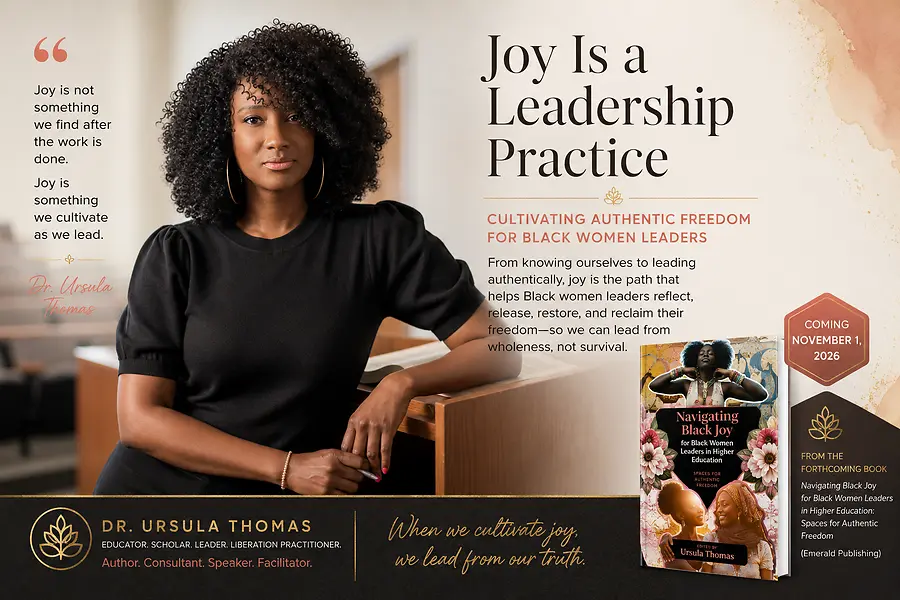
Cultivating Black Joy: Leadership Without Self-Abandonment
For Black women, leadership has too often been shaped by expectations to be resilient, dependable, self-sacrificing, and endlessly available. We learn to carry institutions, organizations, families, communities, and other people's expectations while postponing our own wholeness. But leadership should not require us to abandon ourselves in order to serve others.
My work with Black women and joy begins with a different premise:
Black joy is not an emotion to be pursued. Black joy is a liberatory leadership practice that grows from intentional roots and is cultivated through intentional practices.
Joy Is More Than a Feeling
I have come to understand joy as something much deeper than happiness or temporary pleasure. Joy is connected to how we know ourselves, how we care for ourselves, how we establish boundaries, how we release what no longer serves us, and how we choose to lead from a place of authenticity.
For Black women leaders, this distinction matters.
We can be successful and still be disconnected from ourselves. We can be accomplished and exhausted. We can be admired and depleted. We can occupy positions of influence while quietly giving away the very parts of ourselves that make leadership meaningful.
Cultivating joy asks us to interrupt that pattern.
It asks us to consider not simply, What am I accomplishing? but also, Who am I becoming while I accomplish it?
The Work of Cultivating Joy
The Black Women Joy Map™ emerged from my work to help Black women leaders move from simply surviving leadership demands to intentionally cultivating a life and leadership practice rooted in authentic freedom.
The framework is organized around four interconnected movements:
Reflect — I know myself.
Joy begins with knowing ourselves. Reflection creates space to examine our experiences, values, identities, desires, boundaries, and leadership practices. Before we can lead authentically, we must be willing to listen to ourselves.
Release — I free myself.
Not everything we have carried belongs to us. Release invites us to examine the expectations, relationships, narratives, obligations, and definitions of success that may have required us to abandon ourselves. Freedom sometimes begins with deciding what we will no longer carry.
Restore — I nurture myself.
Restoration challenges the idea that our value is measured by our productivity. We cannot continually pour from ourselves without creating intentional practices that replenish us. Restoration is not selfishness. It is stewardship of the self.
Reclaim — I lead authentically.
Reclamation is the movement from knowing and nurturing ourselves to leading from our own truth. It means refusing to separate who we are from how we lead. It means making room for a leadership presence that is whole, grounded, and authentic.
Together, these movements create a pathway toward leadership that does not require self-abandonment.
Joy Requires Intention
One of the most important lessons in my work is that joy does not simply happen.
We must cultivate it.
That cultivation can be as intentional as deciding what we will protect, what we will stop tolerating, what we will begin doing differently, and where we will seek support. It can mean creating boundaries around our time. It can mean saying no without explaining ourselves into exhaustion. It can mean recognizing when achievement has become another form of overextension.
Joy requires us to become active participants in our own lives.
For Black women leaders, this can be transformative because we are often conditioned to recognize everyone else's needs before our own. Cultivating joy invites us to reverse that pattern—not by caring less about others, but by refusing to disappear in the process of caring for them.
Leading From Joy
Leadership rooted in joy does not mean leadership without difficulty.
It does not mean ignoring injustice, avoiding hard conversations, or pretending that challenges do not exist. Instead, joy gives us another way to encounter the work.
When we know ourselves, we can lead with greater clarity.
When we release what is no longer ours to carry, we create capacity.
When we restore ourselves, we become more intentional about how we expend our energy.
When we reclaim our authenticity, we stop measuring leadership solely by what we produce and begin considering the quality of the life we are creating while we lead.
This is why I believe joy belongs in conversations about leadership.
Joy is not the opposite of serious leadership.
Joy can be the condition that allows us to lead without losing ourselves.
A Different Definition of Success
Perhaps the question Black women leaders need to ask is not simply, How successful can I become?
Perhaps we should also ask:
Can I become successful without abandoning myself?
Can I lead without constantly proving my worth?
Can I create boundaries and still be a good leader?
Can I experience pleasure, rest, connection, and freedom without feeling that I must earn them first?
Can my leadership be an expression of who I am rather than another performance of who others expect me to be?
These questions move us toward a different understanding of leadership—one in which achievement and authenticity can coexist.
Joy as Authentic Freedom
My work is ultimately about freedom.
Not freedom from responsibility, but freedom to lead without being imprisoned by expectations that require self-erasure.
For Black women, cultivating joy can become an intentional act of choosing ourselves while continuing to serve others. It is the courage to acknowledge that our lives matter beyond our productivity. It is the permission to experience joy before everything is perfect. It is the practice of creating space for ourselves in the very systems and spaces where we have spent so much time creating space for everyone else.
Joy, then, becomes more than something we feel.
It becomes something we practice.
Something we protect.
Something we cultivate.
Something we reclaim.
And perhaps most importantly, something we allow ourselves to experience without apology.
The Invitation
I invite Black women leaders to consider joy differently.
Do not wait until the promotion, the retirement, the finished project, the resolved conflict, or the next season of life to give yourself permission to experience joy.
Begin where you are.
Reflect on who you are.
Release what is no longer yours.
Restore what has been depleted.
Reclaim the freedom to lead as your authentic self.
Because leadership should not cost us our joy.
We deserve to lead—and to live—whole.
From the Author
This article reflects the ideas and framework developed in my forthcoming book, Navigating Black Joy for Black Women Leaders: Spaces for Authentic Freedom, forthcoming from Emerald Publishing in 2026. The Black Women Joy Map™ extends this body of work into an intentional framework for cultivating joy as a liberatory leadership practice.
Dr. Ursula Thomas is an educator, scholar, author, and leadership practitioner whose work centers Black women, education, leadership, equity, and authentic freedom.


