Law, Morality, and Queer Resistance in Hillsborough County (1989-1993)
Queer Citizenship and the Politics of Respectability in 1990s Florida

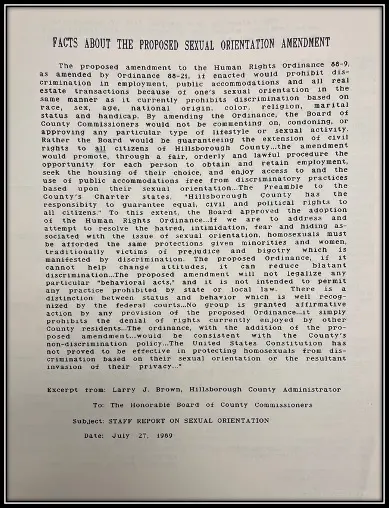
Between 1989 and 1993, Hillsborough County, Florida, became a charged arena in which competing visions of law, morality, and citizenship collided. The debate surrounding a proposed amendment to prohibit discrimination based on sexual orientation was not simply a local policy matter; it reflected broader national conflicts about the meaning of equality, sexuality, and respectability at the end of the twentieth century. In an era marked by the AIDS crisis, evangelical activism, and the mainstreaming of gay and lesbian identity, the struggle in Hillsborough reveals how law and moral discourse were used to determine who counted as a legitimate citizen and moral subject.
This essay examines how the rhetoric of law and morality shaped these debates and how queer activists responded through community organizing, education, and advocacy. I draw on the theories from E. Patrick Johnson’s (2001) Quare Studies and Eng, Muñoz, and Halberstam’s (2005) What’s Queer About Queer Studies Now? Using these sources, I analyze how race, class, and region informed both the exclusionary logic of anti-gay rhetoric and the inclusionary strategies of queer activists. While the inclusionary efforts of queer activists sometimes resulted in the forced assimilation of some queer people to the norms of dominant queer groups (i.e., white cis men or women), these frameworks reveal that the fight for LGBTQ+ rights in Hillsborough County was not simply a struggle for equality but also a negotiation of identity, belonging, and normativity. The Hillsborough County amendment debates reveal how the intertwined languages of law and morality were weaponized to define the boundaries of citizenship and moral worth. Activists’ responses to this weaponization exposed deep tensions between inclusion and exclusion within the queer movement itself: while they sought dignity and equality, they often did so through respectability politics that aligned queerness with heteronormative ideals. These dynamics demonstrate how, in the pursuit of legitimacy, queer movements in late-1980s Florida both challenged and reproduced the moral hierarchies they confronted.
Artifact 1: “Facts About the Proposed Sexual Orientation Amendment”
The archival document “Facts About the Proposed Sexual Orientation Amendment” presents itself as a neutral, bureaucratic artifact, yet it reveals the deeply negotiated terrain of LGBTQ+ rights within the institutional discourse of the late twentieth century. Written in the measured idiom of public policy, the text frames the proposed amendment to Hillsborough County’s Human Rights Ordinance as an administrative extension of existing civil rights, not as a moral or social endorsement. Its language works meticulously to separate “status” from “behavior,” echoing legal precedents that distinguish sexual orientation as an identity rather than an act. This rhetorical maneuver seeks to reassure a skeptical public that the amendment would not “condone any particular type of lifestyle,” while simultaneously asserting equality as a civic obligation. The document’s invocation of the county charter and the U.S. Constitution anchors its argument in the language of democracy and fairness. Yet its repeated disclaimers—insisting that no “behavioral acts” are legalized and no “affirmative action” is granted—expose the anxieties surrounding moral legitimacy and social inclusion. Through this cautious balancing of inclusion and disavowal, the artifact embodies the paradox of liberal reform in the 1990s: it advances recognition through legal neutrality while inadvertently reinforcing the hierarchies it aims to dismantle.
From the perspective of Quare Theory, as articulated by Johnson (2001), the “Facts About the Proposed Sexual Orientation Amendment” reveals how legal language that appears neutral often conceals racialized and classed power dynamics. Johnson critiques mainstream queer theory for centering white, middle-class, urban gay and lesbian identities while neglecting the embodied realities of queer people of color, the working class, and those outside metropolitan contexts. His call for a “theory in the flesh” demands that we read sexuality as intertwined with lived, material conditions: race, geography, economics, and community.
The Hillsborough amendment’s bureaucratic idiom of fairness and equality, while progressive on the surface, primarily reflected the perspectives of those already legible to institutions: white, middle-class professionals who could present themselves as “respectable” citizens. Its rhetoric of neutrality—emphasizing that the ordinance did not “condone any particular lifestyle”—functioned as a gatekeeping mechanism, drawing boundaries around who could be recognized as deserving of rights. Through a Quare lens, the amendment’s inclusivity is thus partial: it affirms those whose identities fit within normative expectations of professionalism and morality while erasing the more marginalized queer subjects whose experiences of discrimination were compounded by race, class, and gender. In this way, the artifact exemplifies how even well-intentioned equality measures can reproduce systems of exclusion under the guise of universality.
Building on the framework of homonormativity, Eng, Muñoz, and Halberstam (2005) describe the rise of queer liberalism—a political formation through which LGBTQ+ inclusion is achieved not by challenging dominant norms, but by aligning with them. The “Facts About the Proposed Sexual Orientation Amendment” operates squarely within this logic. Its assurances that the amendment “will not legalize any behavioral acts” and “grants no affirmative action” reveal a strategic effort to depoliticize queer identity. By framing equality in terms of civic respectability, professionalism, and moral restraint, the document constructs an image of the “good gay citizen” as law-abiding, productive, and non-disruptive. This rhetoric embodies what Eng, Muñoz, and Halberstam identify as the neoliberal containment of queer politics, where inclusion depends on conformity to heteronormative standards rather than the transformation of those standards. The amendment’s appeal to neutrality and fairness masks the ideological work of assimilation, making queerness safe for public consumption by stripping it of its radical potential. In doing so, it reaffirms existing hierarchies of race, class, and gender while granting limited access to those who best perform normative citizenship. The Hillsborough case thus illustrates how legal equality can coexist with social regulation, transforming queer liberation into a politics of respectability and compliance.
Yet the amendment’s very existence also marked a crucial moment of visibility and contestation. In Johnson’s (2001) framework, “quare” is not only about critique but also about embodied survival—a way of naming, acting, and imagining from within one’s marginalized position. The introduction of the Proposed Sexual Orientation Amendment into Hillsborough County’s public discourse represented a collective act of quare resistance, asserting the presence of queer life in a political and cultural landscape that sought to erase it. Even though the language of the amendment was restrained—carefully framed within bureaucratic neutrality and moral defensiveness—it nonetheless carved out a space for queer subjectivity within the civic realm. Its existence in the public record challenged the invisibility that often shrouded local LGBTQ+ experiences, bringing private struggles for dignity into the sphere of law and governance. This moment of visibility, though limited, underscores what Johnson describes as the tension between recognition and resistance. The amendment’s attempt to institutionalize equality was necessarily constrained by the moral and political climate of its time, yet its emergence testified to the resilience of queer communities navigating systems of exclusion. The very act of drafting, debating, and defending this amendment reflected an insistence on belonging—a refusal to remain silent or hidden despite the risks of backlash. In this sense, the artifact captures not only the politics of respectability embedded in early LGBTQ+ rights efforts but also the radical persistence of quare survival: the will to exist, to be seen, and to claim space in the face of erasure. Its limitations do not diminish its significance; rather, they illuminate the ongoing struggle to transform visibility into liberation and recognition into genuine equality.
Artifact 2: “We Can Win” Flyer
The “We Can Win” flyer captures the emotional and political urgency of queer activism in Hillsborough County during a period when public acknowledgment of LGBTQ+ existence was itself a form of resistance. Produced by grassroots organizers in support of the Proposed Sexual Orientation Amendment, the flyer radiates optimism while appealing to civic duty and democratic participation. Its declarative slogan, “We Can Win,” is both an affirmation and a provocation—an insistence that queer citizens belong within the moral and political fabric of the county. The flyer’s visual and textual rhetoric blends moral appeal with hope, situating the queer community not as outsiders demanding special rights but as rightful participants in the public sphere who seek fairness, dignity, and recognition. Although the flyer does not specify which individuals or groups composed its activist base, the tone and framing suggest a coalition oriented around respectability, moderation, and civic engagement—qualities designed to resonate with both queer and non-queer audiences in a politically conservative region.
When read through Quare Theory, as developed by E. Patrick Johnson (2001), the “We Can Win” flyer emerges as a layered performance of regional and intersectional queer identity. Johnson’s framework insists that “quare” acknowledges not just sexuality but also how race, class, geography, and culture intersect to shape lived experience. The Southern context of Hillsborough County adds a unique inflection to the artifact: queerness in the South has historically been mediated by religious discourse, communal ethics, and the necessity of cautious visibility. The flyer’s civic optimism—its language of faith, hope, and perseverance—thus reflects a specifically Southern idiom of resistance, one that negotiates moral respectability while quietly affirming difference. Even if the text does not explicitly invoke race or class, a Quare reading invites us to consider how Black, Latinx, and working-class queer voices might have been present yet unacknowledged within the flyer’s collective “we.” Their experiences, often shaped by double or triple marginalization, reveal the limits of universalist rhetoric in representing the full spectrum of queer life.


