Leadership Ages Like Fine Wine
Exploring how leaders develop through experience, relationships, and the responsibility to invest in others.

Leadership Ages Like Fine Wine
A Three-Part Series on People, Purpose, and the Responsibility to Lead
By Melissa Rodriguez
I've come to believe that leadership ages like fine wine.
Not simply because both take time, but because time alone is never enough.
Great wine is shaped by its ingredients, its environment, and the conditions in which it matures. Leadership is much the same. We are shaped by the people who believe in us, the ones who challenge us, the successes that build confidence, and the failures that humble us.
All of it goes into the barrel.
For more than two decades, I've had the privilege of leading across business, nonprofit, volunteer, and community settings. And if those years have taught me anything, it's that there is no final vintage.
We are always becoming.
This series is about that journey: the ingredients that shape us, the experiences that refine us, and ultimately what we choose to pour into others.
Because leadership isn't about being the most important person in the room.
It's about seeing the people in the room.
Part One: The Ingredients That Shape a Leader
Are leaders born, or do they become?
I believe some people are born with qualities that lend themselves to leadership—confidence, empathy, vision, courage.
But those qualities don't make someone a leader.
Leaders become.
One of my earliest lessons in becoming one came during my career at Claim Jumper Restaurant.
I was the youngest manager the company had promoted and only ten months out of management training when I was handpicked for the opening leadership team of the company's new flagship restaurant at South Coast Plaza.
I was responsible for the entire front of the house.
It was an incredible opportunity—and I felt enormous pressure to prove I deserved it.
So I tried to know everything.
I studied harder. Worked longer. Tried to control every detail.
And in trying so hard not to let anyone down, I nearly missed the most important ingredient:
The people standing right in front of me.
I had an incredibly talented leadership team, many of whom had helped train me. They had experience and strengths I didn't have.
I didn't need to know more than they did.
I needed to trust them.
Once I did, everything changed.
I set clear expectations and accountability but gave them room to lead. They developed the people around them, and together we built a front-of-house team that set a new standard for service.
But they weren't the only ones developing.
I was, too.
They taught me that leadership isn't about having every answer. It's about creating the conditions for other people to succeed.
They also taught me something I still carry today:
People don't need perfect leaders. They need present ones.
There were times I didn't know the answer. I learned there was strength in admitting that. My team knew I cared, that I would listen, and that even when expectations were high, I had their best interests at heart.
That created trust.
And sometimes the most powerful thing a leader can give another person is simply:
I trust you.
More than two decades later, I'm still learning. Still aging. Still becoming.
So, are leaders born, or do they become?
I believe we may be born with some of the ingredients.
But experience, relationships, mistakes, trust, pressure, humility, and time begin working on them.
All of it goes into the barrel.
And eventually, we become.
Part Two: The Aging Process — The Title Doesn't Make the Leader
Does a title make someone a leader?
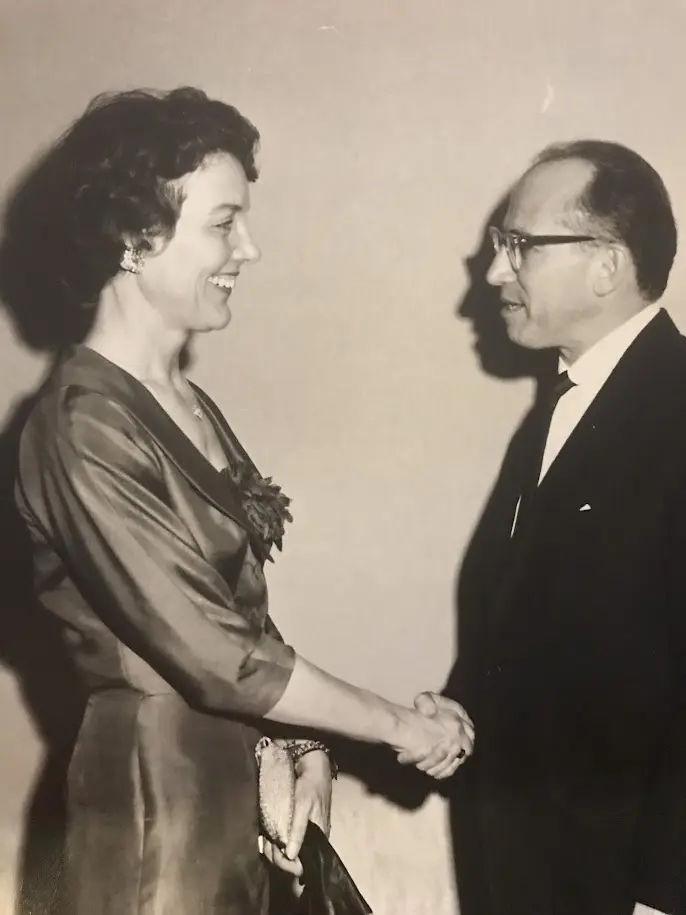
For much of my life, when I pictured a leader, I pictured my grandmother, Dorothy Sutherland.
As a child, her world seemed larger than life. There were photographs with President Franklin D. Roosevelt, a personalized letter from President Ronald Reagan, and dinners where senators, generals, and community leaders sat around her table.
I was in awe of her.
But her leadership story didn't begin in those rooms.
And it didn't begin with the title Executive Director.
It began with service.
My grandmother survived polio early in her life, an experience that helped shape the direction of her life.
In 1938, President Franklin D. Roosevelt founded the National Foundation for Infantile Paralysis, later known as the March of Dimes. It grew into a grassroots movement powered by ordinary people and volunteers raising money—often one dime at a time—to fight polio and fund research.
That national history became part of my grandmother's personal story.
Our family history includes her meeting and working with President Roosevelt as her involvement with the organization grew.
But she didn't begin beside presidents or scientists.
She began as a volunteer, collecting dimes.
Volunteer became employee.
Employee became leader.
And eventually, leader became Executive Director for the March of Dimes.
As a child, I saw the finished product.
I saw the Executive Director. The confidence. The relationships. The important people around her table.
I didn't see the years of collecting dimes that came before the title.
I didn't understand the obstacles she had overcome, particularly as a woman building a career and earning her place in leadership during a very different era.
It wasn't until I became a leader myself that I understood what I had been looking at all those years.
The title came later. The leadership came first.
Like wine aging in a barrel, her leadership had been refined long before Executive Director appeared beside her name.
Polio gave her purpose. Service taught her humility. Obstacles strengthened her. Relationships expanded her influence.
Experience refined her.
As a child, I noticed the important people in the room. As a leader today, I notice how she built the room.
A title can give us authority, responsibility, or a seat at the table.
But it cannot make people trust us.
It cannot make people respect us.
And it cannot make people willingly follow us.
Those things have to be earned.
Today, I don't see Executive Director first.
I see the woman who survived polio.
I see the volunteer collecting dimes.
I see the journey.
And now I understand:
The title didn't make her a leader. The journey did.
Sometimes we don't realize someone taught us how to lead until it is finally our turn to do it.
Part Three: What We Pour Into Others
What happens when leadership stops being about us?
Eventually, the question changes.
It is no longer:
How do I become a leader?
Or even:
How do I become a better one?
It becomes:
Who is better because I was trusted to lead?
For me, that is where leadership becomes service.
And nowhere have I understood that more deeply than through a little green truck and a ministry my father began more than two decades ago.
In 1999, my father, Richard Rodriguez, saw families in the Oak View community struggling to put food on their tables.
So, with one little green truck, a servant's heart, and a joyful yes, he began rescuing food and bringing it to families who needed it.
There was no title.
No organizational chart.
Just a need—and someone willing to serve.
Friday after Friday, that little green truck returned.
Over time, it became something more.
It became a signal that food was coming. That someone remembered. That someone cared.
That little green truck became a symbol of hope.
When my father passed away in 2018, the Rodriguez family, the Labonte family, and an extraordinary group of volunteers stepped forward to make sure his work continued.
Somewhere in that transition, I found myself entrusted with helping lead what my father had started.
At first, I thought my responsibility was to protect his legacy.
Eventually, I understood something bigger:
My responsibility wasn't simply to preserve what he built. It was to create space for others to build upon it.
And I've had the privilege of watching that happen.
I've watched people who once hesitated to step forward become the people others now look to for direction.
I've watched volunteers stop waiting to be told what to do and begin seeing what needs to be done.
I've watched people teach what someone once taught them.
And I've watched young people discover that their voice matters because someone trusted them enough to use it.
Rain or shine, they show up every Friday because the community is counting on them.
Somewhere in those ordinary Fridays, something extraordinary happened:
They became leaders.
Not because I gave them a title.
Because they were trusted.
That changed the way I measure my own leadership.
Earlier in my career, I looked at what I accomplished.
Today, I look at who is growing around me.
Because one of the greatest measures of a leader isn't how much people need us.
It's what people become because we believed in them.
That is what people-first leadership means to me.
Results matter. Expectations matter. Accountability matters.
But so do the people carrying the work.
They need to know:
I am seen.
I am valued.
I am heard.
Sometimes leadership means giving direction. Sometimes it means accountability.
And sometimes it means simply saying:
I trust you.
Then having enough confidence to step aside.
When I look at our ministry today, I still see my father's little green truck.
But I also see what came from it.
A team. A community. New leaders. People serving people.
My grandmother poured something into me.
My father poured something into me.
And now it's my turn.
Because perhaps that is what leadership was always supposed to become.
We may be born with the ingredients.
The journey refines us into leaders.
But what we pour into others becomes our legacy.
Leadership ages like fine wine.
And eventually, what life has poured into us is meant to be poured into others.
About the Author
Melissa Rodriguez is a people-first leader with more than two decades of experience leading teams across business, nonprofit, volunteer, and community settings. Her leadership philosophy centers on trust, service, developing others, and creating environments where people know they are seen, valued, and heard.


