Medicine Wheel
Ancient Wisdom: The Blackfeet Medicine Wheel and Cosmic Knowledge

Chapter Eleven
Medicine Wheel
Long Time Pipe Woman and Pretty Wolverine Woman, along with their husbands, Chief Shot Both Sides and Sixapo, spent their leisure time telling stories of their ancestors, past experiences, philosophies, and Napi stories through oral tradition. There was no electricity on the reserve for television or radios. At that time, there were no cars; people traveled by horse and wagon. It was a hard life in many ways, but also a pristine one that supported enlightenment.
There were certain ancient ceremonies to which many were not privy, other than invited guests of the honored Chief or members of the sacred societies. Long Time Pipe Woman was witnessed by select family members as a medicine woman performing healing rituals that would astound even the most mystical thinkers of modern times. Young people learned the customs and beliefs of the Blackfeet people as part of their daily education.
After Ba-Ti-Ga-Sa-Pi learned to speak English, Chief Shot Both Sides depended on him to translate important government matters. He read and discussed letters and acted as a translator during meetings with Canadian government representatives. Through these sacred individuals—the Chief and the Medicine Woman, beloved elders of the Kainai—he learned the ways of personal power and loyalty to his people.
In the early 1950s, the Chief asked his great-grandson to accompany a group of anthropologists and archaeologists as a guide to explore parts of the Kainai Reserve. The professionals pledged not to disturb anything and made an agreement with Chief Shot Both Sides to report back any discoveries.
The great-grandson relaxed in the shade of a tree and watched the anthropologists crawl around on their hands and knees with small scoops, brooms, and magnifying glasses, searching for evidence of a sacred monument. He shook his head and laughed at the sight; they looked somewhat ridiculous to him.
However, his attitude changed when he observed their unbridled excitement upon discovering parts of a medicine wheel. Curious, he joined the group, and they explained what they believed they had found.
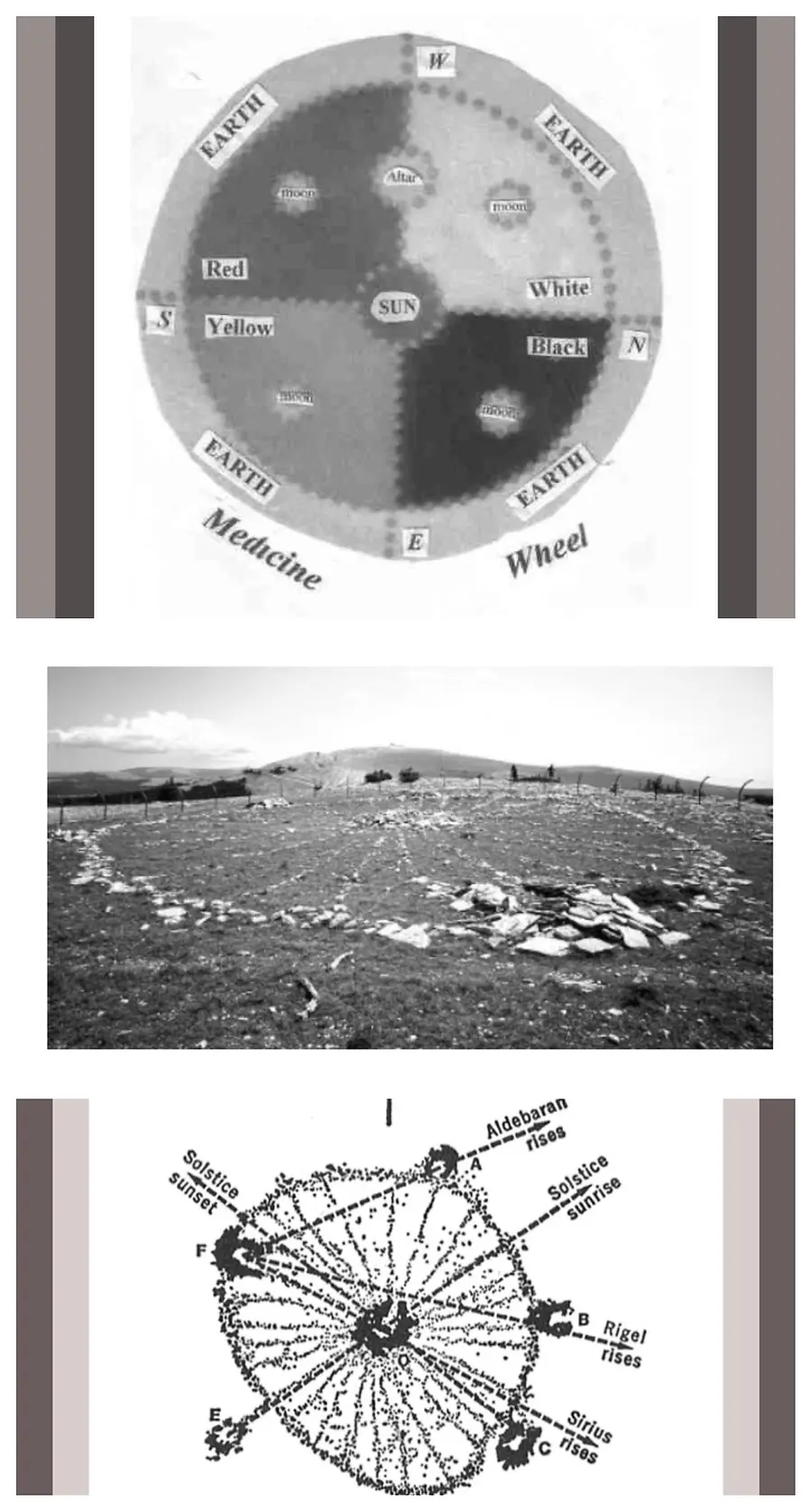
The Many Spotted Horses Medicine Wheel lies along the northeastern portion of the reserve. It is marked by four spokes extending from an inner circle to an outer circle of rocks. The pie-shaped sections of the circle appear to represent the four phases of the moon. They also signify the four seasons, and the spokes point precisely to the four cardinal directions.
Each evening, after a day spent with the archaeologists and anthropologists, he would bring sketches of their discoveries home to the elders. The Chief and his wife would describe exactly what the findings represented and explain some of their significance. The following morning, the professionals eagerly awaited news from their translator regarding the elders’ insights. This became a significant enterprise and stimulated worldwide fascination with the medicine wheel.
Afterward, Ba-Ti-Ga-Sa-Pi worked alongside them on hands and knees, exploring and documenting the ancient wheel with great vigor, tracking the days—most often thirty in total. There were twelve sticks, one for each month, with every third stick marked by an extra ring, providing an exact count of 364 nights in a year.
The Blackfeet traditionally counted nights rather than days, which accounts for the difference between their system and the Caucasian calendar. Even more remarkable was the fact that every fourth year, the twelfth stick had an additional ring added to designate leap year. Another feature was a long piece of rawhide attached to a stick, stretched from the center to the outer ring and moved each night to monitor the sunrise. A rock marked the shadow of the rawhide strip, signifying that it took ninety days for the sun to rise in the southeast rather than due east. Smaller pegs were secured in the ground to mark actual seasonal changes. Days were not discussed in the language; instead, time was measured in moons or nights.
The inner core of circular rocks represented the sun, while the outer circle signified the earth. Blackfeet spirituality considered the sun the maker of the entire universe. The earth was viewed as the mother who nurtured and protected all life. The sky was regarded as the father who provided air to breathe. Water spirits gave sustenance and messages of mystical phenomena. All plant and animal life was honored, as they too provided humanity with life force.
The seasons were referred to by names different from those used today. January was called Eating Stored Provisions Time. It was the immobile month due to intense cold, during which clan members shared provisions. February was Eagle Time, as eagles began migrating back to the area. March was Duck Time, marked by the return of ducks. April was Frog Time, when snow melted and frogs emerged from winter shelters. May through September was known as Blossom Time. October through April was called Unpredictable Time because weather conditions could vary drastically.
Guided by the findings of anthropologists and archaeologists, astronomers grew increasingly interested in the many medicine wheels found throughout Alberta. The more they studied these wheels, the more they uncovered remarkable evidence that ancient Indigenous peoples possessed a far greater understanding of the cosmos than previously believed.
Without a written language, the ancients became experts at preserving and transmitting knowledge through wisdom keepers. Medicine pipe holders developed highly trained memories and precise methods for tracking the sun, moon, stars, and planets.
They were taught “sky marks” and celestial patterns and used medicine wheels to track these movements with rawhide strips and stones. Further investigation proved that the line through the hub aligns with the summer solstice sunrise. The probability of this being a chance occurrence is estimated at one in four thousand, validating the expertise of the water pipe holders.
In 1975, the National Geographic Society funded a group of researchers, including Dick Forbis of the University of Calgary and Tom and Alice Kehoe of the University of Wisconsin, to further study medicine wheels. The Moose Mountain Wheel in southeastern Alberta was particularly well preserved and extensively studied. It contained directional elements similar to many other medicine wheels.
The Moose Mountain Wheel indicates that the cairn at the end of Spoke E aligns with the summer solstice sunrise. Cairn F serves as a star sight for Aldebaran and Rigel, both dawn-rising stars. These alignments are believed to have occurred between 200 B.C. and 100 A.D., making this wheel over two thousand years old.
Further excavation by the Kehoes of a portion of the central cairn revealed a stone base built on land previously cleared by fire. This discovery allowed for radiocarbon dating, which astonishingly suggested a date of over twenty-six thousand years ago.
A large proportion of the oldest medicine wheels are located in Alberta. This indicates that water pipe holders were making these sophisticated observations thousands of years ago, perhaps even longer. It may be reasoned that, because other medicine wheels are younger, Aboriginal astronomy may have originated in Alberta and spread to neighboring tribes through apprentices who carried the knowledge back to their own lands.
The Kainai ancestors also possessed highly sophisticated knowledge of the night sky. Long Time Pipe Woman always instructed relatives to create a stone circle around the tipi used during travel and summer Sun Dances. This indicated that a medicine bundle holder, pipe carrier, or Chief had dwelled there temporarily. No one was permitted to enter that sacred space for four years.
Inside the larger circle surrounding the tipi was a smaller circle encircling the fire at the center of the lodge. To the west of the outer circle, another small circle surrounded the altar. There, sacred bundles, pipes, sweetgrass or sage receptacles, and other sacred objects were housed. After the lodge was removed, the resulting stone circles closely resembled a medicine wheel.
Long Time Pipe Woman instructed tribal members, especially youth, daily in ancestral wisdom. She had traveled with the buffalo and witnessed both their destruction and the damaging effects of whiskey traders and other disheartening societal changes. She understood that many of her people would eventually forget their culture, traditions, and empowering spiritual practices. She was determined that her great-grandson would retain these “secrets” so that one day he could remind the people of who they truly were, enabling them to rise once more from a position of knowledge and power.
“Sometimes I dream of my grandmother, still instructing me in the ancient ways,” Ba-Ti-Ga-Sa-Pi revealed before joining them in the Big Sand Hills. “It is as if she is still urging me to speak out and remind our people who they truly are. Now that I am considered an elder, I feel an urgency to return this knowledge to my people—to open their eyes and encourage them to look up to the great Sun above. I see my people’s power beginning to emerge once again. In the sunlight, they blossom and grow, returning to their strength as a great people.”


