Modernizing Legacy Systems Without Breaking Culture
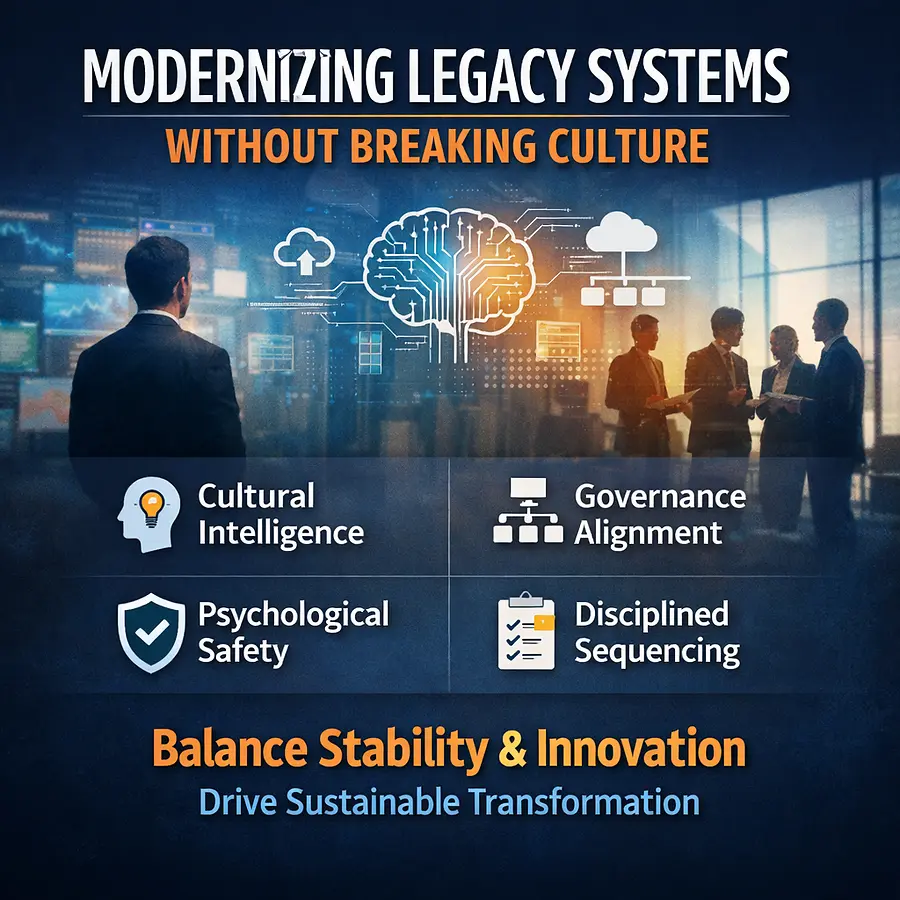
Modernizing legacy systems takes more than architecture strategy. It requires cultural intelligence, governance alignment, psychological safety, and disciplined sequencing. Directors who balance stability with innovation drive sustainable, enterprise-wide

In large enterprises, legacy systems are rarely just technical debt.
They are emotional infrastructure.
They carry:
- Institutional survival stories
- Audit history
- Late-night production recoveries
- Promotions earned by keeping them alive
When modernization fails, it is rarely because of bad technology.
It fails because culture was treated as collateral damage.
For Director-level leaders — especially those operating in regulated or enterprise-scale environments — modernization is an exercise in systems thinking, political awareness, and emotional intelligence.
Let’s go deeper.
1. Understand What the Legacy System Protects
Legacy platforms often protect three things:
A. Stability
For operations teams, legacy equals predictability.
Predictability equals job security.
When a system has “never failed an audit,” that becomes cultural armor.
B. Expertise Hierarchy
Certain individuals hold power because they understand the old system deeply.
Modernization can feel like a threat to their value.
If those individuals feel displaced, resistance becomes strategic.
C. Identity
Many organizations define themselves by the systems they built:
- “We built this from scratch.”
- “Our workflows are custom.”
- “No one else operates like we do.”
When you modernize, you are not replacing software.
You are re-negotiating power structures.
Director Insight:
Before you present a roadmap, identify whose identity is tied to the current state. Engage them early. Give them ownership in the future-state design.
2. Diagnose Cultural Risk Before Technical Risk
Technical assessments measure:
- Architecture gaps
- Integration limitations
- Security posture
But cultural risk is harder to quantify — and more dangerous.
Ask:
- Has the organization experienced failed transformations before?
- Are teams fatigued from constant change?
- Is leadership unified — or fragmented?
- Are incentives aligned with modernization outcomes?
In heavily governed sectors (federal healthcare, fintech, regulated industries), compliance culture often outranks innovation culture.
That means:
- Change must feel controlled.
- Governance must evolve alongside architecture.
- Communication must be deliberate, not aspirational.
Directors who ignore cultural temperature create silent resistance.
Directors who map it create strategic advantage.
3. Sequence Change Strategically — Not Emotionally
Many modernization efforts are triggered by frustration:
- “This system is outdated.”
- “We need cloud now.”
- “We are behind competitors.”
Emotional urgency leads to reckless sequencing.
Instead, Director-level modernization should follow a structured arc:
Phase 1: Stabilize
Clean up technical debt that creates noise.
Build confidence before disruption.
Phase 2: Pilot with Influencers
Choose early adopters with influence — not just technical skill.
If respected operators support the shift, culture follows.
Phase 3: Parallel Run
Run legacy and modern systems simultaneously where feasible.
This reduces fear and builds comparative trust.
Phase 4: Controlled Decommission
Celebrate retirement of legacy systems.
Honor their contribution publicly.
Modernization should feel ceremonial — not surgical.
4. Redefine Organizational Identity with Precision
Culture is narrative-driven.
If modernization messaging is:
“We are outdated.”
You will create defensiveness.
If messaging is:
“We are evolving to protect our future.”
You create alignment.
Strong Directors reposition modernization as:
- Risk mitigation
- Operational resilience
- Talent attraction
- Strategic enablement
You are not changing who the organization is.
You are expanding what it can become.
Language matters.
Tone matters.
Public recognition matters.
5. Upgrade Governance Alongside Architecture
Modern platforms introduce:
- API ecosystems
- Cloud-native flexibility
- AI-enabled automation
- Continuous delivery models
But if governance remains:
- Committee-heavy
- Approval-layered
- Politically fragmented
You create operational friction.
Modernization requires governance redesign:
- Clear product ownership
- Defined decision rights
- Accelerated approval loops
- Transparent escalation paths
Directors must bridge compliance and agility.
In enterprise settings, this balance determines success.
6. Protect Psychological Safety During Disruption
Transformation anxiety manifests in subtle ways:
- Increased scrutiny
- Defensive meetings
- Passive delays
- Elevated defect sensitivity
Teams are not resisting technology.
They are protecting themselves.
Director responsibilities include:
- Over-communicating change timelines
- Providing reskilling pathways
- Ensuring no team feels disposable
- Creating forums for dissent
Psychological safety reduces shadow resistance.
When people feel included, adoption accelerates.
7. The Financial and Talent Implications
Modernization impacts more than operations.
Financial Impacts
- Short-term cost spikes
- Licensing overlaps
- Training investments
- Vendor negotiations
Without executive sponsorship, funding volatility can destabilize progress.
Talent Impacts
High-performing engineers want modern stacks.
Institutional experts want stability.
If modernization is chaotic, you lose both.
Directors must:
- Retain institutional knowledge
- Attract forward-looking talent
- Build mentorship bridges between the two
Culture becomes the competitive differentiator.
8. What Happens When Culture Is Ignored
When culture is sidelined, modernization results in:
- Executive blame cycles
- Team attrition
- Adoption delays
- Governance bottlenecks
- Shadow systems created outside formal architecture
You may technically “launch.”
But operational trust erodes.
In enterprise transformation, trust is currency.
Once depleted, recovery is slow.
9. The Director as Cultural Architect
At Director level, you are no longer a delivery manager.
You are:
- A political navigator
- A systems thinker
- A risk balancer
- A cultural architect
You must hold two truths simultaneously:
- Legacy systems cannot sustain future scale.
- Legacy culture deserves respect.
Your role is to integrate past strength with future capability.
Because modernization is not about replacing history.
It is about honoring it — while building what comes next.