THE IDENTITY GOVERNANCE TRIBUNE
Why most organizations' identity governance programs aren't ready for the AI era—and how to fix them before auditors find out.

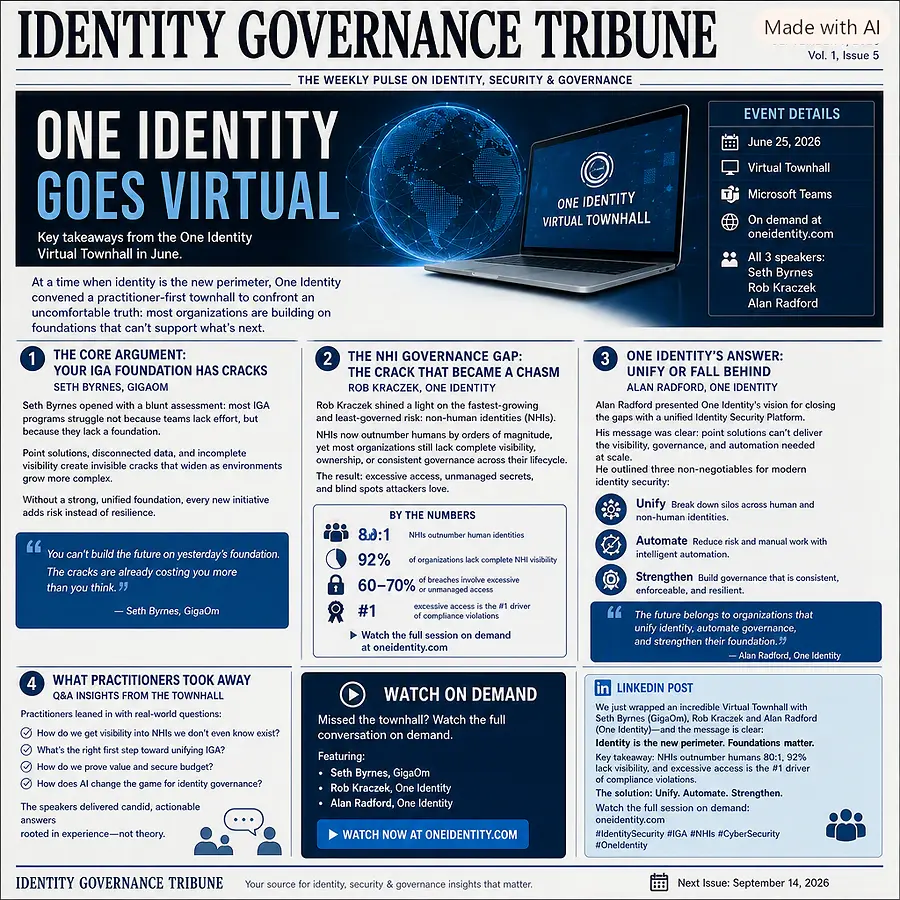
Event Details
EVENT: Identity Governance & Compliance Readiness: Building the Foundation That Holds
FORMAT: Virtual Town Hall — Microsoft Teams
DATE: June 25, 2026 | Now available on demand at oneidentity.com
SPEAKERS:
- Seth Byrnes — Research Director, GigaOm
- Rob Kraczek — Senior Principal Product Manager, One Identity
- Alan Radford — Global IAM Strategist, One Identity
When One Identity hosted its virtual town hall on June 25, 2026, the title was carefully chosen: Identity Governance & Compliance Readiness: Building the Foundation That Holds. In a market flooded with agentic AI announcements, NHI vendor maps, and billion-dollar acquisitions, the event took a deliberately practitioner-first stance, asking not what the industry is building, but whether the foundation on which most organizations stand is strong enough to support what comes next. The answer from all three speakers was consistent, candid, and uncomfortable: for most organizations, it is not.
The Core Argument: Your IGA Foundation Has Cracks
GigaOm Research Director Seth Byrnes opened with a framing that set the tone for the entire session: organizations are not failing at identity governance because they lack tools. They are failing because they built their IGA programs on assumptions that no longer hold and have been patching the cracks ever since rather than addressing the foundation itself.
Byrnes walked through GigaOm's research findings on where IAM programs most commonly fall short: fragmented identity data across disconnected systems, access certification campaigns completed on paper but not enforced in practice, and lifecycle management workflows designed for a world in which every identity had an HR record, a manager, and a fixed set of entitlements. That world, Byrnes argued, no longer exists.
"Organizations are not failing at identity governance because they lack tools. They are failing because they built their IGA programs on assumptions that no longer hold—and have been patching the cracks ever since." — Seth Byrnes, Research Director, GigaOm
The NHI Governance Gap: The Crack That Became a Chasm
Rob Kraczek, Senior Principal Product Manager at One Identity, made the foundation metaphor concrete. The fastest-growing source of structural risk in IGA programs today, Kraczek argued, is not a misconfigured access policy or a missed certification. It is the non-human identity.
Service accounts, API keys, OAuth tokens, RPA bots, and now AI agents: these identities already outnumber human identities in most enterprise environments by a ratio of 80:1, and most of them exist entirely outside the IGA lifecycle. They were provisioned without an owner. They have never been certified. They have no offboarding trigger. And when the project that spun them up is deprecated, they frequently persist indefinitely with full access and no accountability.
Kraczek was direct: IGA programs that will hold up under the next wave of compliance scrutiny—SOX, SOC 2, ISO 27001, and NIST AI RMF—are those that treat non-human identities as first-class governance objects today, not after the next audit finding forces the conversation.
By the Numbers
- 80:1 — Non-human-to-human identity ratio in the average enterprise
- 92% — Security teams that are not confident legacy IAM covers NHI and AI agent risks
- 60–70% — Enterprise applications still ungoverned by IGA programs
- #1 — Compliance readiness: the top driver of IGA modernization investment in 2026
- June 25, 2026 — Live event date | Now available on demand at oneidentity.com
One Identity's Answer: Unify or Fall Behind
Alan Radford, One Identity's Global IAM Strategist, used the session's second half to walk through what a repaired, future-ready foundation looks like in practice. His argument centered on unification: the era of separate tools for IGA, PAM, Active Directory management, and access management is ending. Organizations that continue operating siloed programs will find it increasingly difficult to demonstrate compliance, respond to audit findings, or govern identities that move across all those domains simultaneously.
Radford identified three capabilities he described as non-negotiable for any IGA program that expects to hold up in the agentic AI era:
1. Unified Identity Data: A single, correlated view of every identity—human and non-human—across every system. No blind spots. No manual reconciliation. No orphaned accounts living outside the governance perimeter.
2. Continuous Lifecycle Management: Not quarterly certification campaigns driven by a calendar, but event-driven governance that responds in real time to changes in access, role, and risk posture. When an AI agent's underlying workload is deprecated, its credentials and access are retired automatically—not six months later at the next review.
3. Compliance-Ready Reporting: Audit evidence generated automatically as a byproduct of governance activity, not assembled manually in the weeks before an audit. Regulators are increasingly expecting continuous evidence, not point-in-time snapshots.
"The organizations that will hold up in the agentic AI era are not the ones with the most tools—they are the ones with the fewest gaps." — Alan Radford, Global IAM Strategist, One Identity
What Practitioners Took Away
The Q&A portion of the session surfaced a theme that runs through every IGA conversation right now: practitioners are not struggling to understand the problem. They are struggling to build a business case for fixing a foundation that, on paper, still passes its audits.
The panel's answer was consistent: the business case is being built for you by regulators, auditors, and the AI agents now being deployed without governance controls in environments that were never designed to handle them. The question is not whether the foundation will be tested. It is whether your organization gets to fix it on its own terms or on someone else's timeline.
The session is available on demand at oneidentity.com and is recommended viewing for any IGA practitioner preparing for a 2026 program review, compliance audit, or budget conversation about IGA modernization.
📺 Watch On Demand
Identity Governance & Compliance Readiness: Building the Foundation That Holds
Available at: oneidentity.com
Runtime: 60 minutes | Format: Microsoft Teams town hall recording
Speakers: Seth Byrnes (GigaOm) · Rob Kraczek (One Identity) · Alan Radford (One Identity)

Carol Griffin is a technology, security, and telecommunications leader with more than two decades of experience guiding large‑scale infrastructure, identity, and cloud modernization programs. She is the Founder of ROSE Tech Academy LLC, a Microsoft Security Advisor in the Microsoft Community’s private NDA program, and a Technical Thought Speaker with the Microsoft Speakers Hub. Carol spent 25 years at AT&T,…