Our Ancestors Didn't Call It Autism or ADHD. They Called It a Gift.
How two opposing neurological operating systems under one roof became our family's blueprint for coexistence.
When my son sat down for his formal developmental assessment, I watched the evaluator work through a standardized form, pen moving from box to box. Eye contact? Present. Polite
compliance? Checked. Conversational tracking? Normal.
Each checkmark landed like a small verdict. At the end of the session, the clinician delivered the final
one, a diagnosis that felt more like a riddle than an answer: my son showed “many traits” of a person
on the autism spectrum, but he was not clinically autistic. I would hear those words again. Sitting through my own adult assessment, I received almost exactly the same verdict. We had the footprints, the system told us. We just weren't standing in the room.
As a Black mother raising children in a society still fractured by racial bias, I understood immediately
what the clinical eye had missed. Many of the tools used to identify neurodivergence today were
shaped by research centered largely on white, middle-class boys. They measure what a person shows on the outside, the visible behaviors and deficits, rather than how a mind actually processes the world on the inside. And they rarely account for the layered reality of growing up Black in America. Families like mine fall straight through that gap and land in a frustrating diagnostic gray zone: too many traits to dismiss, too much composure to confirm. But where the medical establishment sees a deficit or a confusing borderline case, I see something older, deeper, and far more powerful. I see an inheritance. The autism and ADHD that run quietly, and often undiagnosed, through our family are not tragedies to be managed. They are specialized operating systems, passed down through generations and finely tuned by ancestors who needed every ounce of focus, vigilance, and invention to survive, then to create, and then to transcend.
Our ancestors didn't call it autism or ADHD. They had other words for the child who noticed everything, the elder who could fix anything, the cousin who couldn't sit still but could talk a whole room into motion. Often, they simply called it a gift.
The Double Mask
To understand why the system so often misreads Black families, you have to understand the scripts so
many of us are raised on.
Mainstream assessments treat steady eye contact and social compliance as signs of a neurotypical brain. If a person holds your gaze, answers politely, and follows the conversation, assessors often conclude that they can't be autistic and can't be struggling with executive function.
What those assessors don't see is that in a racially charged society, protective parenting isn't a style. It's a survival mandate. From the time my sons were small, I deliberately trained them to over-index on eye contact, to hold absolute composure, and to follow careful verbal scripts with anyone in authority. We do not have the luxury of letting a meltdown, a burst of hyperactive energy, or a moment of sensory overload be misread by a hostile world as defiance, aggression, or a conduct disorder. For our children,
being misread can cost far more than a grade. So we wear what I call a double mask. The first hides our neurodivergent traits so we can function in a neurotypical world. The second hides our natural expressions so we can stay safe in a racialized one.
We monitor our body language and our tone with near-mathematical precision. When an assessor looked at my son and saw a perfectly compliant young
man, they weren't looking at a neurotypical brain. They were looking at a masterclass in survival-driven adaptation, one I had taught him myself.
A Clash of Titans
Understanding your own wiring doesn't make the road smooth. For many years, our home moved to a
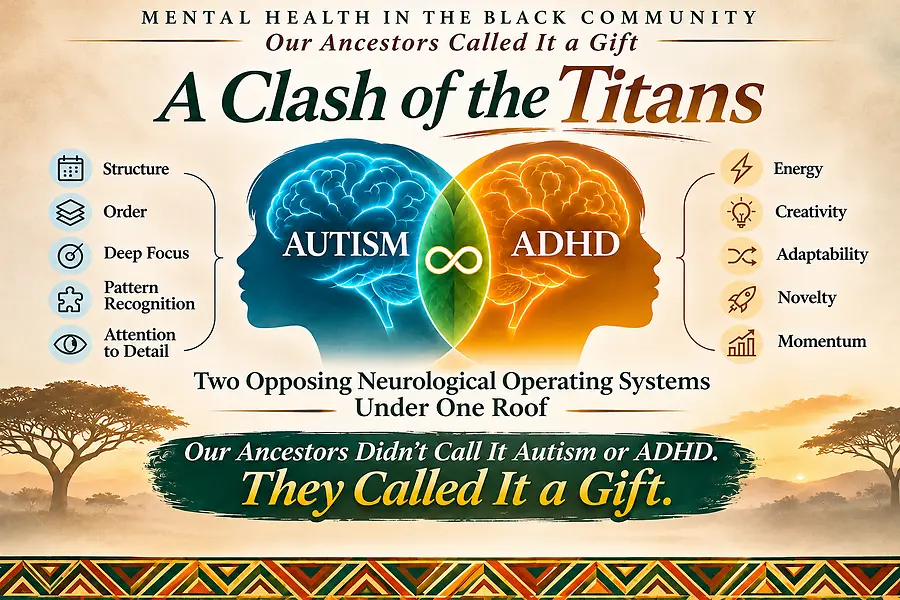
quiet, predictable rhythm, an autistic rhythm built on order, containment, and low sensory input. That predictability was how we felt safe. But life asks us to grow, and real advocacy is forged in real complexity. Years ago, I chose to build a life with a man who lives with severe ADHD, as does his daughter, who is now eleven. What followed was nothing short of a clash of titans. Autism craves predictability, quiet, and structure to keep sensory overload at bay. ADHD is wired the opposite way. Because the ADHD brain often struggles to regulate dopamine, the chemical messenger tied to motivation and reward, it goes looking for stimulation: novelty, movement, variety, and spontaneous change are how it finds focus. Put those two operating systems under one roof and the ground shifts beneath everyone. In our house, one person's way of coping became the very thing that set off another person's panic. The strain broke along different lines for each of my twin sons, proof that even within the same family and the same genes, neurodivergence carries pressure in its own way.
Around sixteen, the upheaval became too much for one of my twins, who lives with a learning
disability and mental illness. Without the quiet predictability his nervous system depended on, the
constant change wore him down until he could no longer hold steady. Today, to protect his stability and his peace, he lives in a structured group home. His twin brother took a different path. He found ways to cope, to adapt, and eventually to flourish in the middle of the chaos. He turned the challenge into a stepping stone and became a gifted scholar.
Today he lives in our old family home with roommates, balancing college and a life of his own.
Separate Roofs, a Front-Row Seat
To protect everyone's peace, our family made an agonizing but necessary decision: we would
decentralize, at least for now. Today we live across separate households. I live with my fiancé and his young daughter, and together we do the daily, unglamorous work of learning each other's minds. Living where autism and ADHD meet takes a real toll. For the autistic mind, a chaotic environment can trigger constant hyper-vigilance. A messy room, a missed time, or a sudden change of plans can register in the body as a genuine threat, and over time that becomes exhaustion and burnout. For the ADHD mind, an autistic partner's need for quiet and firm structure can feel like rejection, stirring up shame,
a sense of confinement, and anxiety. Left unaddressed, that mismatch can convince an entire family that it is permanently failing. We refuse to let that be our story.
In our household, we have a front-row seat to cracking the code of neurodivergent coexistence. The
real world isn't made of tidy, uniform environments. It's made of messy, beautiful, conflicting
differences. More families than we realize are quietly drowning behind closed doors because they
believe love alone should make it seamless. But love without strategy is just sentiment. We are proving that our differences are not a deficit. They are our edge, the reason we are learning to survive, stay prepared, and build the tools to thrive in an unpredictable world.
Our Blueprint
Along the way, we learned that peace doesn't come from trying to fix anyone's wiring. It comes from
designing our environment around it and learning to translate for one another. Here is what works for
us.
Environmental Zoning
We stopped expecting one house to serve one kind of brain and set clear, non-negotiable zones.
“Low-stimulus sanctuaries,
” supported by tools like noise-canceling headphones, are
spaces where noise, clutter, and unannounced entry are off-limits, so an autistic nervous system can
finally drop its guard. At the same time, we protect “high-stimulus zones” where the ADHD nervous
system is free to play music, move around, and leave creative projects out in the open without masking.
Parallel Play
We let go of the idea that connection means doing the same thing, the same way, at the
same time. We can share a room while running on completely different tracks. My fiancé or his
daughter may be juggling three things at once while my scholar son or I are locked into one deep,
linear focus. We share space and love without demanding that anyone's brain conform.
Visual, Transparent Systems
To bridge the autistic need for routine and the ADHD struggle with
time blindness, we moved our schedules out of our heads and onto shared tools: digital calendars and color-coded whiteboards. When a plan changes, it changes visibly and in advance. That gives the autistic brain time to process the shift, and gives the ADHD brain a flexible framework without
nagging or the feeling of being controlled.
Radical Neuro-translation
We built a family language that separates intent from neurological
friction. When an ADHD family member leaves a cabinet open or switches tasks abruptly, the autistic family member translates it not as disrespect but as a dopamine-seeking brain at work. When an autistic family member shuts down or needs to be alone, the ADHD family member translates it not as
rejection but as sensory saturation.
Claiming Our Own Answers
Practicing these methods at home is building something in us that many households never have to
develop: adaptability, resilience, and real problem-solving under pressure. Our home has become a
training ground for a world full of people whose minds work differently from our own.
My scholar son is learning to hold his focus amid real-world noise, practice that will help protect him
from burnout in the workplace. Our daughter is learning structure and the value of deep focus by
watching the autistic members of our family, turning her rapid-fire creativity into organized,
executable skill. Together we are a multidisciplinary team, systematizers and innovators in one alliance. Our dynamic is our superpower because it trains us, every single day, to coexist with,
understand, and lead people whose brains work in opposition to our own. We cannot wait for a flawed and culturally biased system to catch up to our reality or hand us a neat prescription for running our homes. Waiting for that validation means letting our families break under struggles no one has bothered to name. True equity in neurodivergent care will not arrive until we openly challenge two things: the Eurocentric baselines of mental health, and the idealized, neurotypical myth of the perfect nuclear family. So to my fellow Black parents navigating complicated, many-layered households: your family is not
broken. You are solving a profound neurological puzzle in a world that never handed you the instructions.
Trust your intuition over a biased test. Protect your family's peace at all costs, even if it means rewriting what a traditional household looks like. And know that your unconventional journey is a
testament to resilience. Our brains are different and our homes are complex, but we are carrying
forward a legacy of visionaries, system-builders, and adaptive creators who have always used their gifts to reshape, survive, and master the world. Our ancestors may not have called it autism or ADHD. But they knew a gift when they saw one.
◆ ◆ ◆
Tuesday Michelle Brown is a Baltimore-based mother, entrepreneur, and human services professional who spent nearly two decades working in DC government programs that serve families. She writes about
neurodivergence, family, and wellness in the Black community.
Contact: tuebrown@yahoo.com
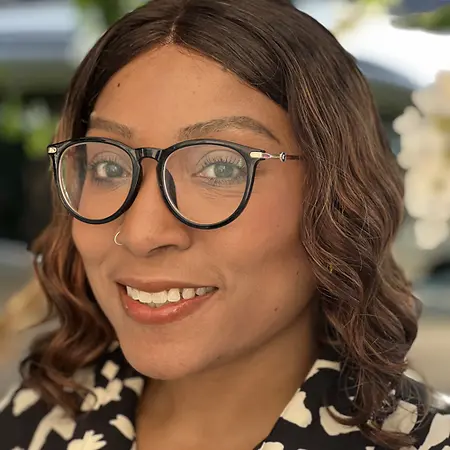
Tuesday Michelle Brown is the Founder and CEO of Fitox LLC, and Co-Founder of Combined LLC a Baltimore-based wellness company specializing in functional nutrition and cold-pressed beverages. Since 2020, Brown has combined entrepreneurship with workforce development, creating innovative wellness programs and educational initiatives. As a Management Analyst with DC Department of Health Care Finance since 2013, she…