Out of the Box Hiring: Why Your Next Best Employee Is Hiding Behind a “Wrong” Resume
Why Your Hiring Practices May Be Broken, Not Your Talent Pool

"We Just Can't Find Good People Anymore"
If I had a dollar for every time I heard a brilliant business owner, executive, or HR director repeat that phrase over coffee, I'd be retired on a beach somewhere.
The hiring market feels impossible right now. It's a bizarre paradox: candidates look absolutely flawless on paper but show up on day one with zero real-world motivation. Or worse, they interview like absolute rockstars, mastering all the right buzzwords, only to completely fail to live up to that persona once they're actually on the clock.
But as leaders, we have to stop pointing fingers at the market and ask ourselves a tough, objective question:
Are we actually experiencing a talent shortage, or are our hiring practices broken?
The reality is that we have outsourced our intuition to technology. In a world dominated by automated job sites, applicant tracking systems, and seven-second résumé scans, we've stopped reading between the lines.
We program search engines to look for pristine corporate pedigrees, specific degrees, and exact keyword matches. In doing so, we build a digital wall that weeds out the very high-grit performers our businesses desperately need to survive.
We're optimizing for people who are good at writing résumés rather than people who are good at doing the work.
Let me give you a perfect example from the culinary world—an industry notorious for high turnover and intense frontline pressure.
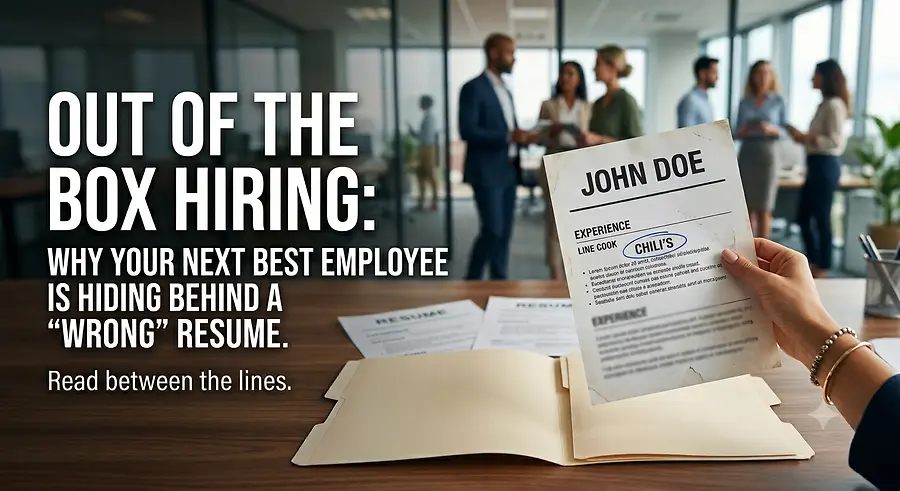
A seasoned operator I know manages a high-end restaurant with an incredibly talented, tight-knit kitchen staff. Recently, an applicant submitted a résumé for a line cook position. The culinary team took one look at her application, saw years of experience at a large corporate chain, and immediately wanted to pass.
They judged the pedigree.
They assumed a mainstream, high-volume chain background wouldn't translate well to their upscale, scratch-cooking environment. They wanted a candidate from a boutique culinary school or another high-end competitor.
But this operator saw things differently.
He bypassed the team's initial bias, looked past the corporate logo on the résumé, and brought her in for a trial anyway.
The result?
A few weeks later, that same skeptical kitchen staff was pulling him aside to say:
"Oh my gosh, she is phenomenal. We're so glad she's here."
Why?
Because what the team missed during their seven-second résumé scan was the hidden training.
A cook coming from a high-volume corporate operation already knows how to handle immense pressure. They know how to work within strict execution frameworks. They manage incredible speed, understand the importance of standard operating procedures (SOPs), and show up consistently because corporate environments don't tolerate no-shows.
She already had the grit, the muscle memory, and the stamina. She simply needed the right leadership and a new environment to let her shine.
The "200-Resume" Trap
Now, I can already hear hiring teams and HR managers pushing back:
"Mindee, you don't understand. We get 200 applications for a single open position. If we don't put up these automated digital guardrails, we'll spend all day reading résumés and making phone calls."
I hear you.
The sheer volume is real, and time is your most valuable asset.
But let's look at the actual math of your workday.
When you rely on automated filters to slash that stack of 200 applications down to 10, you're letting a machine select the 10 best writers, not the 10 best workers.
You then spend hours coordinating schedules, conducting interviews, onboarding a candidate, and—far too often—watching them walk out the door or fail to deliver three months later because they lacked the execution grit the role required.
Then you get to reset the clock and do it all over again.
Those automated guardrails aren't actually saving you time; they're simply delaying the pain.
You're trading a few hours of strategic, human-centered screening upfront for weeks of operational headaches later.
The goal isn't to make fewer calls.
The goal is to make the right calls.
When you rely solely on algorithms to screen candidates, you miss the diamond in the rough. You miss the person who has the character but lacks the "perfect" background.
If you want to stop the hiring cycle from repeating itself and find people who genuinely represent themselves with integrity on the job, you have to change how you read the paper.
Here's how to start reading between the lines:
1. Hire for Grit, Not Just Pedigree
Stop looking for pristine, linear career paths.
Look for experience in high-volume environments, long tenures in notoriously demanding industries (such as hospitality, retail, or frontline skilled trades), and nontraditional career journeys.
Someone who stayed in a demanding role for three years has likely developed a level of resilience that a job-hopper with a prestigious degree may never have had to test.
Grit scales.
A résumé doesn't.
2. Filter for Consistency, Not Keywords
Since you can't call all 200 applicants, change what you're scanning for.
Stop hunting for industry buzzwords that perfectly match your job description.
Instead, do a rapid visual scan for tenure, loyalty, and evidence of perseverance.
If someone spent three years managing chaos in a high-volume retail or hospitality environment, they've already demonstrated a strong work ethic.
Give that person the five-minute phone screen over the candidate with the flawlessly optimized LinkedIn profile.
A brief conversation will tell you more about someone's energy, motivation, and authenticity than any software program ever could.
3. Test Execution, Not Interview Skills
If you want to know whether someone will accurately represent themselves on the job, stop asking standard behavioral interview questions.
They've already Googled the answers.
Instead, put them in a realistic scenario during the interview process.
Ask them to draft a response to a difficult client, walk through a live technical problem, or shadow a team member for an hour.
Observe how they naturally communicate, adapt, and solve problems under a reasonable amount of pressure.
The talent your business needs is absolutely out there.
They just don't always fit neatly into the polished corporate boxes the modern hiring system prefers.
Stop skimming the surface of applications.
Trust your instincts.
Look for the hidden operators.
Your next rockstar may be hiding behind a corporate chain label.