
Rewriting Your DNA
From Inherited Trauma to Conscious Healing: A Neuroscientific and Psychological Guide to Breaking Generational Cycles

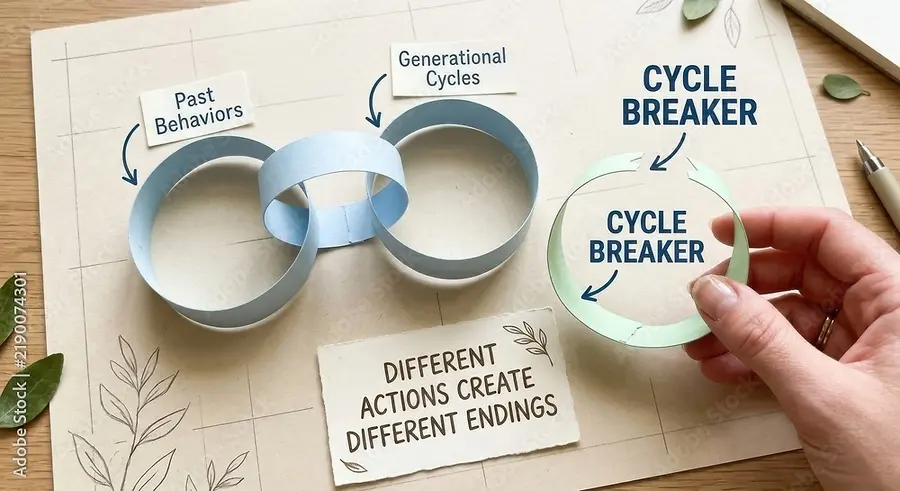
I. The Anatomy of Generational Trauma: Epigenetics, Transmission, and the Invisible Legacy
Every human being enters the world carrying not only a unique genetic code but also an invisible emotional and psychological inheritance. For generations, behavioral patterns, emotional dysregulation, and survival tactics have been passed down through families like heirlooms. We often refer to these entrenched, destructive cycles as generational curses. However, through the lens of modern clinical psychology and neuroscience, these are not mystical afflictions or moral failings. They are learned patterns of survival, adaptive responses to chronic stress, and, in some cases, biologically altered stress-response systems.
To understand how to break a generational curse, we must first map out how it is constructed and transmitted across decades. Transmission occurs through three primary mechanisms: biological (epigenetics), behavioral (modeling and socialization), and environmental (family systems and socioeconomic stress).
Epigenetics reveals that our environment and lived experiences can alter how our genes are expressed without changing the underlying DNA sequence. Seminal studies on trauma survivors and their descendants demonstrate that extreme chronic stress can leave chemical tags on DNA, predisposing subsequent generations to heightened anxiety, hypervigilance, and exaggerated physiological responses to stress. When a grandparent or parent lives through war, extreme poverty, domestic violence, or severe systemic oppression, their nervous system adapts to survive. They pass down a hyperreactive amygdala-the brain's alarm system-to children who may grow up in entirely safe environments, yet whose bodies behave as though they are under constant threat.
Behaviorally, children learn how to navigate the world by observing their primary caregivers. If a parent copes with anger by exploding into rage or withdrawing into the silent treatment, the developing child internalizes these strategies as standard human behavior. The child's neuroplasticity-the brain's ability to reorganize itself by forming new neural connections-molds around the trauma response of the household. Over time, these repeated relational dynamics solidify into deeply entrenched neural pathways, making familiar dysfunction feel comfortable, predictable, and safe, even when it is actively harmful.
II. The Psychological Function of Dysfunctional Beliefs as Childhood Trauma Coping Mechanisms
A cornerstone of breaking generational patterns is shifting how we judge our own past behaviors and those of our ancestors. We often label toxic family behaviors-such as emotional coldness, overcontrol, gaslighting, perfectionism, or codependency-as pure malice. While some behaviors cause profound harm, clinical psychology asks a deeper, more compassionate question: What function did this behavior serve?
In the context of developmental trauma, almost every dysfunctional belief and behavioral pattern started as a brilliant, life-saving coping mechanism. For a child growing up in an unpredictable, emotionally volatile, or abusive environment, the developing psyche must find a way to maintain attachment to the caregiver while managing overwhelming terror or pain. Because a child cannot safely confront a threatening caregiver, they internalize the dysfunction and develop protective cognitive distortions.
1. Splitting and Compartmentalization
Children often utilize psychological splitting-categorizing people or situations as entirely good or entirely bad-to make sense of caregivers who are both sources of comfort and sources of fear. This defense mechanism allows the child to preserve the illusion that the caregiver is safe while projecting all danger onto themselves or the outside world. This manifests in adulthood as rigid, black-and-white thinking, preventing nuanced emotional processing and perpetuating relational instability.
2. Internalizing Blame (The Ego-Protective Illusion)
To a child, the realization that their parents are fundamentally incapable, unsafe, or abusive is too terrifying to process, as it threatens their primary attachment and survival. To cope, the child concludes: I am bad; therefore, if I change, my parents will love me and keep me safe. This manifests in adulthood as chronic guilt, toxic shame, imposter syndrome, and an obsessive need for control. The belief that "everything is my fault" is a coping mechanism that grants the child a false sense of agency in an uncontrollable environment.
3. Hypervigilance and Anticipatory Compliance
Growing up with a volatile caregiver trains the nervous system to constantly scan the environment for microexpressions, changes in tone, or shifts in body language that signal impending danger. In adulthood, this hypervigilance presents as chronic anxiety, people-pleasing, and the inability to relax. While exhausting now, this was once an essential survival tool that allowed the child to anticipate abuse or neglect and modify their behavior to stay safe.
Recognizing these patterns as coping mechanisms does not excuse the harm they cause, but it transforms our relationship to them. We move from self-loathing and resentment to radical understanding. We realize that the inner critic, the emotional walls, and the compulsive need for perfection are not flaws in our character; they are outdated armor forged by a child who was trying to survive.
III. Rewiring the Brain: Neuroplasticity and Cognitive Restructuring
Once we identify the inherited scripts and understand their historical origins, the real work of breaking the generational cycle begins. This requires intentional, sustained effort to rewire the brain through principles derived from cognitive behavioral therapy (CBT), acceptance and commitment therapy (ACT), and neuroscience.
The human brain operates on energy efficiency. Neural pathways that are used frequently become heavily myelinated, meaning the electrical signals travel down them rapidly and automatically. These are our default mode networks-the well-worn cognitive ruts of self-doubt, catastrophizing, and emotional reactivity. When a triggering event occurs-such as a partner expressing a boundary or a child crying-the brain instinctively travels down these ancestral pathways, resulting in an automatic, knee-jerk emotional reaction.
To establish new ways of thinking, we must interrupt this automation. This process relies on neuroplasticity, which demonstrates that the adult brain can continually form new neural connections and prune old ones throughout life. However, neuroplasticity requires two critical ingredients: conscious awareness and deliberate repetition.
1. Developing Metacognition
Metacognition is the ability to think about one's own thinking. It allows us to step back from our thoughts and observe them as mental events rather than absolute truths. When an inherited belief surfaces-for example, the belief that asking for help makes me a burden-metacognition allows us to notice the thought, pause, and ask: Is this mine? Is this objectively true, or is this an echo of my mother's exhaustion? This pause creates space between stimulus and response, breaking the automatic reflex of the generational cycle.
2. Cognitive Reframing and Schema Therapy
Schema therapy focuses on identifying early maladaptive schemas-broad, pervasive themes regarding oneself and one's relationships that develop during childhood and are elaborated throughout life. By identifying core schemas such as abandonment, emotional deprivation, or subjugation, individuals can systematically challenge and reframe them. For instance, they can replace the schema of inevitable rejection with the balanced cognitive truth that healthy relationships involve safe, secure attachments and mutual respect.
3. Somatic Regulation and Nervous System Repatterning
Because generational trauma lives in the body just as much as the mind, cognitive reframing alone is insufficient. Somatic practices-such as breathwork, polyvagal exercises, progressive muscle relaxation, and somatic experiencing-teach the nervous system that it is safe to down-regulate. By teaching the body to exit fight-or-flight mode during moments of stress, we prevent the activation of generational trauma responses, allowing the prefrontal cortex-the seat of logic, empathy, and executive function-to remain online.
IV. The Crucible of Change: Navigating Family Systems and Relational Fallout
Breaking a generational curse is rarely a solitary, peaceful internal journey. Because family systems are homeostatic entities-meaning they strive to maintain a delicate balance, even if that balance is toxic-introducing change into the system inevitably triggers resistance from other members.
When one person decides to break a cycle, they disrupt the unwritten rules of the family dynamic. If the family system relies on a scapegoat, emotional repression, or enmeshment, an individual who sets firm boundaries, expresses authentic emotions, or refuses to participate in manipulation will often face backlash. Family members may accuse the cycle-breaker of being selfish, arrogant, disloyal, or "broken."
This phase of the journey requires immense psychological fortitude. Understanding Bowen Family Systems Theory helps illuminate why this happens. Family systems operate much like a mobile hanging from the ceiling: if you pull or change the position of one piece, every other piece must shift to accommodate the movement. When you heal, you force the system to confront its own unhealed wounds. Those who are unwilling or unable to face their own trauma may project their discomfort onto you.
Navigating this relational fallout requires developing radical acceptance. We must accept that we cannot force our family members to heal, nor can we control their reactions to our growth. Our responsibility is strictly contained within our own boundaries. Establishing these boundaries is an act of profound self-love and generational repair. Every time we choose a calm response over a reactive explosion, every time we validate our own emotions instead of minimizing them, and every time we refuse to pass down shame to our children or peers, we cast a vital vote for a new lineage.
V. Cultivating the New Legacy: Intentional Culture and Post-Traumatic Growth
As the old cognitive architecture dissolves and new pathways solidify, the individual enters a transformative phase characterized by post-traumatic growth. Post-traumatic growth is a psychological phenomenon in which individuals who have experienced intense trauma or adversity not only recover but also experience positive psychological transformation, finding deeper meaning, enhanced personal strength, richer relationships, and a heightened appreciation for life.
Establishing new ways of thinking means actively designing a personal and relational culture from the ground up. Without an intentional blueprint, we risk drifting back into familiar habits simply because they are culturally or biologically accessible. Building this new culture involves several core pillars:
1. Emotional Literacy and Validation
In many dysfunctional families, certain emotions-such as anger, sadness, fear, or even joy-are forbidden or heavily policed. Breaking the cycle requires cultivating emotional literacy: the ability to identify, name, and express a wide spectrum of emotions safely. By welcoming all emotions as valid messengers rather than dangerous threats, we teach ourselves and those around us that feelings do not require destruction or denial.
2. Conscious Parenting and Relational Repair
For those who are parents, breaking the curse takes the form of conscious or gentle parenting. This does not mean striving for perfection, which is simply another trap of generational anxiety. Instead, it means practicing rupture and repair. When we inevitably make mistakes or react out of our own unhealed triggers, we own our behavior, apologize to our children, and model emotional accountability. This teaches the next generation that mistakes do not equal worthlessness and that relationships can survive conflict through repair.
3. Cultivating Chosen Communities
Healing often requires expanding our definition of family. Because biological family systems can remain hostile to change, building a chosen family-friends, mentors, and partners who value emotional safety, radical honesty, and mutual respect-provides the corrective emotional experiences necessary to cement our new ways of thinking.
Ultimately, breaking a generational curse is the ultimate act of reclaiming one's autonomy. It is a profound declaration that while we did not choose the pain we inherited, we are entirely responsible for what we do with it. By shining the light of awareness on the dark corners of our family history, we liberate not only ourselves but also alter the trajectory of every generation that follows us, turning a legacy of survival into a thriving inheritance of freedom, resilience, and love.
What specific generational pattern or familial belief system are you most focused on dismantling in your own life right now?

Dr. Ashley Valenzuela is a healthcare executive with over two decades of experience in program management and operations, currently serving as Program Manager at Prime Physicians. She progressed from pharmacy technician to leadership roles overseeing multibillion-dollar VA healthcare service and clinical staffing agreements. Dr. Valenzuela holds a PhD in Health Administration and emphasizes servant leadership,…





