Russian Culture
Russian Art's Transformation: From Aristocratic Ideals to Realist Nationalism in the 19th Century

Ivan Aivazovsky | "The Ninth Wave" (1850)
"Subjects and experiences previously considered in bad taste became acceptable; violent and shocking scenes provided the opportunity for representing strong emotions…In true Romantic tradition, Aivazovsky provides a moment of intense drama, but does not tell us how this saga will be resolved."\[1\]
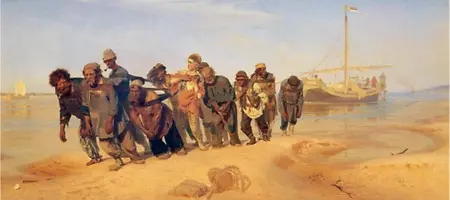
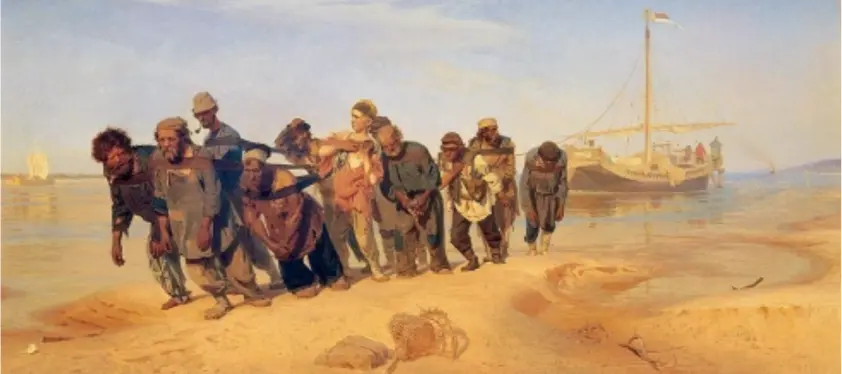
Ilya Repin | "Barge Haulers on the Volga" (1870-73)
"During the course of the 19th century what was deemed an appropriate subject for a painting changed from portraits of the ruling class to those of working people sometimes engaged in difficult physical tasks. Images of hard-working people came to be seen as noble and worthy."\[2\]
The major differences can be found in the appeal of the images: whereas Aivazovsky showcases the natural aesthetic through perceived drama, Repin highlights the drudgery of labor. There is significant emotional weight in the labor depicted in Repin's painting, overcast with desolate disillusionment, whereas Aivazovsky portrays disassociation in the face of conflict. Likewise, Aivazovsky leaves his painting's resolution open to interpretation, whereas Repin showcases the drama through the weight of labor and, however, more or less presents the resolution of his painting without defeat.
Russia experienced centuries of Europeanization, during which the culture, systematic functions, and evolution of the Russian Empire were more or less shaped by forced Westernization. In the 19th century, following the Crimean War and the emancipation of the serfs, Russian culture shifted from showcasing the aristocracy through portraiture to capturing the common people through realist depictions. Russian artists shifted away from idolizing imported ideals and theology and began to focus on Russian nationalism.
There was significant political dissent and ideological disruption, which led to violence and eventually revolution. However, the culture itself held the country's political world stance within its rapidly established and powerfully foundational social culture. Although Russian art stayed within its own borders, Russian ballet became world-renowned, and its musical compositions, in their generally accelerated rise, gained significant recognition in Europe.
Russian art moved toward landscape painting to capture "Mother Russia" and prided itself on the realism of everyday civilians. Russian culture was not necessarily interested in anything surrealist or avant-garde; the shift in Russian artistry was critiqued based on its ability to credibly document reality in its most accurate depiction.
\[1\] "The Coming of Age of Russian Art: First Half of the 19th Century." The Guggenheim Museums and Foundation. Accessed November 13, 2026. https://www.guggenheim.org/teaching-materials/russia/the-coming-of-age-of-russian-art-first-half-of-the-19th-century.
\[2\] "Art and Society: Second Half of the 19th Century." The Guggenheim Museums and Foundation. Accessed November 13, 2026. https://www.guggenheim.org/teaching-materials/russia/art-and-society-second-half-of-the-19th-century

Taunie Sparkes is an art gallery and distribution professional who founded sparksink.com in 2018 and specializes in literature, art, and photography. She holds a History degree with a business minor from the University of Idaho and is pursuing an MBA. Sparkes serves as a Girl Scouts troop leader and volunteers regularly in her daughter's classroom. Her daughter has been instrumental in her entrepreneurial journey…