SBA Crackdown on Pandemic-Era Fraud: What 870,000 Borrowers and New Legislation Mean for Small Businesses
SBA Suspends 870,000 Borrowers Tied to $39 Billion in Pandemic Loan Fraud as Federal Enforcement Intensifies

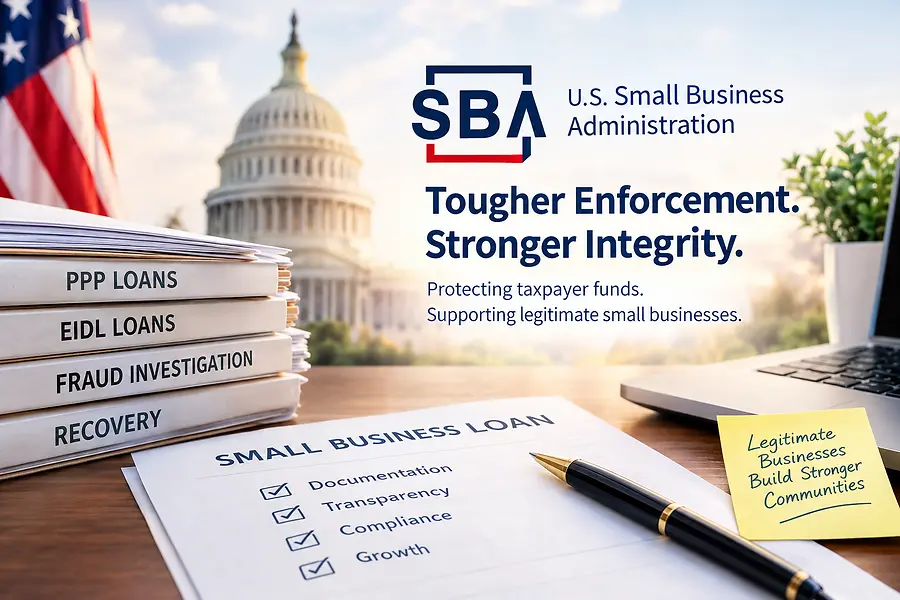
The U.S. Small Business Administration (SBA) Is Tightening Accountability for Pandemic-Era Lending
The U.S. Small Business Administration (SBA) is taking a major step toward tightening accountability for pandemic-era lending programs - and the consequences could reshape the small-business lending environment for years to come.
On September 14, 2026, the SBA announced the suspension of approximately 870,000 U.S. borrowers associated with an estimated $39 billion in suspected fraudulent Paycheck Protection Program (PPP) and COVID-19 Economic Injury Disaster Loan (EIDL) activity. The announcement represents the largest suspension action the agency has disclosed to date and expands the crackdown nationwide.
The announcement comes alongside a broader federal effort to identify suspected fraud, recover taxpayer funds, and prevent individuals who have been convicted of financial misconduct from accessing future SBA assistance.
A Major Shift in SBA Enforcement
The PPP and EIDL programs were created during an unprecedented economic crisis to help businesses survive pandemic-related disruptions. While the programs provided critical assistance to millions of legitimate businesses, federal investigators have also spent years identifying cases involving alleged false applications, fabricated businesses, identity theft, inflated payroll figures, and misuse of loan proceeds.
According to the SBA, the newly announced suspensions cover borrowers in 45 states, six territories, and the District of Columbia. The agency had previously announced suspensions involving more than 150,000 borrowers tied to approximately $10 billion in suspected PPP and COVID-EIDL fraud in five states.
For suspended borrowers, the consequences are significant. They may be prohibited from receiving future SBA small-business and disaster loans and can be excluded from other SBA programs, including participation in the federal 8(a) Business Development Program.
Importantly, a suspension tied to suspected fraud should not automatically be interpreted as a criminal conviction. The SBA announcement concerns borrowers the agency has identified as connected to suspected fraudulent activity. Criminal liability requires the appropriate legal process.
Operation No Doze Intensifies the Recovery Effort
The SBA Office of Inspector General has also launched Operation NO DOZE, a coordinated enforcement initiative targeting fraud involving PPP and COVID-EIDL programs.
The operation combines SBA investigative resources with the Department of Justice, FBI, U.S. Attorneys' Offices, and other federal, state, and local agencies. Between June 12 and September 1, 2026, the coordinated enforcement effort resulted in felony charges against nearly 80 defendants involving approximately $100 million in intended losses. Approximately 43 defendants pleaded guilty in cases involving about $44 million in intended losses, while approximately 40 defendants were sentenced in matters involving nearly $101 million in intended losses. Collectively, the SBA OIG reported more than 160 criminal defendants and approximately $245 million in intended loss during the enforcement surge.
The SBA has also begun sending demand letters to suspected fraudulent borrowers. The agency said approximately 8,000 borrowers in Kansas and Missouri would initially receive final 30-day demand letters as part of the initiative.
Borrowers who fail to resolve the government's claims could face additional collection and legal consequences, including referral to the Department of the Treasury for collection, additional fees, federal payment offsets, and potential civil or criminal enforcement where appropriate.
The Assisting Small Businesses Not Fraudsters Act
The enforcement push is also being reinforced by legislation known as the Assisting Small Businesses Not Fraudsters Act.
H.R. 825 was introduced by Rep. Roger Williams of Texas and was passed by the House in February 2025 by a vote of 405-0. The bill would generally prohibit individuals who are finally convicted of certain financial misconduct or false statements involving covered SBA loans or grants from receiving future SBA financial assistance, with specified exceptions. It would also extend the restriction to certain businesses associated with a convicted individual.
The legislation has since advanced through the Senate process, with the Senate version, S. 1047, also titled the Assisting Small Businesses Not Fraudsters Act.
The basic principle is straightforward: federal small-business assistance is intended to help legitimate businesses create jobs, grow, and survive - not reward individuals who have been convicted of defrauding the government.
The legislation is particularly significant because it focuses on the consequences of a final conviction, rather than simply treating an allegation as proof of wrongdoing.
What Does This Mean for Legitimate Business Owners?
For legitimate entrepreneurs, the SBA crackdown does not mean that SBA financing is disappearing.
Instead, it signals a lending environment where documentation, transparency, and underwriting discipline are becoming increasingly important.
Business owners seeking SBA financing should expect lenders to take a close look at:
- Business ownership and operating history
- Tax returns and financial statements
- Bank statements
- Existing government-backed loans
- Outstanding federal obligations
- Use of previous PPP or EIDL funds
- Ownership changes and affiliated businesses
- Personal and business credit
- Sources and uses of funds
- Consistency between reported revenue and financial records
For borrowers who have previously received pandemic assistance, maintaining clear documentation may be especially important.
A business owner should be able to demonstrate how prior government-backed funds were obtained and used and should address any unresolved issues before pursuing a new financing transaction.
A More Careful Lending Environment
The broader significance of the SBA's action extends beyond fraud enforcement.
The federal government is signaling that the era of treating pandemic-era lending as a closed chapter is over.
More than six years after the beginning of the COVID-19 pandemic, federal agencies are still analyzing applications, identifying suspicious patterns, pursuing recoveries, and prosecuting alleged fraud.
That means lenders and borrowers should expect greater scrutiny of historical financial information.
For lenders, this can mean stronger verification procedures.
For borrowers, it means that accurate records and clean documentation can become a competitive advantage.
For investors and acquisition entrepreneurs, it reinforces the importance of conducting thorough financial and legal due diligence before purchasing a business that has received government-backed assistance.
Opportunity Still Exists for Qualified Small Businesses
There is an important distinction between increased enforcement and reduced access to capital.
The SBA's mission remains focused on supporting America's small businesses. The objective of the current crackdown is to remove fraudulent actors from federal programs while protecting access for legitimate entrepreneurs.
That could ultimately strengthen the SBA lending ecosystem.
When lenders have greater confidence in the integrity of borrower information, legitimate businesses may benefit from a more reliable lending environment.
Entrepreneurs who maintain strong financial records, demonstrate sustainable cash flow, and present well-documented business plans can continue to position themselves for financing.
The lesson for business owners is simple: prepare before you apply.
What Business Owners Should Do Now
If you are considering an SBA loan, business acquisition, or expansion, this is a good time to review your financial records.
Start by confirming that your business and ownership information is accurate. Review previous PPP and EIDL documentation. Make sure tax returns, financial statements, and bank records are consistent. Identify any outstanding federal obligations or unresolved issues.
If your business has multiple owners or affiliated entities, understand how those relationships could affect SBA eligibility and underwriting.
And if you receive a notice from the SBA concerning a suspected debt or eligibility issue, do not ignore it. Seek qualified legal, accounting, or financial guidance and respond through the appropriate government process.
The Bigger Picture
The SBA's suspension of 870,000 borrowers connected to $39 billion in suspected pandemic-era fraud represents a significant turning point in the government's long-running effort to clean up emergency lending programs.
At the same time, the Assisting Small Businesses Not Fraudsters Act demonstrates a broader policy direction: future federal assistance should be directed toward legitimate entrepreneurs while individuals convicted of defrauding the government face meaningful consequences.
For legitimate small-business owners, the message should not be one of fear. It should be one of preparation.
The lending landscape is becoming more disciplined. Documentation matters. Transparency matters. Financial integrity matters.
And for entrepreneurs who have built real businesses, maintained accurate records, and used government assistance appropriately, that increased accountability could ultimately create a stronger environment in which legitimate businesses can continue to grow.

Gladys Yarbrough is CEO of KD Bar Investments and Private Money Lending Manager at Blue Horizon Capital Group. With over two years in real estate and private lending, she specializes in helping distressed homeowners and structuring profitable transactions. Certified Project Money Lender with cosmetology and business education, Gladys received Outstanding Leader of the Year Award for 4-H mentorship. She excels at…