Spear Woman's Story from the book Sacred Wisdom of the Ancient Grandmothers
The account of Long Time Pipe Woman's Brother's Clan Eradication

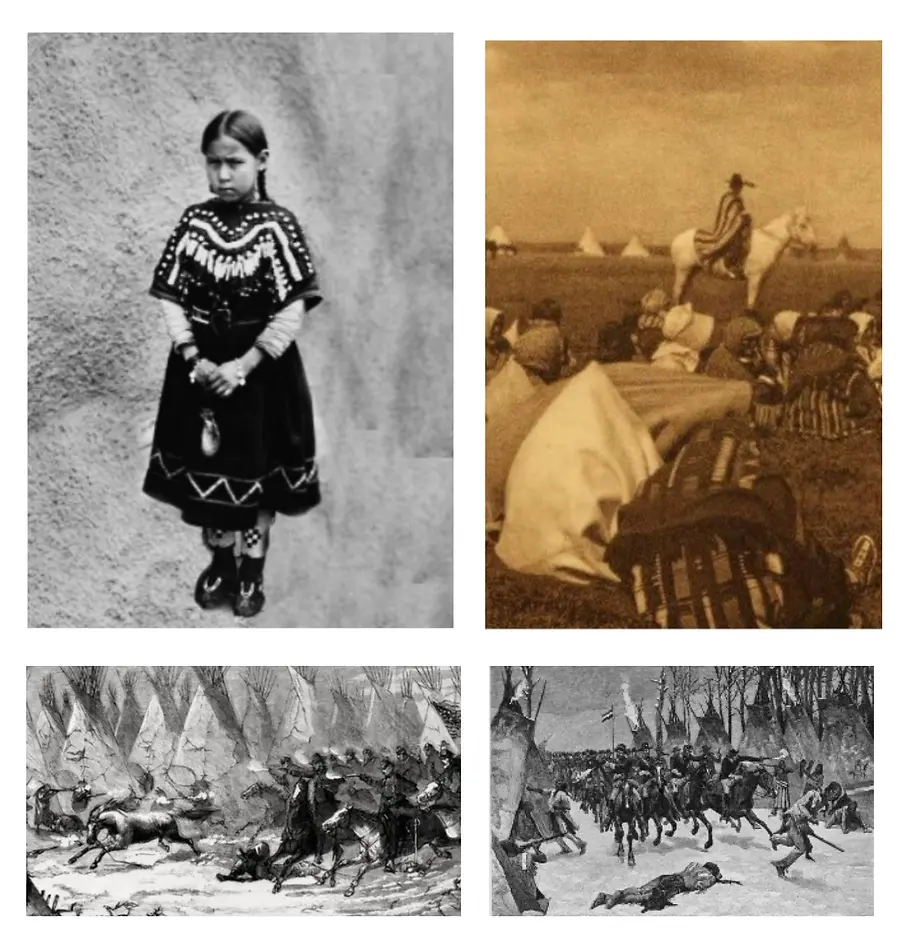
Spear Woman's Story
Long Time Pipe Woman looked out over the bend of the Bear River
(now called Marias River), and breathed in the perpetual mist that
seemed to hang over this quiet spot so full of tragic memories for the
Blackfeet Nation. The chill in the air might not have been created from
the weather, but from the silent cries that endlessly echoed throughout
the valley. She told the story to her grown great-grandson, Ba-Ti-Ga-Sa-
Pi whom she raised from a toddler. She needed for him to understand.
The amber prairie grasses waved gently in the evening breeze as if
swaying to the mournful death dirges of hundreds of desperately forlorn
voices singing cross over songs leaving the physical world and moving
to a new horizon called The Big Sand Hills, "Not our time to leave the
Earth Mother, the devils in blue devoured our lives, not time yet, the
babies should have felt the sweet earth beneath their feet as they ran
joyfully as two legged. The little children were to have continued in
their play, learning to honor all life. The mothers were to bring more real
people to bring us joy, the elders to tell their tales of ancient times before
the devils in blue came to destroy all in their blindness.”
The old medicine woman had no more tears to cry for her brother's clan,
they had poured freely as a child when her niece, Spear Woman, had
recounted the horrific episode. The white man's paper had given a
guarantee of security for her brother, Chief Heavy Runner, as he was not
hostile to them in any way. She could feel the agony in her bones, each
cell of her old body cried quietly toward the soldiers with his hands
uplifted. In one of them was the paper which he had been told was a
pledge of safety, held where it could be seen. A shot pierced his heart
and he fell, clutching the paper to his breast.
The soldiers then began firing at everyone. Everywhere was confusion,
everyone looked for cover. All the warriors and able-bodied men had left
some days before on a hunt; only some old and sick men were there. I
rushed into another tent where there were some sick and dying people. I
hid under a back rest on one of the beds. While there, I saw a knife cut a
hole in the teepee and then a soldier thrust himself through the opening.
He fired at every moving body. When he figured no one was alive, he
left. I was small and quiet, so he didn't notice me. I stayed behind the
back rest for quite a while. I could hear lots of shooting, and there were
screams and crying all around. Finally the noise died down a bit, and the
shooting stopped, although the smell of powder was everywhere. At last I
peeked out, and the soldiers had gone.
I found an old uncle of mine, and the two of us then found my mother
with three more of her children; they had somehow managed to escape.
Mother decided to try to make it on foot to Fort Benton, about ninety
miles, even though we didn't have a horse, practically nothing to eat, and
it was very cold. She had to do something. To stay in that camp was to
die. So we started off, following a horse trail in deep snow. We were
lucky enough to find some soldiers' rations which they had thrown away
close to camp, and these kept most of us alive.
It took several days of painful walking before we got to the outskirts of
Fort Benton. Before we got there, we were scared by some noise up ahead.
Mother was brave enough to leave us and creep toward the
sounds. By the time she got back, the baby we were minding had died.
When we got to a hill overlooking Benton, mother was too exhausted
and scared to go on, so we found a bit of shelter and holed up, hoping to
spot some passing Indians who might look after us. We were lucky,
some Piegans came by before long and took us with them.
We were told that the commanding officer, Baker, was so drunk during
the attack on our camp that he didn't know what was going on, and made
no effort to be in command of his seizers. When he found out that
Mountain Chief's camp was downstream, he went there but did nothing
until the next morning, and by then it was too late.”
Black Plume stood with the old woman and squeezed her hand tightly
then released it and sat down, the weight of the reality being almost too
much for his legs to hold him up. Taking his cue, the medicine woman
sat beside him and recounted more eyewitness accounts from kinsmen
and women she had known and loved who had survived the ordeal,
"Buffalo Trail Woman was an elder when I knew her but she remembered
the massacre as if it had been recent, she told me that the
firing lasted for quite a spell. Some of those in the lodge where she had
slept were killed. Her husband, Good Stab, also known as Yellow Owl,
realized what was taking place and prepared for war. He went to his
mother's lodge, some distance away, and was shot and killed there.
She, herself, was wounded on the back and on her left ear. I could see
scars were plainly evident even on her elderly body. She saw how others
in her lodge were shot, including an old man who dug a trench near the
fire pit, a kind of fort. Their lodge was pitched a considerable distance
from the others. Later, the soldiers marched to their lodge and fired upon
it. The old man got into his trench and covered himself with buffalo skin
trimmings.
Later she saw the soldiers gather all of the belongings of the camp and
set them on fire. But before this was done, the scout or interpreter for the
soldiers came to where she, and other wounded people were. He told them
to get their things and they would move them to two lodges that were spared
from fire or capture, for hospital purposes, because the rest
of the camp furnishings were going to be burned.
The soldiers surrounded the lodge where she had been and fired upon it,
killing everyone except those who escaped by chance. The soldiers did
care for some wounded ones by sheltering them in the two lodges and
giving them some food, but these were mostly women and children. She
also noticed that the soldiers gathered all the horses and took them.
After the soldiers left, a Gros Ventre woman who was married to a
Blackfeet man came to us. She was looking for her daughter, whom she
thought had escaped. We answered the Gros Ventre woman and she
came into the lodge where we were. Then together she made a tour,
searching for her little girl and her husband. She found him mortally
wounded in his mother's lodge. As she was peeping into the lodge,
talking to her husband, he asked her for a drink of water, but a soldier
came along and pushed her to one side. He saw the husband was still
alive, opened fire upon him, and shot him dead. Later, Joe Kipp, the
interpreter, told Buffalo Trail Woman to escape, and said that she had no
business to be out among the men.”
Long Time Pipe Woman sighed and continued, "Good Bear Woman was
even older than Buffalo Trail Woman, but she was there, she was there,
she never forgot. She would not say much but her words still ring in my
memory. She said that when she awoke, she saw the soldiers come over
the hill. As they reached the shore of the river, they split into two groups;
one went to the right, while the other went to the left, surrounding the
camp. She noticed Chief Heavy Runner come out of his lodge and go to
meet the commanding officer. He handed him some papers, which the
commanding officer read, then he tore them up and threw them away. As
Heavy Runner turned about face, soldiers fired upon him and killed him.
After the chief was killed, all of the Indians who had turned out to see
what was going to take place, saw the shooting and ran back into their
lodges. She said she heard a bugle, and the shooting immediately
followed, shooting the camp from all directions. After the first volley of
shots, the shooting ceased for a while. The soldiers marched to the
opposite side of the river, apparently after more ammunition. After the
fourth volley, she and three others managed to escape through the brush
and across the river on the ice. At night, she and others managed to reach
other camps further up on the Bear River, which the soldiers hadn't
molested. After they made their escape good, they went to a high point
from where they observed the soldiers tearing the lodges down and
setting them on fire. Then the soldiers gathered all the horses and left the
scene with them."
Ba-Ti-Ga-Sapi swallowed hard and spoke to his cherished great-
grandmother, "Grandmother, you don't have to go on, this is still so
painful for you." The old woman shook her head saying, "No, it is time
to let these things come forth out of my spirit and release them back to
the Sky Father here in this place, I am being called to finish this so I
might have some bit of peace regarding this awful time." She continued,
"Now my mother told me the account of Mountain Chief's sister, Bear
Woman. She was not in the camp when the event occurred, but was
nearby and heard the accounts of the survivors as soon as they made
their escape. She said she was told by the eye witnesses that the winter
camp was called Bear Paw Coulee, beside the Bear River. Most of the
warriors had left camp on a hunt. They didn't worry about defending the
place because Heavy Runner had a paper from the government saying
that the band was friendly and at peace with the whites.
Her friends said that soldiers came early in the morning and surrounded
the camp. When Heavy Runner went toward them with his peace paper,
he was shot and killed before he got to them. Then all the soldiers began
firing down at the lodges from the ridges above the camp. They shot almost
everybody, women and babies, old men and boys. A few got
away, but some of them died from their wounds and others froze to
death because they left everything behind them to escape with their
lives. An awful lot of Peigans were killed. Only one soldier died, and
they said it was his own fault, he was poking around the camp, and a
dying Indian shot him from inside a lodge.
She said that it was evident that Colonel Baker knew it was a friendly
camp, because the soldiers had captured a young boy, Bear Head, who
had been out at the horse herd. One of the Army's scouts, Joe Kipp,
could speak Blackfoot, and he found out from the boy that the troops
were surrounding Heavy Runner's friendly camp. Joe Kipp told the
colonel, but that didn't make any difference, the colonel said he wanted
to make sure.
Even though they said the soldiers saw Heavy Runner carrying his peace
paper, they shot the chief. That got the rest of the soldiers to start
shooting too. Later it was told that one scout, Joe Cobell, boasted to that
he shot Heavy Runner because the chief had taken some Cobell horses
and wouldn't give them back and the Army wouldn't help because they
didn't want to get in bad with friendly Peigans. This was Joe's way of
getting even and getting hold of more horses than he had lost, only six
horses.
Joe was said to have bragged to Butch Henkel, his son-in-law, about it.
He said that over two hundred in the camp were killed, many women
and kids and old people, because most of the warriors were away. He
thought that sure taught them a good lesson, and he got their horses!
That revelation caused a lot of bad feelings towards Joe, it was said that
Butch didn't like Joe much after that. It was obvious, everybody knew
that most of the horses were Heavy Runner's. Most of the animals had
no Army or white man brands, and Bear Woman herself recognized
many of the camp's buffalo-runners, Indian horses, in Joe's herd.
She said she heard later that the colonel was supposed to be punished for
doing all that killing. But then she was told that he had been sent to
Washington to be a big shot. She figured that maybe that was his
punishment.”
The oppression of the moment was alleviated briefly by the levity of that
statement and both the old medicine woman and her grandson chuckled
at the thought of sending the offending Colonel to the fire pit of
Washington, D.C. as a punishment. "Now I will tell the last story,"
Grandmother said with more strength, "Then we will speak of this no
more.
The young one of whom Bear Woman spoke, Bear Head, he was not so
old when he personally told me about his experience here in this valley
of death. He said that as the winter of 1869-'70 wore on, the buffalo
herds drifted farther and farther away from the mountains, and my
brother's people had to follow them or starve. They moved down to the
mouth of the Two Medicine River; then in middle-winter-moon they
moved down on Bear River and camped in a bottom that Mountain
Chief's band had just left, going a little way farther down the river.
He said that the buffalo herds remained so far from the river that they
had to go for a two or three days' hunt in order to get meat for their
helpless ones. He told his mother that he would join the next party of
hunters to go out. His family still had dried meat to last for some days.
In the morning he found his horses in the timber well above camp.
Suddenly he ran into a multitude of white men: seizers (soldiers). He
was so astonished, frightened, that he could not move. One of the seizers
came and grasped his arm, spoke to him, tapped his lips with his fingers.
He was not to speak or shout. He was a chief, this seizer, had strips of
yellow metal on his shoulders, had a big knife and a five-shots pistol. He
made young Bear Head advance with him; all the seizers were
advancing. They came to the edge of the camp; close before them were
the lodges. Off to their right were many more seizers looking down upon
them. It was a cold day. The people were all in their lodges, many still in
their beds. None knew that the seizers had come.
A seizer chief up on the bank shouted something, and at once all of the
seizers began shooting into the lodges. Chief Heavy Runner ran from his
lodge toward the seizers on the bank. He was shouting to them and
waving a paper writing that their Indian Agent had given him, a writing
saying that he was a good and peaceful man, a friend of the whites. He
had run but a few steps when he fell, his body pierced with bullets.
Inside the lodges men were yelling, terribly frightened women and
children screaming, in agony from wounds, from horrible pain as they
died. He saw a few men and women escaping from their lodges shot
down as they ran. Most terrible of all for him to hear was the crying of
little babies.
He said that the seizers all advanced upon the lodges, one seizer still
firmly holding him by the arm. They shot at the tops of the lodges setting
them on fire then cut the bindings of the poles so the whole lodge would
collapse and begin to burn and smother those within. He saw his own
lodge go down and burn. Within it were his mother, his almost-mothers
(aunts), his almost-sisters (cousins). Oh, how pitiful their screaming as
they died was he related to me with bitter sadness. At last the seizer
released his arm and went about with his men, looking at the smoking
piles, talking, pointing, laughing, all of them. Finally, the seizers
rounded up all of my brothers' band's horses, drove them to the valley a
little way, and made camp. Bear Head sat before the ruin of his lodge
and felt sick. He said that he wished that the seizers had killed him, too.
In the center of the fallen lodge, where the poles had fallen upon the fire,
it had burned a little, then died out. He could not pull up the lodge-skin
and look under it. He could not bear to see his loved ones lying there,
shot or smothered to death.
Bear Head said that from the timber and the brush round about, a few
old men, a few women and children, came stealing out and joined him.
He said, 'One seizer was killed. I saw him fall.' Old Three Bears said,
'We had warning of this, a white trader told us the whites were going to
revenge the killing of Malcom Clarke by Owl Child.’
Bear Head said that that night the white seizers did not closely watch the
hundreds of horses they had taken from my brother Heavy Runner's
band. They managed to get back some of the herd. He finished his tale to
me by saying that when the white killers had gone, as best the survivors
could, they buried the dead, a terrible grieving task it was. They counted
our fallen kin as fifteen men, ninety women, fifty children. Forty-four
lodges and lodge furnishings destroyed, and hundreds of their horses
stolen.”
Black Plume stood up and helped the one he held so dear to her feet.
There were no more words spoken, nothing left to say. The tales had told
it all, the woeful stories had been released back into the place where they
originated. Grandmother felt a bit lighter, as if a heavy burden had been
at least partially lifted. She was a honored and sacred woman of great
faith, there was no doubt she knew her older brother and his band
celebrated a different kind of life in the realms of The Big Sand Hills.
Later Black Plume found a document written by a Caucasian, Stan
Gibson, who had great empathy for the Blackfeet and the horrible events
of that day. Stan was a professor who was teaching at the University of
Alberta in Calgary when he researched and wrote his findings on the
Heavy Runner Massacre.
Black Plume sadly read the account which said, in effect, that on
Sunday, January 23, 1870, at first light, in numbing cold, two hundred
United States cavalrymen waited in ambush positions along the bluffs
overlooking the Bear River at the large winter campsite of the Piegan
leader, Chief Heavy Runner. The camp was surrounded, its warriors
were away hunting, and the troopers eagerly awaited the command to
fire. When the chief realized what was happening, he came out of his
lodge and walked toward the bluffs, waving a safe-conduct paper. Joe
Kipp, the scout and translator, shouted that this was the wrong camp but
he was threatened into silence by the commanding officer. Another
scout, Joe Cobell, fired the first shot, killing Heavy Runner immediately.
What followed, according to Lt. Gus Doane who commanded F
Company in the attack, was touted by him as the greatest slaughter of
Indians ever made by United States troops.
Some two hundred Piegan Indians, mostly women, children and the
elderly, were killed by the murderous Army. Their shells riddled the
lodges, collapsing some onto smoking fire pits and suffocating the half-
awake, terrified victims. Some of their bullets killed children under the
protecting bodies of mothers and grandmothers. Those who ran to the
banks of the river were captured later. Approximately one hundred
and forty helpless captives were turned loose without adequate food and
clothing, some of them froze to death trying to walk to Fort Benton,
ninety miles away. Around eleven o'clock, the commander, Major
Eugene Baker, headed downstream with all but one of his companies to
find the real target, the camp of Mountain Chief, designated clearly in
his orders. Gus Doane's F Company was left behind to round up the
band's hundreds of horses. The small camp of Mountain Chief, wasn't
attacked until the next morning, but by then it had been abandoned and
the band was well on its way to safety on nearby Canadian territory.
This event was almost certainly a pre-emptive act of barbaric military
terrorism towards the Blackfoot Confederacy of Blood, Piegan, and
Blackfoot tribes. General Phil Sheridan did indeed specify the camp of
Mountain Chief as the Baker target, but Baker's local superiors urged
him to use his own discretion and 'punish' the Piegans who might be
guilty in the past or future. Whether Baker was drunk at the time of the
attack (a civilian who was with the troops, Horace Clarke, swore that
this was the case), is irrelevant.
There was a brief storm of outraged protest in Congress and in the big
Eastern papers, but General of the Army William Sherman deflected a
public inquiry by silencing the protests of General Alfred Sully (the BIA
superintendent of Montana Indians) and Lieutenant William Pease, the
Piegan Indian Agent (who had reported the damning body-count).
Sherman quickly issued a press release denying any military guilt, based
on the fact that he 'preferred to believe' what he was told by his officers,
that most of the dead Piegans were warriors in Mountain Chief's camp,
that 'firing ceased the moment resistance was at an end, quarter was
given to all who asked for it, a hundred women and children were
allowed to go free.' This was the same Sherman who guaranteed his
officers, "I will say nothing and do nothing to restrain our troops from
doing what they deem proper on the spot. You may now go ahead in
your own way and I will back you with my whole authority, and stand
between you and any efforts that may be attempted in your rear to
restrain your purpose or check your troops.”
Professor Gibson adamantly stated that the Miras or Bear River
massacre was a disaster which was, in scale and as weighty in
consequences as Wounded Knee. Custer's debacle at the Little Big Horn,
at midpoint in the sequence of massacres, has been chronicled so
microscopically that there is even a biography of Capt. Myles Keogh's
horse, 'Comanche.' Yet well over a century later, he was unable to locate
a book in print about the Heavy Runner Massacre, and most historians
have totally ignored the event, even when their stated topic has been the
Indian Wars.
Finally, Gibson said he wasn’t even able to locate a signboard on a
distant highway to mark the location of the lost mass grave of the Piegan
victims at the time of his article. In the 1960's two researchers found
many of the verifiable Springfield cartridge casings left behind on the
ambush bluffs, and published their findings in 1970, only to be ignored.
In fact, five years later an official state document declared the site
destroyed and noted that Baker may have hit the wrong camp but they
emphasized, "At any rate, it worked.”


