Stewardship in the Age of AI: Why the Next Generation Must Inherit More Than Technology
Why the foundations we preserve matter more than the innovations we chase.

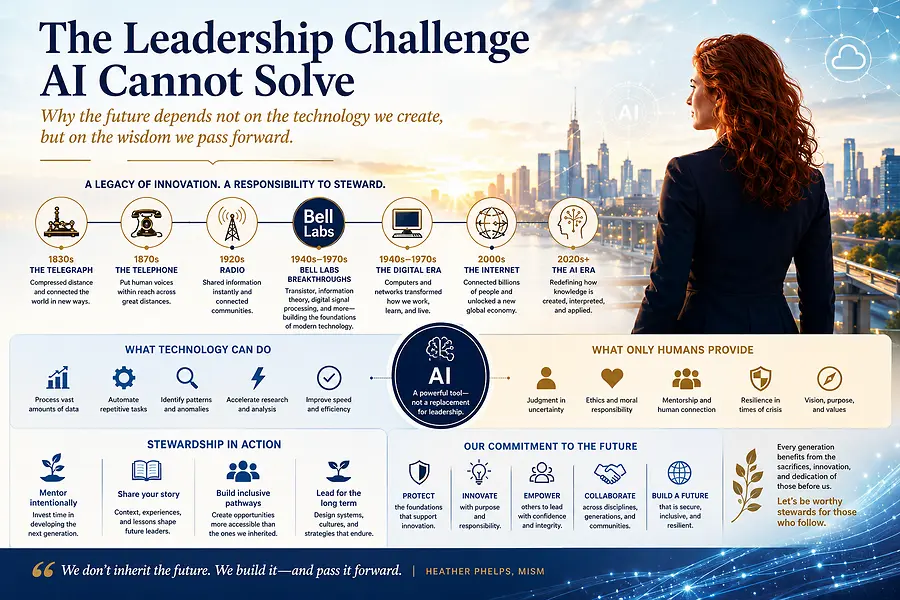
Every generation likes to imagine that it stands at the center of history. We look at the technologies transforming our lives and convince ourselves that no one before us has experienced change on such a scale. Yet history tells a different story. The telegraph once compressed distance in ways that seemed miraculous. The telephone allowed voices to travel across cities, states, and eventually continents. Radio connected communities through invisible signals. Television transformed how societies shared information. The internet collapsed barriers to communication altogether, and now artificial intelligence is reshaping how knowledge itself is discovered, interpreted, and applied.
The tools change. The pattern does not.
What often fascinates me most is not the innovation itself, but the continuity that makes innovation possible. Long before cloud computing, smartphones, or cybersecurity became boardroom discussions, generations of engineers, scientists, operators, and researchers were quietly building the foundations upon which our modern world would stand. Their names are often forgotten, their accomplishments hidden beneath layers of newer technology, yet their influence surrounds us every day.
Every message we send, every video call we join, every transaction we complete, and every AI model we interact with ultimately depends on systems that were designed, maintained, and improved by people who understood that progress is rarely about creating something entirely new. More often, it is about building upon what already exists.
This perspective has become increasingly important to me throughout my career in telecommunications, cybersecurity, compliance, and risk management. Working within industries that support critical infrastructure provides a unique vantage point. You quickly discover that the technologies capturing headlines are often only the visible layer of a much larger ecosystem. Beneath every application, platform, and service lies an intricate network of physical infrastructure, communications systems, engineering principles, operational processes, and human expertise that has evolved over decades. These systems were not built for a single company, a single generation, or even a single purpose. They were built to endure.
When people speak about digital transformation, they often focus on what is changing. I find myself increasingly focused on what must be preserved.
The History of Telecommunications Offers One of the Clearest Examples
Many of the breakthroughs that continue to shape modern technology can be traced to the work performed at Bell Labs throughout the twentieth century. Information theory established the mathematical foundations for modern communications. The invention of the transistor paved the way for every computing device we use today. Advances in switching, networking, signal processing, and communications engineering created capabilities that would eventually evolve into the global digital infrastructure we now take for granted. Those innovations did not emerge from a desire to disrupt for disruption’s sake. They emerged from a commitment to solving difficult problems while ensuring that systems remained reliable, scalable, and accessible.
As the telecommunications industry expanded, carriers faced challenges that seem surprisingly familiar today. Networks needed to interoperate. Systems built by different organizations needed to communicate seamlessly. Reliability had to be maintained even as complexity increased. Engineers had to balance innovation with operational stability. The technologies evolved, but the underlying challenge remained constant: how do we continue moving forward without breaking the foundations that support everyone?
Cybersecurity now faces a remarkably similar challenge.
Many organizations still approach security as a collection of tools, controls, and compliance requirements. While those elements are important, they are only part of the picture. The strongest security programs are not built through technology alone. They emerge from a deep understanding of systems, processes, human behavior, and risk. Compliance can confirm that controls exist. Audits can verify that policies have been documented. Frameworks can provide structure. Yet true resilience comes from understanding why those controls matter and how systems behave when conditions become unpredictable.
That understanding cannot be downloaded, automated, or generated instantly. It is accumulated through experience.
One of the Greatest Risks Facing Modern Organizations Is Not a Lack of Technology
It is the gradual loss of institutional knowledge. Across industries, experienced professionals are retiring, changing careers, or moving into advisory roles. Entire generations of expertise are leaving the workforce at a time when technological complexity continues to increase. Organizations frequently invest heavily in modernization initiatives while underinvesting in knowledge transfer. Procedures are documented, but judgment is harder to capture. Playbooks explain what actions should be taken, but they rarely convey the intuition developed through years of solving problems under pressure.
My military experience reinforced this lesson long before I entered cybersecurity leadership. In mission-critical environments, equipment matters, processes matter, and training matters. Yet the most valuable resource is often the person who understands how all of those elements interact when circumstances deviate from the plan. Experience teaches pattern recognition. It develops judgment. It allows leaders to distinguish between routine challenges and emerging threats. Most importantly, it enables individuals to remain effective when information is incomplete and uncertainty is high.
Artificial intelligence will undoubtedly transform how organizations operate. We are already witnessing its ability to accelerate research, improve efficiency, automate repetitive tasks, and enhance decision-making. The potential benefits are extraordinary, and I believe we are only beginning to understand how profoundly these technologies will shape the future. At the same time, AI highlights a distinction that leaders must not forget.
Knowledge and wisdom are not the same thing.
Knowledge can be stored, indexed, searched, and generated. Wisdom emerges through experience, context, accountability, and reflection. Artificial intelligence can help us process information at unprecedented scale, but it cannot replace the responsibility that comes with leadership. It cannot inherit lessons on behalf of the next generation. It cannot mentor a young professional navigating their first major challenge. It cannot pass along the hard-earned understanding that transforms information into judgment.
This is why I increasingly view leadership through the lens of stewardship.
Stewardship Recognizes That Our Responsibility Extends Beyond Immediate Objectives and Quarterly Results
It asks us to consider what we are preserving, what we are building, and what we are leaving behind. The technologies we manage today will eventually be replaced. The platforms we implement will evolve. Even the organizations we serve will continue to transform. What endures is the culture we create, the people we develop, and the principles we pass forward.
For women leaders, this responsibility carries particular significance. Many of us entered industries where mentorship was inconsistent and representation was limited. We learned to navigate environments that often required persistence, adaptability, and resilience. The progress achieved over recent decades is meaningful, but it also creates an obligation. We have an opportunity to ensure that future generations inherit more than professional opportunities. They should inherit confidence, encouragement, perspective, and access to the knowledge that helps them thrive.
The future will belong to leaders who can bridge disciplines rather than operate within silos. It will belong to individuals who understand technology without losing sight of humanity, who embrace innovation without abandoning responsibility, and who recognize that resilience is ultimately a human capability supported by technology rather than a technological capability supported by humans.
Every generation inherits systems it did not build and benefits from sacrifices it did not make. The networks that connect our world, the technologies that power our economies, and the knowledge that drives innovation are all products of stewardship exercised by those who came before us. Our responsibility is not simply to maintain those achievements, nor is it merely to modernize them. It is to ensure that the understanding behind them survives as well.
Because the most important thing we will ever pass to the next generation is not the technology itself. It is the wisdom required to use it, improve it, and steward it long after we are gone.


