Tears of Shame
Understanding privilege, confronting history, and choosing action over shame.

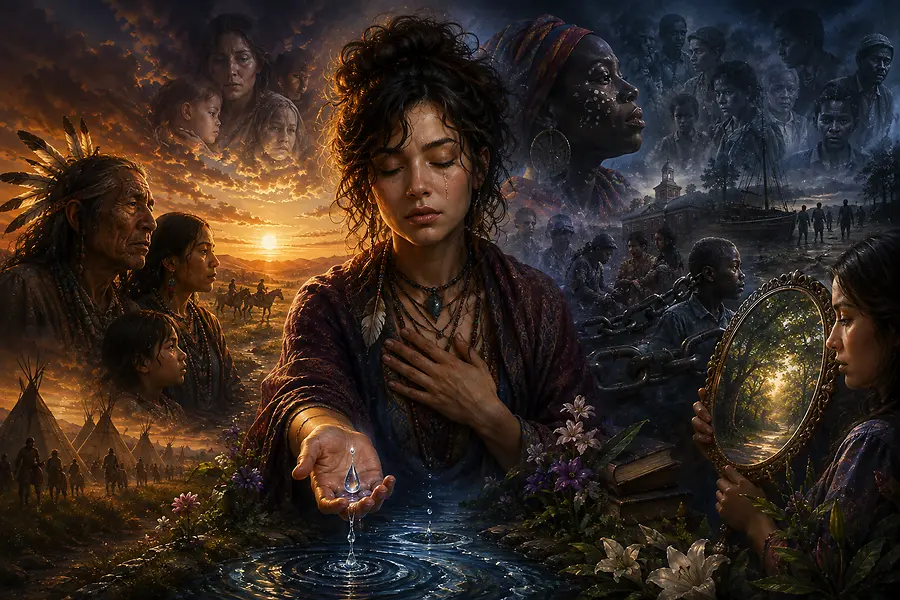
Tears of Shame
When Awareness Must Become Action
There are moments in our lives when something we believed about ourselves begins to unravel.
Sometimes it happens quietly. A conversation. A book. A classroom. Someone else's story.
A piece of history we were never taught. A question we cannot answer as comfortably as we once did.
And then another. Until eventually, we find ourselves standing in front of everything we thought we understood and realizing:
There is more to this story.
For me, understanding race and privilege required one of those awakenings. And it began with resistance.
What Privilege?
For many years, I struggled with the idea of white privilege. I grew up poor. My life had been shaped by loss, trauma, hardship, and circumstances that certainly did not feel privileged. Nothing about survival felt like an advantage. So, when I heard the words white privilege, part of me wanted to ask:
What exactly did being white give me?
It didn't prevent poverty. It didn't prevent trauma. It didn't guarantee safety. It didn't hand me money, education, property, or an easy life. I worked. I struggled. I survived. And all of that was true.
But eventually, I learned something uncomfortable:
My suffering did not mean someone else's disadvantage wasn't real.
Two truths could exist simultaneously. I could have experienced profound hardship and possess advantages within certain social systems because of how others perceived my race. Privilege didn't mean my life had been easy. It meant that my race generally wasn't one of the things making an already difficult life harder. That distinction changed something in me.
And the first tear fell.
The World I Grew Up Around
I grew up around a multicultural reservation community, surrounded by people from different racial, ethnic, and cultural backgrounds. As a child, I was fascinated by cultures different from my own. Their traditions. Their foods. Their ceremonies. Their stories. Their relationships with family and community.
There were times when I even wished I looked different because I felt drawn toward cultures in which I perceived a sense of tradition and belonging that I struggled to locate within myself.
But admiration is not understanding. Proximity is not understanding. And loving pieces of another culture does not mean we understand the historical experience of the people who carry it.
That realization came much later.
As I learned more, I began understanding that traditions I found beautiful existed alongside histories containing colonization, forced displacement, slavery, segregation, cultural suppression, discriminatory laws, and generations of people fighting simply to have their humanity recognized.
I began looking differently at history. And then I began looking differently at myself.
History Looks Different Depending on Where You Stand
Most of us learn history from somewhere. A textbook. A teacher. Our families. Religion. Television. Community stories. National mythology.
But history changes when we begin asking:
Whose voice is missing?
- Who wrote this version?
- Who benefited?
- Who paid the price?
- Whose land was involved?
- Whose labor?
- Whose body?
- Whose children?
- Whose language disappeared from the classroom?
- Whose traditions were called primitive while someone else's were called civilized?
- Whose suffering became a footnote?
Once we begin asking those questions, history becomes harder to keep tidy. We encounter colonization. Enslavement. Forced displacement. Segregation. Discrimination. Violence. Exploitation. And systems whose consequences did not simply disappear when individual laws changed.
There is grief in confronting those realities. There can also be shame. But I have come to believe that shame cannot be where we stop.
I Cannot Take Responsibility for What I Did Not Do
This distinction matters. I cannot personally apologize for every action committed by people who happened to share my skin color. I wasn't there. I didn't create slavery. I didn't write historical laws. I didn't forcibly remove Indigenous children from their families. I didn't create segregation. Inherited guilt does not repair historical harm. But neither does inherited innocence. I live in the world that those histories helped create. And therefore, I have a responsibility to understand that world as honestly as I can.
There is an enormous difference between saying:
"I am personally guilty for everything that happened."
and saying:
"I am willing to understand how what happened continues to influence the world in which I live."
The first can trap us in shame. The second asks us to become accountable.
Poverty and Privilege Can Exist Together
This was perhaps one of the hardest ideas for me to understand.
If I experienced poverty, how could I also experience privilege? Because human beings do not occupy only one social category. Race doesn't erase poverty. Poverty doesn't erase race. Gender doesn't erase either. Neither do disability, education, geography, family structure, religion, sexuality, age, or countless other parts of human experience. We can experience disadvantages in one part of our lives and advantages in another. Understanding privilege does not require competing over who suffered most.
It asks us to become curious about the barriers we personally encountered and the barriers we didn't have to encounter.
That is a much more productive conversation than arguing over who had the harder life. Pain does not need a leaderboard.
Listening Without Making Ourselves the Center
One of the most important things we can learn is how to listen to experiences we have never experienced. That sounds simple. It isn't. Sometimes, when another person talks about racism, discrimination, or injustice, our instinct is to defend ourselves.
But I'm not racist.
But I've struggled too.
But I treat everyone the same.
But that's not what I meant.
Suddenly, someone else's experience becomes a conversation about our intentions.
Listening asks something more difficult of us. It asks:
Can I hear what you experienced without immediately requiring you to reassure me that I am a good person?
That doesn't mean accepting every statement without thought or abandoning critical thinking. It means allowing another human being's experience to exist without immediately placing ourselves at its center.
Sometimes allyship begins with something remarkably simple:
Tell me what happened. I'm listening.
Education Should Make Us Uncomfortable Sometimes
Education is not merely the accumulation of information. At its best, education disrupts certainty. It exposes us to perspectives we have never encountered. It asks us to examine assumptions inherited from families, communities, institutions, and cultures. Sometimes learning feels wonderful. Sometimes learning hurts. Growth can require admitting:
I didn't know.
I misunderstood.
I believed something that wasn't true.
I made assumptions.
I have more to learn.
Those admissions don't diminish us. They create room for us to become wiser. The problem isn't that we were once ignorant of something. None of us is born knowing everything. The problem begins when new information arrives and we choose ignorance because it is more comfortable.
Give Shame a Different Face
I was once asked to put a face to shame. At first, I didn't know what that face looked like. Today, I think perhaps I was asking the wrong question. Maybe shame doesn't need a face. Maybe it needs a mirror. Not so we can stare into it and hate ourselves, but so we can ask:
- What assumptions do I carry?
- Where did they come from?
- Whose experiences have I dismissed?
- What jokes have I allowed to pass without challenge?
- Whose voice have I talked over?
- When have I remained silent because speaking would have been uncomfortable?
- Where am I still learning?
A mirror isn't useful if we use it only for punishment. Its purpose is to help us see. And once we see, we have choices.
What Comes After the Tears?
I called this piece Tears of Shame because that is where this reflection began. But tears alone change very little. Eventually, we have to wipe our eyes. Then we have to decide what happens next.
We can read histories written from perspectives different from our own. We can listen. We can question stereotypes. We can examine our biases without becoming so defensive that learning becomes impossible. We can support educators who teach history honestly. We can challenge discrimination when it happens in our presence. We can create classrooms, workplaces, and communities where people don't have to erase pieces of themselves in order to belong. We can amplify voices that have historically been excluded without assuming we should speak on their behalf. We can remain willing to be corrected. And perhaps most importantly, we can remain curious about one another.
Our Shared Humanity Is Not Sameness
Unity does not require pretending our differences don't exist. Saying I don't see color may sound compassionate, but human beings do have different histories, cultures, and experiences. Seeing one another fully means recognizing those differences without using them to determine whose humanity matters more. We don't need to be the same to create belonging. We need dignity. Respect. Curiosity. Empathy. Courage.
And the willingness to recognize that another person's freedom does not diminish our own.
Let the Tears Water Something Better
I cannot rewrite history. None of us can. I cannot undo every injustice committed before I was born. But I can decide what kind of ancestor I want to become. That question matters deeply to me.
What will future generations say we did when we knew better?
Did we defend the comfortable story?
Did we turn away?
Did we argue endlessly about who was responsible?
Or did we finally decide that understanding one another mattered more than protecting ourselves from discomfort?
Perhaps the tears of shame do not need to disappear completely. Perhaps they can become something else. Tears of awareness. Tears of compassion. Tears shed because another person's suffering matters, even when it wasn't our suffering. And then perhaps those tears can water something.
Education. Understanding. Justice. Friendship. Community. Change.
Because awareness without action eventually becomes another form of looking away.
I cannot change what happened yesterday.
But I am responsible for what I choose to do with what I understand today.
And tomorrow will be shaped, at least in part, by what all of us choose to do next.


