Teen Social Media Use: How Hooked Are They—and What Are Platforms Doing to Protect Them?
Understanding teen social media use, the safeguards platforms offer, and what parents need to know.

How hooked are teens?
According to Pew Research Center's 2025 data:
- 63% of U.S. teens use TikTok
- 61% use Instagram
- 55% use Snapchat
- Facebook is much less popular among teens than it was a decade ago.
The concern isn't simply whether teenagers have an account. Frequency and difficulty disengaging are bigger issues. In Pew's research, many teens report being online throughout the day, and about 1 in 5 teens say social media hurts their mental health. At the same time, many teens say social media helps them feel connected to friends.
So the picture is complicated: social media can provide connection, entertainment, and community, while excessive or harmful use can create problems with sleep, cyberbullying, emotional well-being, and time spent online.
What are TikTok, Instagram, and Facebook doing?
There are now substantially more safeguards than there were a few years ago.
PlatformMajor safeguards for teensTikTokDefault 60-minute daily screen-time limit for under-18s, bedtime notification restrictions, private-account protections, restrictions on direct messaging, content filtering, comment controls, and parental Family PairingInstagramTeen Accounts, private-by-default protections, restrictions on who can contact teens, age-appropriate content controls, nighttime protections, and parental supervisionFacebookTeen Accounts and additional restrictions on content, messaging, and interactions, with parental supervision through Meta's Family Center
TikTok
TikTok has one of the more explicit time-management systems.
For users under 18, TikTok says a 60-minute daily screen-time limit is automatically applied by default. Teens can continue using the app after that, but additional steps are required, and parents can use Family Pairing to impose additional restrictions. TikTok also automatically applies more than 50 safety, privacy, and security settings to teen accounts.
Parents can also control things such as:
- Daily screen time
- When TikTok can be used
- Whether the account is private
- Who can comment
- Certain content restrictions
- Whether parents receive certain account/reporting information
TikTok has also added Time Away, allowing parents to pause their teen's TikTok access during designated periods.
Meta has taken a similar approach with Instagram Teen Accounts.
Teen Accounts automatically place young users into more restrictive settings designed to limit:
- Who can message them
- Who can interact with them
- Potentially inappropriate content
- Notifications and nighttime interruptions
- Certain sensitive content and recommendations
Instagram has also introduced a 13+ content setting, designed around age-appropriate content, with an even stricter Limited Content option that parents can select.
For younger teens, the restrictions are stronger. For example, teens under 16 need parental permission to make certain settings less restrictive, including some protections involving Live and unwanted images in DMs.
Facebook has traditionally been less popular with teenagers than Instagram and TikTok, but Meta has been extending its teen protections to Facebook and Messenger.
Meta says Teen Accounts are designed to restrict who can contact teens and what content they see, while parents can manage supervision through Meta's Family Center.
But here's the important part
The safeguards are helpful, but they don't eliminate the problem.
A 60-minute limit, for example, doesn't necessarily mean a teenager will only spend an hour thinking about social media. A teen can move from TikTok to Instagram, Snapchat, YouTube, or another platform.
And there is another significant issue: age verification. These protections depend partly on platforms accurately identifying a user's age. Meta and TikTok have been investing in age-assurance technology, but determining a person's age online isn't perfect.
The bigger question
The real issue isn't simply:
"Should teenagers be allowed to use social media?"
It's becoming:
"How do we give teenagers the benefits of social media without allowing algorithms, endless scrolling, social pressure, and inappropriate content to dominate their lives?"
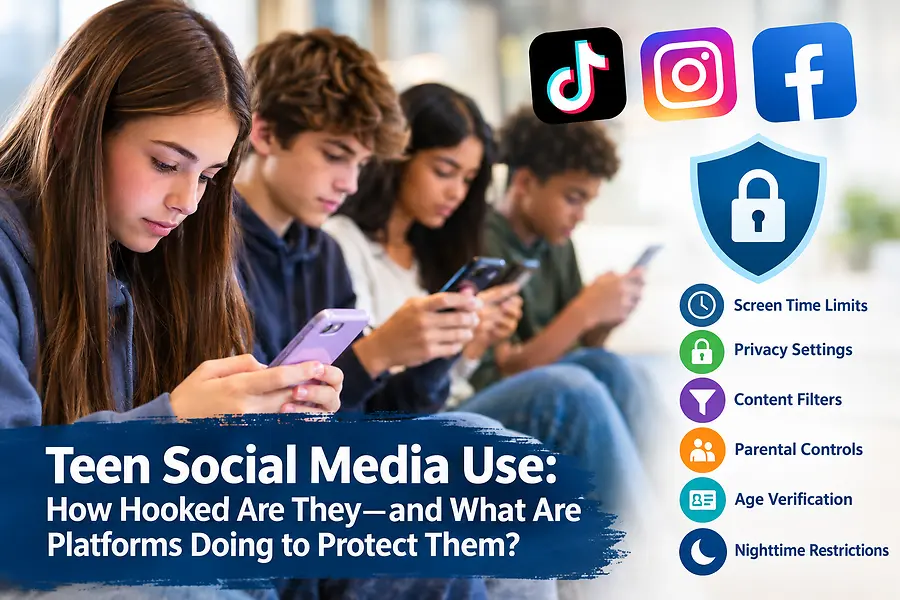
That is why the safeguards increasingly combine screen-time controls + parental controls + content filtering + privacy protections + age verification + nighttime restrictions rather than relying on one single feature.
Confidence: 0.94 - The usage figures and platform safeguards above are based primarily on current Pew Research and the platforms' own 2026 safety announcements. The main limitation is that "hooked" or "addicted" is not a single measurable statistic; frequency of use and problematic use are different things.


