The $875 Billion CRE Maturity Wall Is Shrinking—But the Financing Gap Is Growing
As debt maturity pressures ease, private capital emerges as the new frontier in commercial real estate financing.

Commercial Real Estate's Debt Maturity Wall Is Shrinking—But the Refinancing Problem Isn't Over
Commercial real estate's much-discussed debt maturity wall is beginning to recede—but that does not mean the refinancing problem is over.
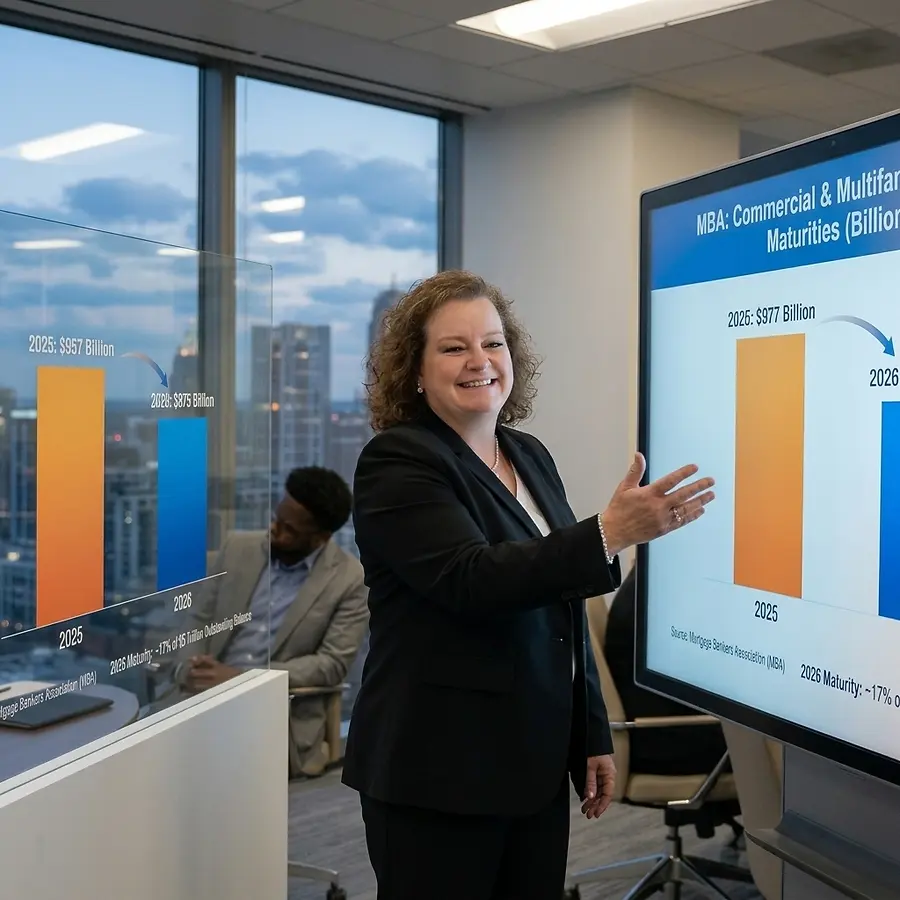
According to the Mortgage Bankers Association (MBA), approximately $875 billion of commercial and multifamily mortgage debt is scheduled to mature in 2026, representing about 17% of the nation's roughly $5 trillion outstanding commercial mortgage balance. The figure is down 9% from the $957 billion scheduled to mature in 2025, suggesting that the peak of the maturity wave may be passing.
But the bigger question for property owners is no longer simply how much debt is coming due.
It is who will refinance it?
Banks Are Becoming More Selective
Depository institutions account for approximately $396 billion, or 21%, of their outstanding commercial mortgage balances coming due in 2026. Another $200 billion is tied to CMBS, CLOs, and other asset-backed securities, while $163 billion is held by credit companies, warehouse facilities, and other lenders.
At the same time, banks are becoming more selective about the commercial real estate loans they are willing to originate—particularly loans requiring transitional or bridge financing.
That creates an important opening for private lenders, debt funds, and other non-bank sources of capital.
Industry research from With Intelligence shows that as banks reduce their exposure to commercial real estate, private credit is taking a larger role in property lending. Lending to non-depository financial institutions increased substantially during the first half of 2025, while real estate debt funds recorded $51 billion in final closes during 2025—the strongest fundraising total since 2021.
The Refinancing Gap Is Where Opportunity Lives
Bridge financing has always carried more risk than conventional permanent financing.
A permanent loan generally relies on an established property, stabilized cash flow, and predictable debt-service coverage. A bridge loan, by contrast, may finance a property that is being renovated, repositioned, leased up, refinanced, or otherwise transitioned toward stabilization.
That additional risk comes with a higher cost of capital.
Depending on the property, leverage, sponsor strength, market, and loan structure, bridge financing can price materially above conventional permanent debt. The difference is not necessarily a sign that the market is broken.
It is the price of capital stepping in when traditional lenders are unwilling—or unable—to do the deal.
The Numbers Tell a More Complicated Story
The good news is that commercial real estate lending is recovering.
MBA estimates that total CRE mortgage borrowing and lending reached approximately $706 billion in 2025, a 40% increase from $505 billion in 2024 and a 65% increase from 2023.
Multifamily lending also accelerated. MBA reported $381.8 billion of multifamily mortgage originations in 2025, up 32% from 2024, with 2,530 different lenders participating in the market.
And commercial-property loan performance has shown signs of stabilization. MBA reported that commercial mortgage delinquency rates declined during the second quarter of 2026, although office and lodging properties remain areas of concern, and CMBS delinquencies remain elevated relative to other capital sources.
So, this is not simply a story about a collapsing CRE market.
It is a story about a changing capital structure.
Some Property Types Face More Pressure
The maturity burden is not distributed evenly.
MBA estimates that approximately 30% of hotel and motel mortgage balances, 23% of industrial mortgage balances, and 17% of office mortgage balances are scheduled to mature in 2026. Multifamily is comparatively less exposed, with approximately 13% of its mortgage balances coming due.
That distinction matters.
A high-quality multifamily property with strong occupancy and dependable cash flow may have considerably more refinancing options than an older office building facing declining demand, expensive capital improvements, and uncertain valuations.
Likewise, a hotel with strong operating performance may attract private capital even when a conventional bank will not provide the requested bridge facility.
Private Capital Is Moving Into the Gap
The rise of private real estate credit is one of the most important developments to watch.
With Intelligence reports that real estate debt funds raised $51 billion in 2025, their best year since 2021. Established investment managers and traditional investment firms have also launched or expanded real estate debt strategies as banks have become more cautious.
That creates a growing two-tiered lending environment.
Traditional lenders are increasingly focused on stabilized, lower-risk assets with strong borrowers and predictable cash flow.
Private lenders and debt funds can step into transactions involving higher leverage, transitional properties, construction, repositioning, refinancing challenges, or situations requiring speed and flexibility—provided the risk is properly priced.
The Maturity Wall Is Smaller—But the Capital Question Remains
The MBA expects another $652 billion of commercial mortgage debt to mature in 2027.
That means the refinancing cycle is far from finished.
The decline from $957 billion in 2025 to $875 billion in 2026 is encouraging, but borrowers still have to confront today's higher financing costs, changing property valuations, and more conservative underwriting standards.
For property owners with maturing debt, the strategy may therefore need to change.
Instead of asking only, "What bank will refinance this loan?"
The better question may be:
"Which source of capital is best suited for this asset and this stage of the business plan?"
That could mean a bank loan, agency financing, life-company debt, CMBS, a bridge lender, a private credit fund, seller financing, or a combination of capital sources.
The Bottom Line
The commercial real estate maturity wall is shrinking—but the financing market is changing underneath it.
The $875 billion of debt coming due in 2026 represents both a challenge and an opportunity. Banks are becoming more selective, while private credit and real estate debt funds are expanding their role.
For borrowers, that means financing may be more expensive than it was during the era of ultra-low interest rates.
For lenders willing to understand the asset, structure the risk, and provide capital where traditional institutions cannot, however, the environment could represent one of the most attractive opportunities in commercial real estate since the beginning of the current cycle.
Higher-for-longer is not simply a risk to the real estate market. For the right lender, it can be the business model.


