The AI Economy Is Making Physical Real Estate More Valuable
How artificial intelligence is reshaping the investment landscape and creating new opportunities in physical real estate markets.

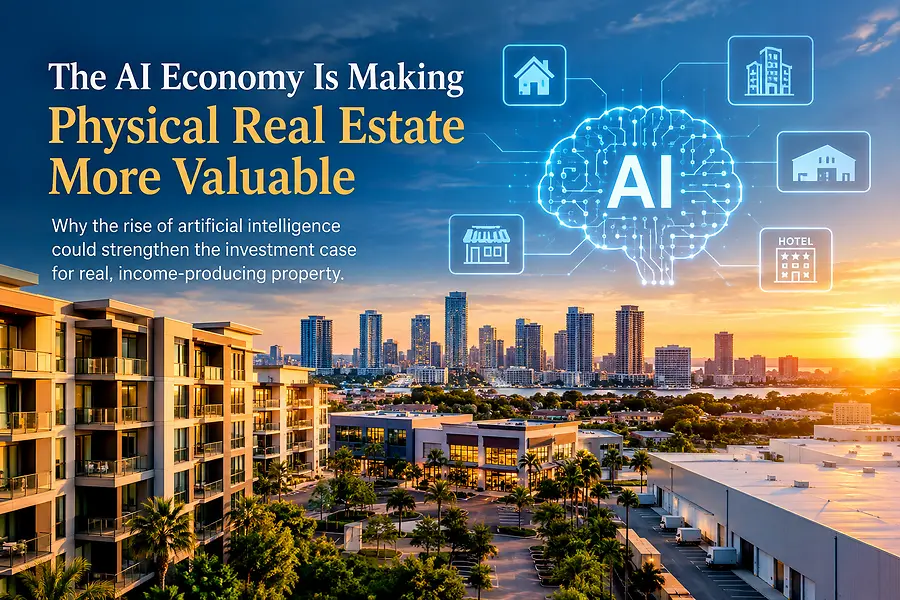
Why the Rise of Artificial Intelligence Could Strengthen the Investment Case for Real, Income-Producing Property
Artificial intelligence is changing the way businesses operate, how employees work, and where capital flows. From automation and data centers to AI-powered financial services and increasingly sophisticated software, the digital economy is expanding at extraordinary speed.
But there is an interesting countertrend developing beneath the surface:
The more the economy becomes digital, the more valuable certain physical assets may become.
That is the idea behind what could be called the "AI Immunity Trade" in real estate-not that real estate is immune to technological disruption, but that certain properties provide something technology cannot eliminate: physical space, location, infrastructure, and tangible utility.
For investors, that distinction may become increasingly important.
Real Estate Has Something AI Can't Manufacture
AI can generate information, automate administrative work, analyze markets, write contracts, manage customer service, and increasingly perform tasks once handled exclusively by humans.
It cannot manufacture land.
It cannot create another downtown location.
It cannot reproduce a well-positioned apartment community, hotel, industrial facility, medical office, or retail center in the exact same location.
And while technology can change how a property is used, the underlying physical asset remains tied to a finite resource: real estate.
This creates an interesting investment dynamic.
As more economic activity moves into the digital world, investors may place an even greater premium on the physical infrastructure supporting that activity.
- Data centers need land and power.
- Warehouses support e-commerce and automated supply chains.
- Housing remains necessary for workers and households.
- Hotels provide physical accommodations.
- Industrial facilities support manufacturing and logistics.
- Retail and mixed-use properties provide places where people still live, work, shop, and gather.
The digital economy still needs a physical foundation.
A Different Kind of Real Estate Cycle
The current real-estate environment also highlights another important distinction: asset fundamentals and the cost of capital are not always the same thing.
According to the perspective presented by a senior DWS real-estate executive, institutional real estate experienced a significant decline from its peak even while underlying property fundamentals remained relatively resilient. His interpretation is that a substantial portion of the decline was driven by the dramatic repricing of capital rather than a corresponding collapse in real-estate fundamentals.
That distinction matters.
When interest rates rise rapidly, property values can fall even when occupancy, rents, and operating income remain relatively stable.
The mathematics are straightforward.
If investors previously accepted a 5% capitalization rate and suddenly require 7%, the value of the same income stream changes dramatically.
That does not necessarily mean the building became less useful.
It means the market changed what investors were willing to pay for that income.
This creates an important question for today's investors:
Are we looking at permanently impaired real estate-or assets that were repriced because capital became more expensive?
Those are two very different situations.
Real Estate May Be Becoming the Relative-Value Trade
Over the past several years, investors have watched enormous amounts of wealth flow into technology stocks, artificial intelligence companies, and other high-growth assets.
The source material points to the dramatic gains in equities and gold since 2022 as evidence that many financial assets have already experienced substantial appreciation.
Meanwhile, commercial real estate has gone through a period of repricing, higher financing costs, tighter lending standards, and reduced transaction volume.
That divergence creates the possibility of a relative-value opportunity.
The argument isn't that equities, technology, gold, or AI-related investments are necessarily overvalued.
Rather, it is that investors should compare today's price of real estate with the price of everything else.
An asset class does not have to be cheap in absolute terms to become attractive.
It simply has to offer a compelling risk-adjusted value relative to the alternatives.
For investors who can acquire quality properties at attractive basis levels, today's market may offer opportunities that were difficult to find during the peak of the real-estate cycle.
The Supply Problem Could Become More Important
Housing provides another reason to watch physical real estate closely.
The source material highlights a sharp decline in residential construction starts and suggests that new supply may not fully catch up with demand until later in the decade.
If that general trajectory proves accurate, the implications could be significant.
Real estate is unlike many manufactured products.
If demand for a particular product increases, manufacturers can often increase production.
Housing doesn't work that way.
Developers must find land, obtain approvals, secure financing, navigate zoning requirements, manage construction costs, and ultimately complete the project.
That process takes time.
A prolonged period of underbuilding can therefore create future scarcity.
For existing property owners, limited new construction can support occupancy and rental demand.
For investors, it can create opportunities to acquire existing assets in markets where replacement costs continue to rise.
Why the Sun Belt and Mountain West Matter
The source also points to institutional interest in Sun Belt and Mountain West markets.
That isn't surprising.
Over the past decade, these regions have attracted businesses, workers, families, and investment because of population growth, business expansion, lifestyle migration, and relative affordability in many markets.
But investors should be careful about treating an entire region as one investment.
The Sun Belt is not one market.
The Mountain West is not one market.
Even within the same metropolitan area, one submarket can perform dramatically differently from another.
The opportunity may ultimately come down to a combination of:
- Population growth
- Employment growth
- Household formation
- Housing supply
- Infrastructure investment
- Rent growth
- Property taxes
- Insurance costs
- Financing availability
- Replacement costs
- Local economic diversification
The best opportunities may not necessarily be in the markets receiving the most attention.
They may be in the specific submarkets where demand is growing faster than supply.
AI May Change Real Estate-Not Eliminate It
There is another reason the AI thesis deserves a closer look.
Technology has disrupted countless industries without eliminating the underlying need for physical infrastructure.
- Online shopping didn't eliminate warehouses.
- Remote work didn't eliminate housing.
- Streaming didn't eliminate studios.
- Digital payments didn't eliminate retail locations.
And AI isn't likely to eliminate the need for physical space.
Instead, it may change which properties are valuable and how they are operated.
- Property managers can use AI to automate communication and maintenance workflows.
- Investors can use AI to analyze financial statements and identify potential acquisitions.
- Lenders can use technology to evaluate risk more efficiently.
- Developers can use AI to model projects and optimize design.
- Owners can use smart-building technology to reduce operating costs.
In other words, AI may become less of a competitor to real estate and more of a productivity multiplier for real-estate owners and investors.
The Real "AI Immunity" Trade
The strongest version of the AI-immunity thesis isn't that real estate is protected from technological change.
It isn't.
- Poorly located properties can still lose value.
- Oversupplied markets can still struggle.
- High insurance costs can destroy cash flow.
- Excessive leverage can turn a good property into a bad investment.
And technology can absolutely change how certain properties are used.
The better thesis is this:
In a world becoming increasingly digital, scarce physical assets with durable demand may become more strategically valuable.
That means investors should focus less on simply owning "real estate" and more on owning the right real estate.
- Properties with strong locations.
- Properties with durable cash flow.
- Properties serving essential needs.
- Properties with limited competing supply.
- Properties that can adapt to changing technology.
- And properties purchased at a basis that provides room for error.
The Opportunity May Be in the Gap
The next real-estate cycle may not look like the last one.
Investors may have to operate in a world where technology moves faster, capital costs remain important, demographics continue shifting, and the distinction between digital and physical businesses becomes increasingly blurred.
That could create an unusual investment landscape.
AI may continue driving enormous amounts of capital toward technology.
At the same time, the physical infrastructure required to support that technology-and the people and businesses using it-will continue to require land and buildings.
That is where the opportunity may lie.
The future may be digital, but the foundation underneath it is still physical.
For real-estate investors, that could make scarce, well-located, income-producing property one of the more interesting relative-value opportunities of the next several years.
The question isn't whether AI will change real estate.
It will.
The more important question is:
Which real estate will become more valuable because of that change?

Gladys Yarbrough is CEO of KD Bar Investments and Private Money Lending Manager at Blue Horizon Capital Group. With over two years in real estate and private lending, she specializes in helping distressed homeowners and structuring profitable transactions. Certified Project Money Lender with cosmetology and business education, Gladys received Outstanding Leader of the Year Award for 4-H mentorship. She excels at…