The Birth of Artificial Intelligence
From the Turing Test to Generative AI: A 70-Year Journey of Machine Intelligence

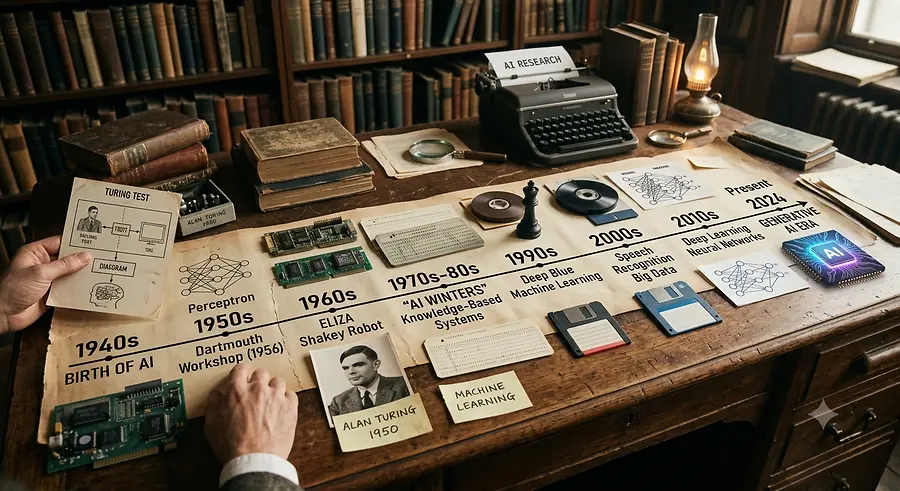
Artificial intelligence (AI) has been around for much longer than many people realize. While today's AI boom-with tools like large language models, autonomous systems, and AI-powered data centers-feels like a recent development, the scientific pursuit of creating intelligent machines began more than 70 years ago.
The Beginning: 1950s - The Birth of AI
The foundations of AI began in the 1940s and 1950s as scientists explored whether machines could imitate human thinking.
One of the most influential early figures was Alan Turing, who introduced the idea that machines could potentially think and proposed what became known as the Turing Test in 1950. The test examined whether a machine could communicate in a way that was indistinguishable from a human.
In 1956, the term "artificial intelligence" was officially introduced during the Dartmouth Workshop, where researchers gathered to explore the possibility of creating machines capable of learning, reasoning, and solving problems.
This event is widely considered the official beginning of AI as an academic field.
1960s-1970s: Early AI Experiments
During the early decades, researchers developed programs that could:
- Solve mathematical problems
- Play simple games
- Understand basic language commands
- Perform logical reasoning
Early AI systems were limited because computers lacked the processing power and memory available today.
Many researchers believed human-level AI was close, but progress was slower than expected.
1980s: The Rise of Expert Systems
In the 1980s, AI entered a new phase through expert systems.
These programs attempted to replicate human decision-making by using large databases of rules.
Examples included systems designed to assist with:
- Medical diagnosis
- Financial analysis
- Manufacturing decisions
- Scientific research
Businesses began adopting AI technology, but limitations in computing power and data availability prevented widespread transformation.
1990s-2000s: Machine Learning Takes Over
AI began changing dramatically when researchers moved away from programming every rule manually and started teaching computers to learn from data.
This period introduced major advances in:
- Machine learning
- Data analysis
- Speech recognition
- Computer vision
In 1997, IBM's IBM chess computer Deep Blue defeated world chess champion Garry Kasparov, demonstrating that computers could outperform humans in specific tasks.
2010s: The Modern AI Revolution Begins
The biggest acceleration came from three developments:
1. Massive Data Availability
The internet, smartphones, and digital services created enormous amounts of information that AI systems could learn from.
2. Powerful Computer Hardware
Graphics processing units (GPUs) originally designed for gaming became essential for training advanced AI models.
3. Deep Learning
Neural networks became dramatically more capable, improving:
- Image recognition
- Translation
- Voice assistants
- Recommendation systems
Companies began integrating AI into everyday products and services.
2020s: The Generative AI Era
The current AI boom accelerated with generative AI, where systems can create new content, including:
- Text
- Images
- Computer code
- Audio
- Video
Large language models (LLMs) became widely known because they could understand and generate human-like language.
This growth created demand for:
- Massive data centers
- Specialized AI chips
- Renewable energy projects
- Advanced cooling systems
- Expanded electrical infrastructure
This is the reason states like Texas are seeing billions of dollars invested in AI facilities today.
So, How Old Is AI?
The answer depends on how you measure it:
- AI as a formal field: About 70 years old (since 1956)
- Early ideas about machine intelligence: More than 75 years old (1940s-1950s)
- Modern machine learning boom: About 15 years old
- Generative AI explosion: About 5 years old
The Bigger Picture
Artificial intelligence is not a sudden invention-it is the result of decades of research, experimentation, and technological progress.
The current AI expansion in Texas and around the world represents a new chapter: moving from AI as a research concept to AI as a major economic infrastructure.
The same way electricity, highways, and the internet transformed society, AI infrastructure may become one of the defining technologies of the 21st century.


