The Bridge Builder
The Person Behind THE Person

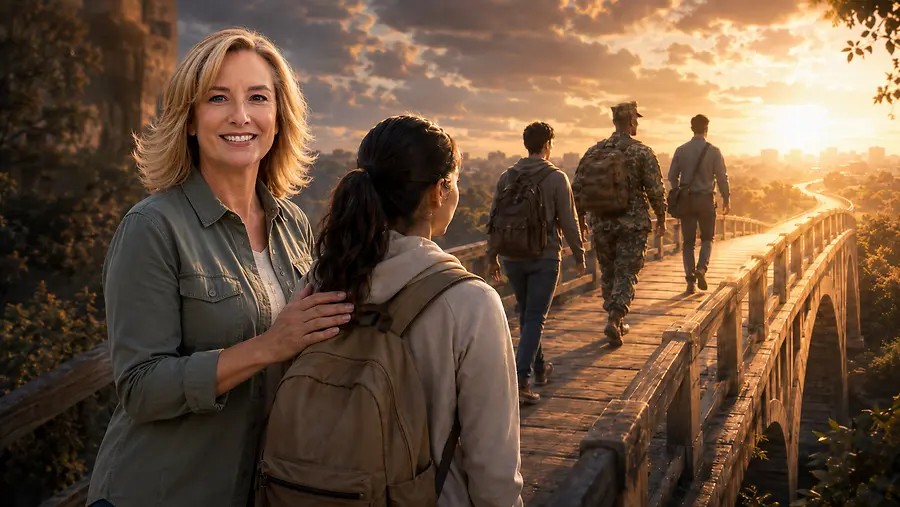
When people talk about leadership, they often focus on the person standing in front of the room—the one giving the speech, receiving the award, leading the organization, or standing in the spotlight.
I appreciate a different kind of leadership: the person behind the person. The mentor behind the student. The teacher behind the leader. The advocate behind the veteran. The person who may not always be seen, but whose impact can change the direction of someone’s life.
That is the kind of leadership I have come to value most—the bridge builder.
I am a bridge builder—the leader who helps someone cross from where they are to where they are capable of becoming.
The Bridge Builders Who Shaped Me
For much of my life, I did not fully understand how many bridge builders had shaped my own journey. One of the earliest was Sister Leia at the girls’ home where my sisters and I lived as children. We were not even legally supposed to be there, but Sister Leia chose to pour into us anyway. She taught us to sing, dance, perform, participate, and believe we had something worth contributing. More importantly, she taught us that we mattered.
Looking back, I realize that this may have been one of the greatest gifts she could have given us. She saw us. She invested in us. She made us feel worthy of someone’s time, attention, and effort.
For children who could easily have felt forgotten, that mattered more than she probably ever knew.
Sally Schneider
Years later, another bridge builder appeared in my life: Sally Schneider, my music and choir teacher at Kenmore High School. The funny part is that I was not the best singer in any room. What Sally saw was not extraordinary talent; she saw a young woman who needed to be there. Choir gave me belonging at a time when I desperately needed it. It gave me structure, purpose, friendships, and a reason to keep showing up. I sang, danced, went to school, and worked two jobs. Choir became one of the few places where effort translated into opportunity.
When I was elected president of the choral department my junior year, even after running against a very popular senior, it was one of my first “holy moly, I did it” moments. Then, in my senior year, Sally put me in for the Ohio State Music Award.
Those accomplishments mattered, but the bigger lesson was this: someone believed I had something to contribute. As president of the choir, I was not the person directing from the podium—Sally Schneider did that. Looking back, that may have been my first lesson in being the person behind the person—supporting the mission, helping others succeed, and discovering that leadership is not always about being in front.
The Army and the Bridge-Building Leader
That lesson followed me into the Army and became part of how I transformed as a leader.
I never needed to be the Command Sergeant Major (CSM). I wanted to be the CSM’s right hand—the person who understood the mission, knew the people, anticipated the gaps, solved problems, and helped make the whole operation work. That is bridge-building, too.
It is not always glamorous. It is not always visible. But it matters. Sometimes the most powerful person in the room is not the one holding the microphone. Sometimes it is the one making sure the right people are heard, the right problems are addressed, and the mission keeps moving.
The Army was the first institution to demand excellence from me. More importantly, it gave me a reason to believe I was capable of excellence. My drill sergeants expected more from me than I expected from myself. They gave me responsibility before I felt ready. They challenged me. They corrected me. They trusted me with opportunities I never would have volunteered for on my own.
Drill Sergeant Peterson
In particular, Drill Sergeant Peterson left a lasting impression. As a young woman from Ohio, I sometimes struggled to understand his strong Southern accent. Eventually, I admitted it to him. Instead of embarrassing me, he adjusted, chuckled, and kept teaching. By the end of basic training, he had nicknamed me “Queen Elizabeth” because I always had the answers, and he put me in for promotion. What I remember most, however, is not the promotion—it is that he saw leadership potential in me before I saw it in myself.
The Army did not simply demand excellence from me; it poured into me. It gave me the tools, mentors, discipline, and opportunities to accomplish missions and tasks I never knew I could attempt, let alone succeed at. It also taught me that success is a team sport. I learned that if I let down my team, I also let down myself. We succeeded together. We struggled together. We crossed the finish line together. Perhaps most importantly, I learned that mistakes did not have to define or ruin me. If I fell on my face, I got back up—not because failure did not hurt, but because failure did not get the final say.
The Roles That Bring the Greatest Fulfillment
Over time, I began to recognize a pattern. The people who had the greatest impact on my life were not necessarily the people standing in the spotlight, but they had power. They were the bridge builders—the people who saw something in me before I saw it in myself, challenged me to grow, and refused to let me settle for less than I was capable of becoming.
As I have gotten older, I have realized that the roles bringing me the greatest fulfillment all have something in common:
- The mentor
- The advocate
- The teacher
- The mother
- The bridge builder
None of those roles are really about me. They are about pouring into someone else until they can see greater possibility for themselves.
A Priceless Gift
The bridge builders in my life gave me a priceless gift: people flourish when they are seen, valued, challenged, and given the opportunity to grow. Sister Leia poured into little girls who could easily have been overlooked. Sally Schneider gave me a place to belong when I desperately needed one. Drill Sergeant Peterson saw leadership potential I could not yet see in myself. Numerous Army mentors demanded excellence while also giving me the tools, guidance, and opportunity to achieve it.
Each of them helped answer questions I did not yet know how to ask:
- Do I matter?
- Do I belong?
- Am I capable?
- Can I become something more?
Their belief changed the trajectory of my life. My life’s work has been, and will remain, passing that gift on.
Passing That Gift On
Whether I am helping a veteran navigate a difficult system, encouraging a student to take a chance on themselves, supporting my children, mentoring a future leader, or simply listening to someone who feels unseen, the goal is the same. I want to help people remember:
- That they matter.
- That they deserve to be seen.
- That they still belong.
- That they are capable.
- That they can become more than they ever imagined.
If that becomes my legacy, it will be more than enough.