The Capacity Trap: Why Doing It All Is Keeping Your Business From Doing More
How to Break Free from Operational Work and Build a Scalable Business

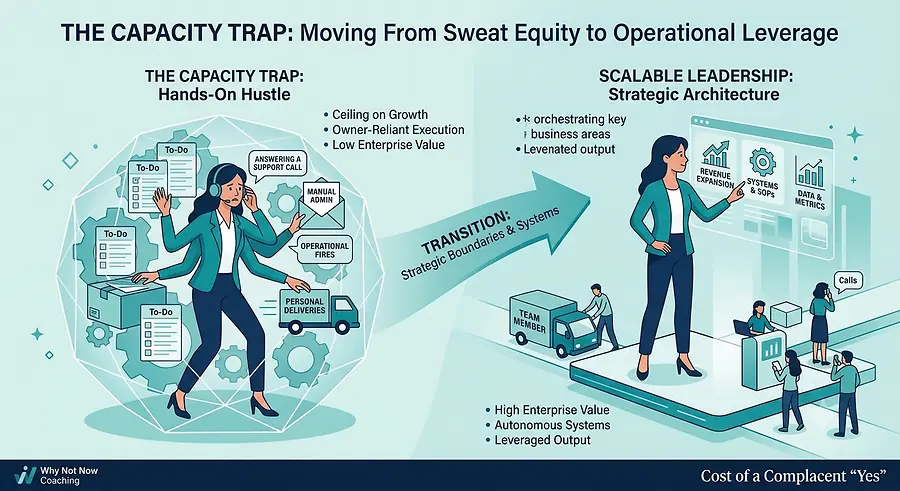
The Capacity Trap: When Hard Work Becomes the Barrier to Growth
In early-stage leadership, hustle is the ultimate competitive advantage. When you are building an enterprise from the ground up, wearing every hat isn't just necessary—it's practical. You sell during the day, manage operations at night, handle the finances on weekends, and step in to put out operational fires the moment they ignite.
For a time, this hands-on agility works. Revenue grows, client relationships strengthen, and you gain an intimate, granular understanding of every moving part in your business. You take pride in being the engine that powers the entire operation.
Then, an invisible wall appears.
Revenue plateaus or begins to fluctuate unpredictably. Your schedule becomes packed with low-leverage execution. You find yourself trapped in the daily delivery of your product or service—loading trucks, managing routine customer service, or wading through manual administrative tasks—working entirely in the operational gears rather than steering the ship.
Welcome to The Capacity Trap—the dangerous inflection point where the very work ethic that made you successful becomes the ceiling that caps your company's growth.
The Seductive Illusion of "Efficiency"
High-performing leaders fall into the Capacity Trap not because of laziness, but because of a deeply ingrained cognitive bias:
"It's faster, cheaper, and better if I just do it myself."
When you possess strong technical skills, high standards, and a deep personal commitment to quality, delegating can feel like a compromise. If a critical task needs to be completed—whether it's stepping onto the sales floor, managing supply logistics, or executing client deliveries—it often feels far more efficient to roll up your sleeves and get it done yourself.
However, this creates a false sense of productivity. While completing hands-on work provides an immediate sense of accomplishment, it quietly drains your highest-value asset: strategic bandwidth.
When a founder or executive trades finite leadership time for tactical labor, two critical organizational breakdowns occur:
The Growth Ceiling Hardens
A business cannot scale beyond the physical capacity of its leadership team. If operational output requires your personal presence and labor, revenue reaches its ceiling the moment your calendar fills up. You become the organization's greatest bottleneck.
Operational Atrophy Takes Hold
When leaders become the default safety net for tactical problems, teams stop developing problem-solving muscles. The organization becomes conditioned to rely on owner execution rather than repeatable systems, creating an environment where nothing moves forward without your direct involvement.
The Financial Cost of Owner Labor
Many business owners justify staying in the operational weeds because it saves immediate payroll or contractor expenses. They look at the $25-per-hour cost of a delivery driver, customer service representative, or administrative assistant and decide to save the money by doing the work themselves.
What they fail to calculate is the opportunity cost of their time.
If your strategic, sales, or business development activities have the potential to generate $200, $500, or even $1,000 per hour in enterprise value, spending three hours delivering products doesn't save $75. It costs the business thousands of dollars in lost growth opportunities.
Every hour spent doing work below your level of responsibility is an hour taken away from revenue expansion, market positioning, and long-term planning. You cannot build a million-dollar company on a ten-dollar-an-hour calendar.
From Sweat Equity to Operational Leverage
To break through this ceiling, leaders must fundamentally redefine what productivity means. Sustainable organizational growth does not come from doing more work—it comes from building operational leverage.
Leverage is the ability to achieve maximum output through systems, processes, data, contracts, and talented people rather than through personal sweat equity. Moving from owner-dependent execution to process-driven scalability requires a deliberate four-step framework.
1. Audit Your "Delivery Truck" Tasks
Every leader has a "delivery truck"—a recurring, high-effort, low-leverage task they continue to perform simply because they always have.
Take a hard look at your weekly schedule and divide your activities into two categories:
- Strategic Engine Work: sales strategy, financial modeling, team development, and key partnerships.
- Operational Maintenance Work: order fulfillment, deliveries, routine administrative work, and vendor follow-up.
Calculate the exact number of hours consumed by operational maintenance. Then ask yourself:
"If these hours were redirected entirely toward high-impact sales activities or strategic growth initiatives, what would our revenue look like next quarter?"
2. Manage by Framework, Not Intuition
Many leaders remain trapped in operations because they manage by instinct rather than by data. When sales decline or operations stall, their default response is to work harder instead of analyzing the metrics.
To successfully step away from manual execution, build simple, visible performance dashboards. Know your conversion rates, customer traffic, lead sources, delivery margins, and key operational indicators.
When you manage through measurable data, you can diagnose operational issues from the captain's chair instead of climbing into the engine room to inspect every part yourself.
3. Move from Executor to Architect
Scaling requires transitioning from the person doing the work to the architect designing how the work gets done.
Before delegating or outsourcing tactical responsibilities—whether to third-party logistics providers, operational staff, or specialized support—you must document the playbook.
Create clear, repeatable Standard Operating Procedures (SOPs). When you codify your operational standards, you make consistent, high-quality execution independent of your physical presence.
4. Build for Asset Value, Not Just Cash Flow
A profitable business generates cash flow today. A scalable business creates an autonomous asset that operates predictably tomorrow.
Whenever you face an operational decision or bottleneck, ask yourself:
"Does this solution make the business more dependent on me, or does it build a system that will outlast me?"
Stepping back from manual execution isn't about working less for the sake of leisure. It's about building an enterprise resilient enough to thrive through structure, strategy, and team capability.
The Highest Return on Leadership
Strategic boundaries aren't just about saying "no" to external distractions. They are also about saying "no" to low-leverage internal work.
Stepping away from the day-to-day tactical churn takes courage. It requires trading the immediate satisfaction of execution for the long-term discipline of building systems. Yet when you step out of the operational machine, you reclaim the bandwidth needed to lead, innovate, and scale sustainably.
Your organization doesn't need you to be its hardest-working laborer.
It needs you to be its visionary architect.