
The Disconnection We Have Learned to Call Normal
How Trauma Creates Disconnection and Why Reconnection Is Essential for Individual and Collective Healing
There are moments when something I have been writing suddenly takes on a meaning much larger than the page in front of me.
Recently, while working on my book, I came across a passage I had written about trauma and healing.
I stopped.
I read it again.
And then I began thinking about the world around us.
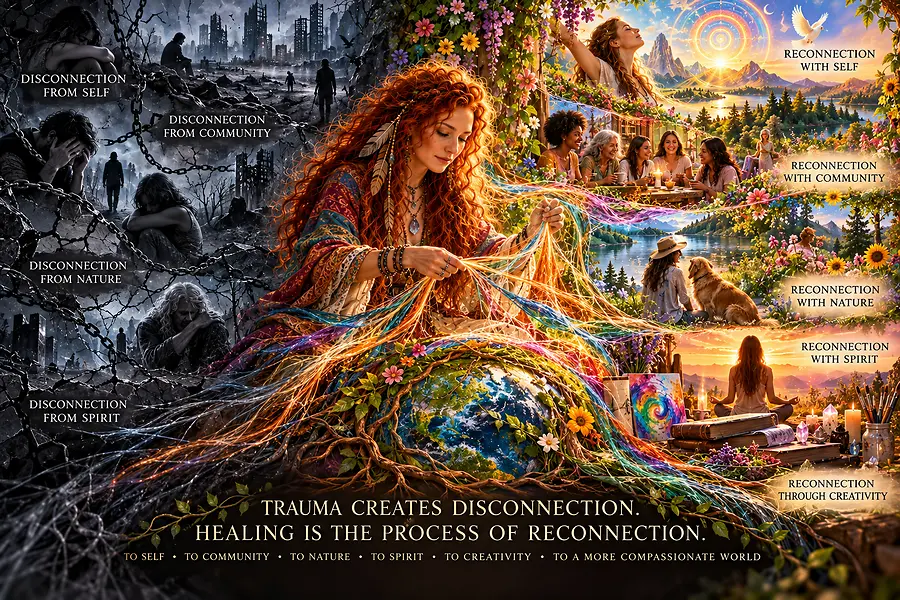
Trauma creates disconnection. Disconnection from self. Disconnection from community. Disconnection from nature. Disconnection from spirit. Healing is the process of reconnection.
What began as a reflection on personal healing suddenly felt like a question about our entire society.
Because when I look around today, I see a world struggling with disconnection on an extraordinary scale.
People divided from one another. Families struggling to communicate. Communities fractured by fear and mistrust. Individuals disconnected from their own needs, emotions, and identities. Children spending more time navigating digital environments and less time exploring the natural world. Adults working so hard to survive that meaningful connection becomes something they hope to find time for later. And everywhere, people searching for belonging.
I began wondering whether some of what we are witnessing is not simply a crisis of disagreement, but a deeper crisis of connection.
What happens to a society when people forget how to belong to themselves, to one another, and to the living world around them?
When Disconnection Begins Within
Trauma can change the way we experience ourselves and the world.
For some people, overwhelming experiences create a sense of separation from their own emotions, bodies, memories, or identities.
Sometimes that separation is protective. When an experience becomes too painful, frightening, or overwhelming, distancing ourselves from what we feel can become a way to cope.
We learn to function. We learn to anticipate danger. We learn to keep going.
We may become exceptionally good at caring for others while struggling to recognize our own needs. We may learn to ignore exhaustion, discomfort, sadness, or fear because acknowledging those feelings once seemed unsafe. And over time, we may become so accustomed to surviving that we forget what it feels like simply to live.
I believe this is one of the quieter consequences of trauma. It can interfere with our relationship with ourselves. We may know what everyone else expects from us but struggle to answer a simple question:
What do I want?
Or perhaps an even more difficult one:
Who am I when I am no longer living according to someone else's expectations?
Reconnection begins, in part, by making room for those questions. Not with judgment. Not with demands. But with curiosity, compassion, and the freedom to discover our own answers.
A Society That Rewards Disconnection
Now consider what happens when the world around us reinforces some of those same patterns.
We celebrate productivity while treating rest as a luxury. We encourage independence while often overlooking the importance of interdependence. We measure success through possessions, titles, income, and accomplishments, sometimes without asking whether people feel fulfilled or connected. We expect individuals to manage extraordinary pressures while providing too little support for the communities in which they live.
And when someone begins to struggle, we may ask what is wrong with that person before asking what conditions have contributed to their distress.
This does not mean every social problem is caused by trauma. Poverty, discrimination, political conflict, economic insecurity, technological change, and unequal access to resources have distinct causes that deserve serious attention. But trauma can influence how people experience those conditions, respond to uncertainty, and relate to one another. And environments characterized by chronic insecurity, exclusion, or fear can make healing more difficult.
We cannot understand human well-being by examining individuals while ignoring the environments in which they are trying to survive.
That is one reason I believe healing must involve more than individual coping strategies. We must also examine the conditions that help people feel safe, valued, connected, and capable of participating in their communities.
When Community Becomes a Word Instead of an Experience
We use the word community constantly. Online communities. Professional communities. Neighborhood communities. Spiritual communities. Educational communities.
But what does community actually mean? Is it simply living near other people? Sharing a digital platform? Belonging to an organization? Or does genuine community require something more?
I believe community begins when people recognize that their lives are connected. When someone notices that a neighbor has not been seen for several days. When an elder has someone to share a meal with. When a child has trusted adults who encourage curiosity and creativity. When someone experiencing grief does not have to carry it entirely alone. When people can disagree without immediately denying one another's humanity. When helping is not always a transaction. And when belonging does not depend upon being useful, agreeable, or identical to everyone else.
Community is not the absence of differences. It is the willingness to remain human with one another despite them.
Yet many of our social environments seem to reward competition, comparison, suspicion, and division. We become separated into categories. We begin relating to labels instead of people. And eventually, we may stop asking what another person has experienced and begin assuming we already know who they are.
Disconnection makes it easier to judge someone we have never taken the time to understand.
The Difference Between Being Connected and Feeling Connected
We live in an extraordinary technological age. We can speak with someone thousands of miles away. We can learn about cultures, histories, scientific discoveries, and events almost instantly. We can build friendships and communities that would once have been impossible.
Technology has created meaningful opportunities for connection, especially for people who are isolated by geography, disability, or circumstance.
But access to communication does not automatically create emotional closeness. We can have hundreds of contacts and still feel lonely. We can participate in endless conversations without feeling heard. We can spend hours observing other people's lives while becoming increasingly dissatisfied with our own. And we can become so accustomed to responding to information that we lose opportunities for reflection.
Connection requires more than contact. It requires attention. Listening. Trust. Reciprocity. And the willingness to recognize another person's humanity.
Perhaps we need to ask not simply how connected our devices have become, but how connected we feel to the people around us.
When We Lose Our Relationship With Nature
There is another form of disconnection that concerns me deeply: our separation from the natural world.
Nature has always been one of my greatest teachers. A garden does not grow because someone demands immediate results. A tree does not apologize for resting through winter. A river does not stop being a river because its course changes. The natural world reminds us that growth, change, rest, and renewal are part of life.
Yet many people move through their days with little opportunity to experience that relationship. Our schedules are crowded. Our environments are increasingly built around convenience and efficiency. Some communities lack safe, accessible green spaces. And many people simply do not have the time or resources to spend outdoors.
For those who can access it, time in nature can offer opportunities for movement, reflection, sensory engagement, and relief from daily pressures.
But reconnecting with nature is not only about personal well-being. It is also about remembering that we are part of an interconnected living system. The health of our communities is tied to the health of our environments.
Clean water matters. Healthy soil matters. Trees matter. Animals matter. Access to green spaces matters. And our relationship with the natural world influences how we understand responsibility for the places we share.
We cannot separate human flourishing entirely from the environments that sustain human life.
What Happens When We Lose Our Spiritual Center?
I use the word spiritual thoughtfully. I do not believe spirituality belongs exclusively to any one religion or tradition.
For some people, spiritual connection comes through prayer or religious practice. For others, it emerges through meditation, music, creativity, nature, service, ancestral traditions, or quiet reflection. And for others, a sense of meaning and belonging may be grounded in secular philosophy or human relationships rather than spiritual belief.
What matters to me is the underlying human need to experience meaning. To understand our values. To feel connected to something beyond immediate demands. To consider how we wish to live.
When people become consumed by survival, those questions can disappear beneath everyday responsibilities. We stop asking what gives our lives meaning. We stop making time for reflection. We may even begin confusing what we are expected to accomplish with who we are.
Reconnection invites us to rediscover the beliefs, values, relationships, and practices that help us live with greater intention. Not because everyone must follow the same path, but because every person deserves the opportunity to explore what makes life meaningful to them.
The Generations That Carry What Was Never Discussed
One of the most important reasons to understand trauma is that its consequences do not always end with the person who experienced it.
Family patterns can influence how children learn about safety, relationships, conflict, emotions, and trust. A parent who grew up in an unpredictable environment may struggle to feel secure. A caregiver who was never allowed to express emotion may find emotional conversations difficult. A family that learned to survive through silence may continue avoiding painful subjects long after the original danger has passed.
These patterns can be transmitted through learned behaviors, relationships, social conditions, and family environments. But they are not inevitable. And they do not mean that people who have experienced trauma are destined to harm others.
Awareness creates opportunities for change. Education creates opportunities for understanding. Supportive relationships create opportunities to experience something different. And when people are given the resources, safety, and freedom to develop new patterns, families and communities can begin changing the stories they pass forward.
We may inherit patterns we did not choose, but we can work toward creating patterns we do not have to repeat.
Creativity as a Way Back to Ourselves
This is where my work as an artist and educator becomes especially meaningful to me.
I believe creativity can provide an important pathway toward reconnection. Not because painting, cooking, music, writing, or gardening can magically erase trauma. They cannot. And creative practices should not be presented as substitutes for professional care when that care is needed.
But creativity offers opportunities for expression, exploration, connection, and agency. A person who struggles to describe an emotion may find expression through color. Someone who feels disconnected from their body may enjoy the sensory experience of kneading bread or working with clay. A person who has lost confidence may discover satisfaction in growing something from seed. A group of strangers may begin building relationships while preparing a meal together.
Creativity can create spaces where people are not defined solely by what happened to them. They are allowed to explore what they can imagine, learn, and make.
That matters. Because healing is not only about understanding pain. It is also about rediscovering possibility.
What If We Built Communities Around Reconnection?
Imagine approaching education, community development, and human services through a different set of questions.
Instead of asking only how to make people more productive, what if we also asked how to help them feel connected? Instead of focusing exclusively on individual achievement, what if we created more opportunities for cooperation? Instead of treating creativity as an optional luxury, what if we recognized its role in learning, expression, and community participation? Instead of assuming everyone has access to nature, what if we designed environments where more people could experience it? Instead of expecting people to navigate grief, hardship, and transition entirely alone, what if we strengthened the relationships and resources available to them?
This does not require abandoning personal responsibility. It means recognizing that responsibility exists alongside opportunity, support, and social conditions.
We can encourage individual growth while also working to create environments where growth is possible. We can value independence while acknowledging that human beings need one another. And we can recognize that lasting change often begins when people feel they have a meaningful place in the world.
Healing the Whole Person
These ideas are central to the philosophy behind my work and writing.
I believe human beings deserve to be understood as whole people. Not simply as diagnoses. Not simply as workers. Not simply as students. Not simply as survivors. Not simply as members of a particular social category.
We are individuals with histories, bodies, emotions, relationships, creative capacities, values, and hopes. Our well-being is influenced by the interaction of these dimensions.
That is why I continue exploring approaches that bring together education, creativity, nature, community, reflection, and trauma-informed principles. Not as a single solution for every person, but as interconnected opportunities for learning, connection, and personal growth.
I do not believe healing should become another demand for perfection. I believe it should make more room for humanity. More room to rest. More room to question. More room to create. More room to belong. And more room to decide who we wish to become.
Reconnection Is Also a Social Responsibility
Perhaps the most important realization I had while rereading that passage from my book was this:
We cannot place the entire responsibility for healing on individuals while ignoring the conditions that contribute to disconnection.
If people are isolated, we need opportunities for community. If people are overwhelmed, we need systems that recognize human limits. If people are excluded, we need to examine barriers to participation. If people are afraid to speak, we need environments where their voices can be heard safely. If children are struggling, we need to consider not only their behavior but also their relationships, experiences, and surroundings. And if our communities are divided, we need to ask what might help people begin seeing one another as human beings again.
Reconnection does not mean everyone must agree. It does not require returning to an idealized past. And it does not mean overlooking injustice or abandoning boundaries in the name of unity.
Healthy connection requires respect for difference, personal autonomy, and accountability. Sometimes reconnecting with ourselves even means recognizing that certain relationships are unsafe and choosing distance. Belonging should never require surrendering our dignity.
Perhaps We Have Been Asking the Wrong Question
We spend an extraordinary amount of time asking what is wrong with the world. What is wrong with our communities? What is wrong with our relationships? What is wrong with our children? What is wrong with the people who disagree with us?
Those questions may identify real problems. But perhaps we also need another question.
What have we become disconnected from, and what would it take to reconnect?
To ourselves. To one another. To the natural world. To our creativity. To our values. To the places where we live. To the possibility that we can create something different together.
I am not suggesting that reconnection alone will solve poverty, discrimination, violence, or every other challenge facing society. Meaningful change requires practical action, resources, policies, and accountability. But I believe reconnection can be part of the foundation that makes such change possible.
Because it is difficult to care for what we no longer feel connected to. It is difficult to build community when we no longer recognize our need for one another. And it is difficult to imagine a better future when survival has consumed our capacity to hope.
Perhaps healing begins when we create enough safety and space for those capacities to return.
One conversation. One relationship. One garden. One classroom. One shared meal. One creative act. One community at a time.
I began this reflection with a passage from my book. I want to end by returning to its central idea:
Trauma can create disconnection. Healing can involve reconnection.
And perhaps, when we begin taking that idea seriously—not only in our personal lives but also in the way we build our communities—we may discover something important.
A disconnected society cannot become a connected one simply by asking individuals to heal in isolation.
We must also create places where connection can grow. Where dignity is protected. Where differences can be respected. Where creativity is welcomed. Where nature is valued. Where people can find meaning. And where nobody must earn the right to belong by surrendering who they are.
Because perhaps the future we are searching for will not be built by teaching people to survive an increasingly disconnected world.
Perhaps it will begin when we remember how to create a world in which more people can truly belong.
Mylee Star Hawk, MAED, founded Mama Star's Healing Circle to support healing through education, art, and community. With 25+ years in education and community support, Star specializes in addressing generational trauma through creative expression, culinary arts, and spiritual practices. An ordained minister and master chef pursuing a doctorate in Transpersonal Psychology, she integrates education, creativity, and…





