The Future of Family Living
Discover how prefabricated homes are reshaping family living by enabling multiple generations to live independently on shared property.

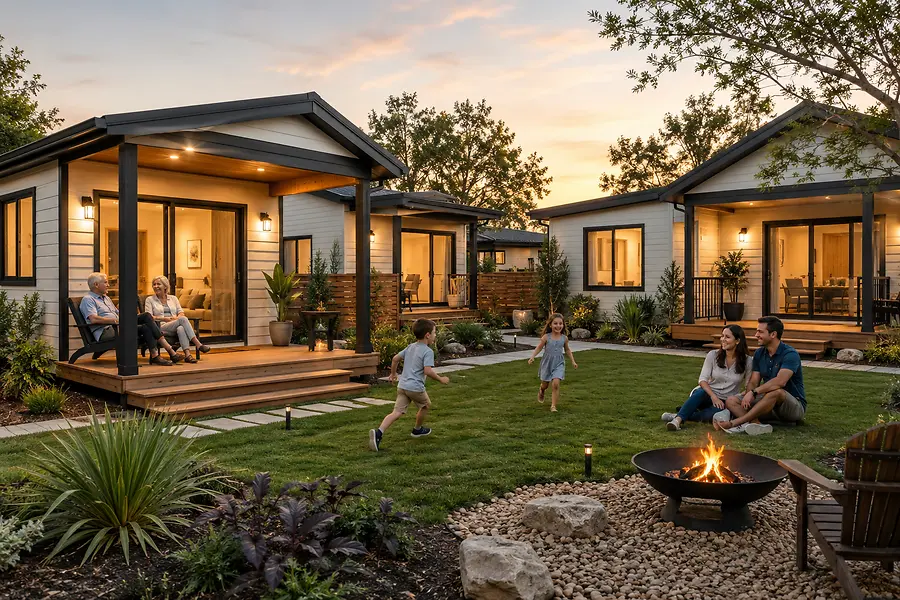
How Modular Homes Are Bringing Generations Together
As housing prices, rents, and everyday living expenses continue to rise, families are finding new ways to share resources while maintaining their independence. One solution gaining attention is multi-generational living supported by modular and prefabricated homes.
Instead of moving grandparents, parents, and adult children into one crowded household, some families are choosing a different approach: placing a separate, fully equipped home on the same property.
The result can provide something many families are looking for—proximity without sacrificing privacy.
A Home Close Enough to Help
For one Australian family, a modular home created an opportunity for grandparents to live just steps away from their daughter and grandchildren.
The grandparents had considered building a traditional home but found the cost prohibitive. A prefabricated modular house offered another option. The home was constructed off-site, transported to the property in sections, and assembled relatively quickly.
The arrangement allowed the older generation to remain independent while being close enough to help with everyday family life.
Grandparents could spend time with their grandchildren, assist with school routines, and enjoy family meals while still returning to their own home at the end of the day.
That balance is one of the major attractions of multi-generational housing.
Together—but Not Under the Same Roof
Multi-generational living doesn't necessarily mean everyone has to share a kitchen, living room, or daily schedule.
A separate modular home can create a natural boundary between generations.
Parents can raise their children according to their own routines. Grandparents can maintain their independence. Adult children can have access to family support without feeling as though they have moved back into their parents' home.
In many cases, that separation may actually strengthen family relationships.
It provides opportunities to spend time together when everyone wants to—but also gives each household a place of its own.
Housing Costs Are Changing Family Decisions
The growth of multi-generational households is being driven by more than a desire for family connection.
Housing affordability is becoming an increasingly important factor.
Young adults are finding it more difficult to purchase homes. Older homeowners may have significant equity in their properties but still face increasing costs as they age. Parents are also dealing with expensive childcare, housing, and other household expenses.
For some families, sharing property and resources can provide a practical financial solution.
Recent Australian census data cited by ABC News showed a significant increase in multi-generational households, with the number rising from about 275,000 to 335,000 between census periods.
The trend illustrates how economic conditions can influence the way families choose to live.
Another Option: Bringing Adult Children Home
Multi-generational living doesn't always require a new building.
Some homeowners are simply modifying their existing homes to accommodate adult children or grandchildren.
For families with enough space, this can allow younger adults to save money that might otherwise go toward rent while they work toward purchasing their own homes.
It can also benefit older homeowners.
Having adult children nearby can provide companionship and an additional layer of support as parents grow older.
The key is establishing clear expectations.
Some families choose to operate almost like roommates, maintaining separate finances, food, schedules, and responsibilities while sharing the same property.
Modular Housing Could Become a Bigger Part of the Solution
The concept of factory-built housing is not new, but modular construction remains a relatively small part of Australia's overall residential construction market.
One reason is consumer confidence. Some buyers still associate prefabricated housing with temporary or lower-quality construction.
Modern modular homes, however, can be designed as permanent residences with kitchens, bathrooms, bedrooms, living spaces, and other features comparable to traditionally constructed homes.
Another major advantage is construction speed.
Because much of the building process takes place in a controlled factory environment, work can continue while the foundation and property are being prepared.
Once the modules arrive, they can be assembled much faster than many conventional builds.
The Potential for More Housing
Industry researchers believe modular construction could become increasingly important as governments, developers, and builders look for ways to increase housing supply.
One analysis cited by ABC News estimated that coordinated investment and policy support could potentially result in hundreds of thousands of additional homes over a 20-year period.
The benefits could be particularly significant in communities struggling with housing and labor shortages.
Building portions of homes in factories can reduce the amount of construction work required at the property itself and potentially improve productivity.
The Rise of the Modern Multi-Generational Property
The traditional idea of a family home is changing.
Tomorrow's family property may not necessarily be one large house where everyone shares the same living space.
Instead, it could be a property containing two or more independent residences.
Imagine a property where:
- Grandparents have their own one- or two-bedroom home.
- Parents have a separate primary residence.
- Adult children have a private living area.
- Everyone shares outdoor space, gardens, or recreational areas.
- Family members can help one another without giving up personal space.
This type of arrangement could become particularly attractive in suburban and rural communities where larger lots provide room for additional dwellings.
More Than a Housing Strategy
The greatest benefit may not be financial.
For many families, multi-generational housing creates something increasingly difficult to find—time together.
Grandparents can watch grandchildren grow up. Adult children can remain connected to their parents. Families can share responsibilities during difficult seasons of life.
And when circumstances change, the property may continue to adapt.
A home designed for multiple generations today could eventually become a residence for aging parents, an independent home for adult children, a guest house, or even a rental property.
A Different Vision for Homeownership
The housing affordability challenge is forcing families to think differently about how property is purchased, developed, and used.
Modular construction may be part of that evolution.
Rather than asking whether every generation needs a completely separate property, families are beginning to consider whether one strategically planned property could serve several generations.
The goal isn't simply to put more people under one roof.
It's about creating homes that allow families to stay connected while preserving independence, privacy, and dignity.
For families willing to think beyond the traditional single-family-home model, modular and multi-generational housing could offer a compelling path toward more affordable and flexible living.