THE IDENTITY GOVERNANCE TRIBUNE
Signal-to-Consequence Mapping: Automating Identity Governance Responses for AI Agents

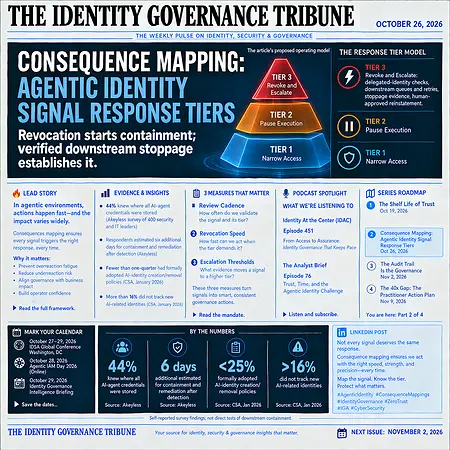
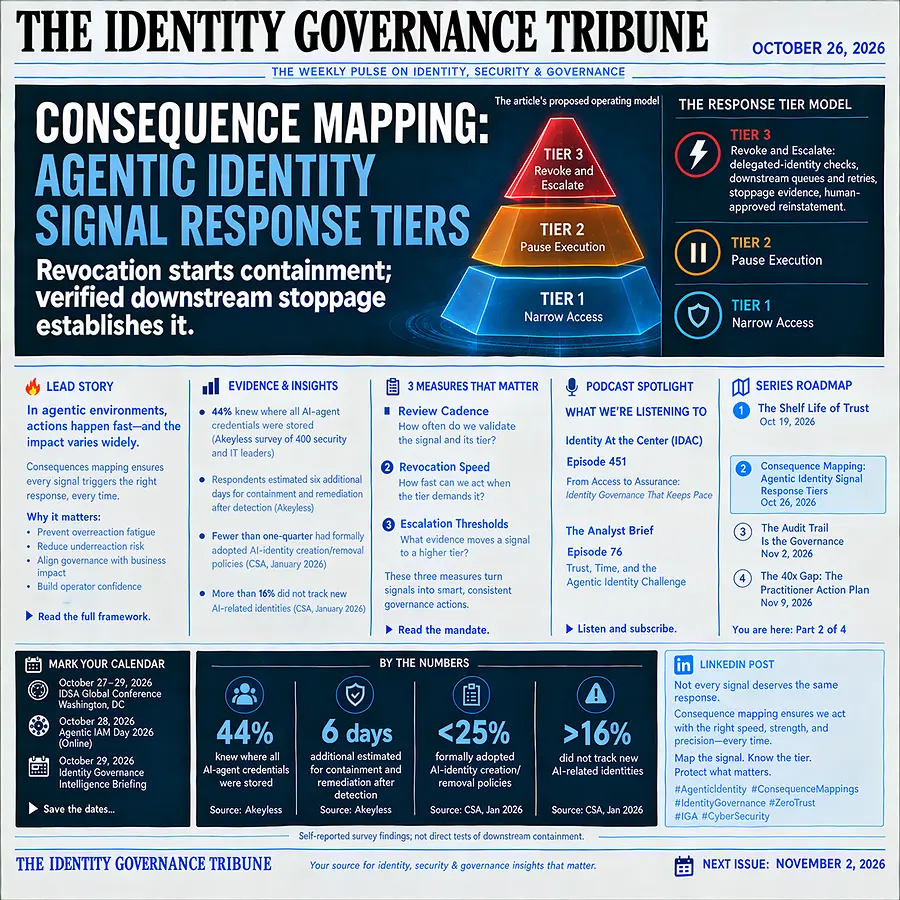
The Identity Governance Tribune | Vol. 1, Issue 8 | October 26, 2026
In the last issue, we described the shelf life of an access decision as the window between a governance judgment and a material change that makes that judgment unreliable. The practical consequence is immediate: when the assumptions behind an authorization decision no longer hold, the governance program needs a mechanism to detect that change and a predefined response for what happens next.
That mechanism is not a review campaign. Review campaigns are scheduled in advance, operate on calendar intervals, and evaluate access in aggregate. This article proposes a complementary mechanism for agentic identity governance: a signal-to-consequence mapping—a predefined table connecting specific observations about agent behavior to specific authorized responses. Those responses are decided before pressure arrives and encoded into the governance architecture, so detection triggers an authorized decision rather than an improvised conversation.
The proposed model applies a familiar security-operations principle: when a defined condition is met, a defined response follows. Incident response playbooks, SIEM escalation rules, and threat intelligence workflows provide useful parallels. Here, the same logic is applied to AI-agent identity governance, with predefined responses to behavioral changes that may undermine an earlier access decision.
THE GAP BETWEEN OBSERVATION AND AUTHORITY
Detection alone does not authorize action. Consider an organization with behavioral analytics, SIEM integrations, and anomaly detection: when a signal fires, it produces a ticket, a Slack message, or a meeting, but no predefined response. The observation is made, the authority to act remains unclear, and the agent continues operating. This is the gap between observation and authority that consequence mapping is designed to address.
The VDF AI Governance Handbook, published in August 2026 and covering 14 control domains across more than 40 record and field specifications, names this directly: "A policy document that no gateway enforces is not governance—it is an intention." The distinction matters because intentions do not revoke credentials, narrow tool access, or pause agent execution. Only governance architecture with predefined, authorized consequences can do that.
The CoSAI Agentic IAM framework, approved by the Coalition for Secure AI’s Technical Steering Committee on March 20, 2026, and publicly released on April 17, 2026, provides guidance on identity and access management for AI agents. In the consequence-mapping model proposed here, an observed anomaly is only as useful as the response it is authorized to trigger.
"A policy document that no gateway enforces is not governance—it is an intention."
— VDF AI Governance Handbook, August 2026
THREE TIERS OF AUTHORIZED RESPONSE
Consequence mapping is not a binary choice between “do nothing” and “revoke everything.” This article proposes a graduated response ladder: three tiers matching response severity to signal severity. The aim is proportionate, timely action, with predefined automated responses and human decision points where required.
TIER 1 — NARROW ACCESS (Automated, Immediate)
Trigger: Low-severity behavioral anomaly. The agent’s actions depart from its normal operating pattern but remain within its authorized scope. Examples include unusual API call frequency, tool access outside normal hours, and unusual requests to adjacent data sets that the agent is authorized to access.
Response: Automatically reduce scope by refreshing tokens with narrower permissions, applying rate limits, and suspending access to adjacent data sets pending review. The agent continues executing its primary function. No human decision is required to execute the predefined response; the owner is notified for awareness.
TIER 2 — PAUSE EXECUTION (Automated Trigger, Human Decision)
Trigger: A medium-severity signal indicates that the agent is attempting actions that materially exceed its defined authorization scope, or that a delegation chain has been extended beyond its approved depth. Examples include attempts to create unauthorized agent instances or escalate privileges.
Response: Suspend agent execution and hold the task queue. Notify the named owner with the signal details and decision options: resume with the current scope, resume with a narrower scope, or terminate. Define the decision window and default consequence before deployment. A 15–60-minute window is an illustrative local configuration, not a verified industry benchmark. If no authorized decision is made before the deadline, the predefined default executes automatically.
TIER 3 — REVOKE AND ESCALATE (Automated, Immediate)
Trigger: High-severity signal. The agent is behaving in ways that indicate compromise, prompt injection, or material misuse of delegated authority. Examples: the agent attempting to exfiltrate data, the agent adding instructions to its own memory to conceal behavior, or the agent communicating through channels it created autonomously.
Response: Immediate credential revocation upon signal confirmation, without waiting for a human decision. Terminate affected active sessions, open an incident record, and escalate to the security team. Identify affected child agents, delegated tokens, and sessions, and verify that downstream enforcement points reject the revoked authority.
Stop or quarantine pending work across affected queues, including retries; preserve task records before clearing queues. Account for external actions already in flight, recording what completed, what was stopped, and what remains unresolved. Record where execution actually stopped and when each enforcement boundary acknowledged containment. Revocation starts containment; verified downstream stoppage establishes it. Reinstatement requires a named human to review the evidence, resolve outstanding exposure, and approve a newly scoped restart. These are proposed Tier 3 acceptance criteria, not a claim that every deployment implements them.
"Governance becomes actionable when behavioral drift, anomalous privilege use, or material context change maps to predefined responses—narrowing access, pausing execution, or requiring human revalidation. That turns detection from observation into decision authority and makes the escalation path auditable before pressure arrives."
The response ladder defines what this model authorizes; the evidence below addresses gaps in current identity-lifecycle practice and estimated incident response time. These are different kinds of information. The survey findings provide context, while the local revocation target is a proposed operating objective—not an observed result or proof of containment.
■ BY THE NUMBERS
Six additional days — Respondents’ estimated time to contain and remediate a compromised AI agent after detection, not measured time to revoke credentials. The report surveyed 400 security and IT leaders. Akeyless, The 2026 State of AI Agent Identity Security Report.

Carol Griffin is a technology, security, and telecommunications leader with more than two decades of experience guiding large‑scale infrastructure, identity, and cloud modernization programs. She is the Founder of ROSE Tech Academy LLC, a Microsoft Security Advisor in the Microsoft Community’s private NDA program, and a Technical Thought Speaker with the Microsoft Speakers Hub. Carol spent 25 years at AT&T,…