The Importance of Women in Leadership: Reflections from My Workday Journey
How emotional intelligence and transformational leadership are redefining organizational change through women's vision.

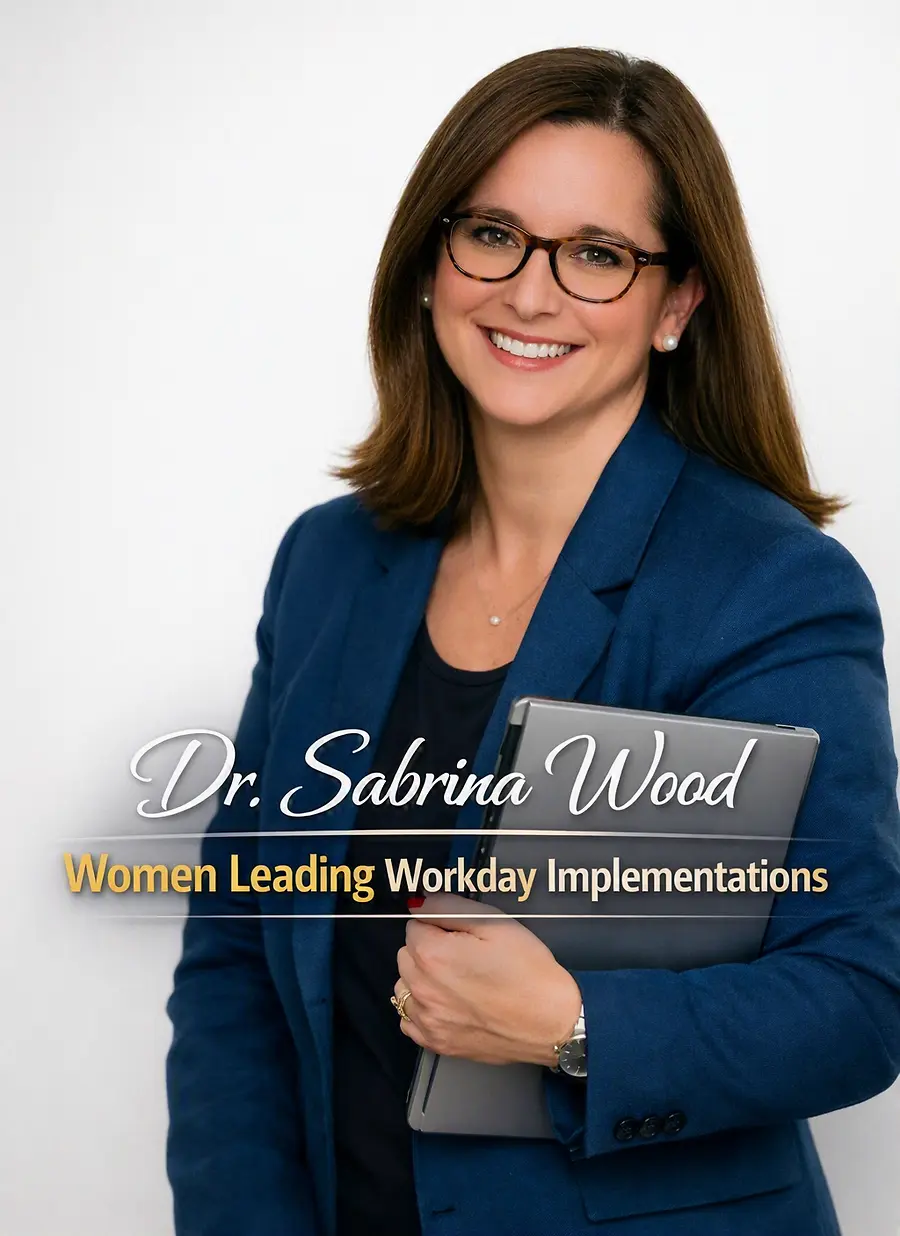
Women Leading the Future of Workday Transformation
By: Sabrina Wood, PhD
As a woman who has spent my career leading Workday Talent, Performance, Learning, People Experience, Peakon Employee Voice, and People Analytics implementations, I have seen firsthand how essential women are to the future of organizational transformation. Our presence in leadership roles is not simply beneficial; it is catalytic. The way women lead fundamentally strengthens the quality, humanity, and long-term success of Workday programs.
Throughout my career at KPMG, Huron Consulting Group, and now as Senior Partner and Area Lead at Solution Architects Group, I have led global teams, architected enterprise solutions, mentored consultants across multiple countries, and guided organizations through complex change.
What I have learned is that Workday implementations are not just technical projects; they are human projects. Women leaders bring the emotional intelligence, communication skills, and relationship-centered leadership that these projects require.
Research supports what I have experienced throughout my career: emotional intelligence is a core driver of effective leadership, especially in environments that require collaboration, cross-functional alignment, and continuous listening (Goleman, Boyatzis, & McKee, 2002). Workday implementations demand all of these qualities.
Whether I am facilitating design sessions, resolving escalations, coaching consultants, or guiding executives through change, the ability to lead with empathy and clarity is essential.
Women often excel in transformational leadership, a style strongly associated with higher team performance, stronger collaboration, and improved organizational outcomes (Wang et al., 2011). In my own work, transformational leadership has meant creating psychologically safe spaces for teams, elevating consultant well-being, shaping best-practice methodologies, and ensuring that every solution reflects both technical excellence and human experience.
This is especially true in Workday Peakon Employee Voice implementations. Peakon requires leaders to understand culture, communication patterns, and the emotional realities of employees. Women's strengths in relationship management and social awareness directly support the continuous-listening frameworks upon which Peakon is built.
Research shows that leaders who prioritize empathy and psychological safety can foster stronger engagement and retention—outcomes central to Peakon's purpose (Hur et al., 2011).
Beyond consulting, my work as a Professional Adjunct Lecturer at National Louis University and as a longtime faculty member at The Chicago School of Professional Psychology has reinforced the importance of women in shaping the next generation of Workday and organizational leaders.
Teaching courses in leadership, organizational behavior, ethics, performance analysis, and diversity has allowed me to mentor hundreds of students, many of whom are women entering leadership roles for the first time.
Representation matters, and I am proud to contribute to a pipeline of women who will continue transforming organizations through both technology and humanity.
Women in leadership are not simply participating in Workday implementations; we are redefining them.
We bring a blend of technical expertise, emotional intelligence, strategic thinking, and inclusive leadership that elevates every project we touch. As organizations continue adopting Workday to modernize HR, Learning, Talent, and People Experience functions, the presence of women leaders will remain a decisive factor in achieving meaningful, sustainable transformation.
I am proud to be part of that movement and proud of the women who continue to lead with strength, empathy, and vision.
References
Goleman, D., Boyatzis, R., & McKee, A. (2002). Primal leadership: Realizing the power of emotional intelligence. Harvard Business School Press.
Hur, Y. H., van den Berg, P. T., & Wilderom, C. P. M. (2011). Transformational leadership as a mediator between emotional intelligence and team outcomes. The Leadership Quarterly, 22(4), 591–603.
Wang, G., Oh, I.-S., Courtright, S. H., & Colbert, A. E. (2011). Transformational leadership and performance across criteria and levels: A meta-analytic review of 25 years of research. Group & Organization Management, 36(2), 223–270.


