The Leadership Skill Too Many People Ignore
Master emotional discipline and intentional decision-making to lead with clarity and create organizational stability.

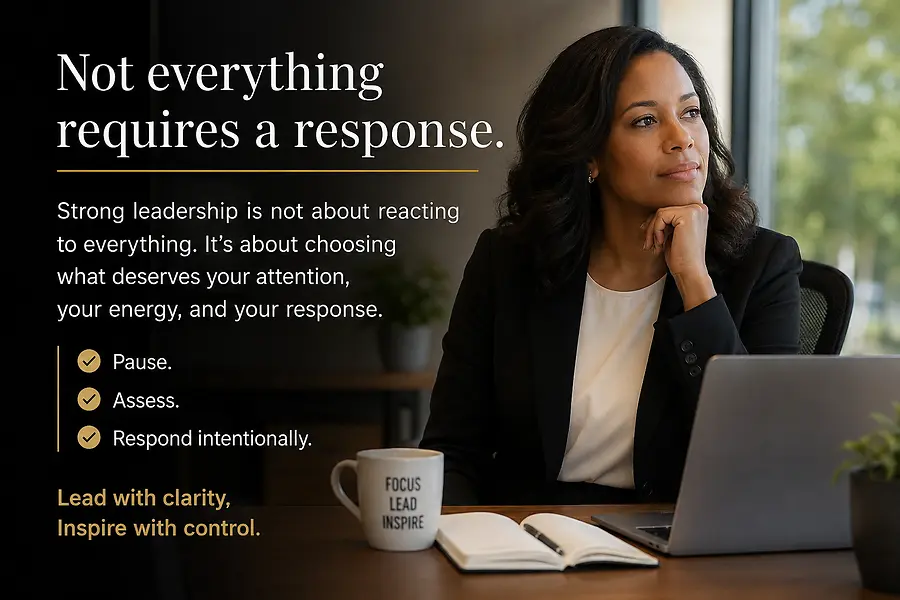
The Power of Restraint in Leadership
One of the most underrated leadership skills is restraint. In today’s workplace, many leaders feel pressure to react immediately to every opinion, disagreement, email, emotion, or conflict. But strong leadership is not measured by how quickly you respond. It is measured by how intentionally you lead.
Executive Presence Is Emotional Discipline
Executive presence is often less about speaking louder and more about mastering emotional discipline. The ability to pause, assess objectively, regulate emotions, and lead with clarity creates stability within teams, especially during moments of tension, uncertainty, or conflict.
Reactive Leadership Creates Organizational Chaos
When leaders operate impulsively, emotionally, or from personal bias, it creates confusion, mixed messaging, fear-based communication, inconsistent decision-making, workflow disruption, reduced productivity, and emotional fatigue within teams. Teams become distracted managing personalities and unnecessary urgency rather than focusing on execution, innovation, and outcomes.
The Impact on Productivity and Operational Workflow
Impulse reactions may feel productive in the moment, but they often create long-term operational inefficiencies. Employees who are forced into constant reaction mode lose focus, collaboration weakens, and workflow slows down. In healthcare and other high-performing environments, emotionally reactive leadership can negatively impact morale, retention, communication, interdisciplinary collaboration, efficiency, and the overall experience for both employees and customers.
Emotional Intelligence Is a Leadership Requirement
Research from Harvard Business School identifies emotional intelligence as one of the strongest predictors of effective leadership. Leaders with high emotional intelligence are more likely to remain calm under pressure, navigate conflict effectively, and create healthier team dynamics. Daniel Goleman’s work on emotional intelligence further highlights self-awareness and emotional regulation as critical leadership traits.
Strong Leaders Know What Deserves Energy
Strong leaders know what requires escalation, what requires coaching, what requires accountability, and what simply requires silence. The ability to regulate emotion is not weakness — it is maturity. The ability to remain objective is not disengagement — it is discipline. And the ability to avoid unnecessary conflict is not avoidance — it is strategic leadership.
Leadership Sets the Emotional Tone
The strongest leaders are not the ones who react to everything. They are the ones who understand that clarity, fairness, composure, and intentional communication create credibility. As leaders, we set the emotional tone of our organizations whether we realize it or not. Sometimes, the most powerful response is no reaction at all.
References
• Harvard Business School Online. Emotional Intelligence in Leadership. https://online.hbs.edu/blog/post/emotional-intelligence-in-leadership
• Goleman, Daniel. Emotional Intelligence. Bantam Books.
“Sometimes the most powerful response is no reaction at all.”