The Most Personal Rooms Begin With What Already Matters
Design that honors your story and supports the life you actually live.

Interior design is often presented as a dramatic before and after. The old room disappears, everything new arrives, and the transformation is complete. That can be exciting, but it is not always where the most meaningful design begins.
Sometimes the best starting point is already in the room.
It may be a piece of furniture that has served a family for years, artwork found while traveling, something handmade, or an object inherited from someone deeply loved. It may not be valuable in the traditional sense, but it carries a story. When those stories are removed in favor of whatever is currently popular, a home may become more stylish while feeling less like the people who live there.
I believe a well-designed space should support the life that needs to be lived within it. It should also reveal something about the people living that life.
Begin With the Life, Not the Shopping List
Before choosing paint colors, furniture, or finishes, I want to understand what needs to happen in the room.
How do people move through it? What creates frustration? What makes them feel comfortable? Are they hoping to gather, rest, work, create, or simply move through the morning with less chaos?
A beautiful room that does not support daily life will eventually become a burden. The furniture may be impressive, but if no one wants to sit on it, it is not serving the home. A kitchen may photograph beautifully, but if preparing a meal feels difficult, something essential has been missed.
Design goes much deeper than deciding what looks good. It creates the setting in which ordinary life unfolds.
Look Carefully at What Is Already There
When approaching a room, I pay attention to what should stay. This is not only a practical way to work; it can also lead to a much richer design.
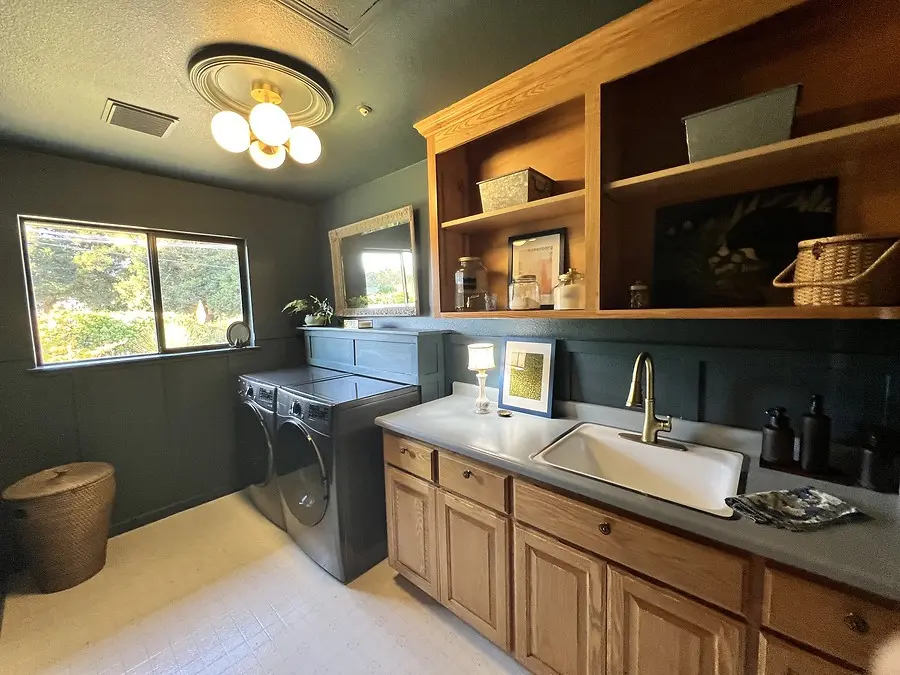
In my own laundry room, some of the most meaningful pieces are not traditional laundry-room décor. There is my mother's sewing basket, a small lamp that belonged to my grandfather, a piece of art acquired from an estate, and an antique brass trivet given to me by a friend because it had belonged to her father.
Individually, these objects come from different places and periods. The room needed a strong visual story to bring them together, so I used a deep green throughout the space and repeated warm wood, brass, glass, and natural textures. Practical necessities became part of that story rather than distractions from it.
Laundry detergent sheets are kept in a glass-and-brass box instead of a plastic container. Vinegar used for softening laundry sits in a glass dispenser. Even the lids of ordinary storage jars were painted brass to connect them to the other finishes.
There is also a plate painted with yellow flowers beneath a potted fern. No one sees it unless the fern is moved for watering, but I know it is there, and it makes me happy.
Not every meaningful detail has to announce itself. A home is not a display created for everyone else. Some details can exist simply for the person who lives there.
Let History Participate in the Present
Honoring history does not mean turning a home into a museum. It means allowing the past to remain part of the life being lived now.
An inherited chair can be reupholstered. An old textile can become framed artwork. A weathered table can sit beside something contemporary. Pieces from different eras can live together when there is a thoughtful relationship between their color, material, shape, or meaning.
Signs of age do not always need to be removed. Worn wood, softened edges, and visible craftsmanship can bring depth that new objects often have not had time to develop.
Our homes can hold evidence of where we have been while still making room for where we are going.
Bring Nature In With Intention
Nature is another important part of how I understand design. Bringing the outdoors in can be as simple as allowing natural light to move through a room, framing a view, including a living plant, or choosing materials that feel connected to the landscape.
It does not require covering a room in botanical patterns. Sometimes it is the color of the surrounding hills, the texture of unfinished wood, the irregularity of stone, or the quiet movement of linen.
Here in Santa Cruz County, nature is woven into daily life. We carry in sand from the beach, mud from the redwoods, and memories connected to the mountains and coastline. Our homes should be beautiful, but they should also let us live. They need to welcome the evidence of a life being enjoyed.
Create Belonging, Not Perfection
Belonging is difficult to manufacture because it cannot be ordered from a catalog. It develops when a space reflects the individuality of the people within it.
That requires listening. It also requires resisting the urge to make every home look like the same carefully styled image.
Trends can be useful sources of inspiration, but they should not erase personal history or dictate how someone is supposed to live. A client's culture, routines, interests, collections, and memories offer a far more meaningful foundation.
Before redesigning a room, consider three questions:
- What does this room need to help us do?
- What already belongs here, practically or emotionally?
- How do we want to feel when we enter?
Those answers create direction. They help separate what is merely attractive from what is genuinely right for the home.
A beautiful home does not need to be filled all at once, and it does not need to prove anything. It can develop slowly, through thoughtful choices, useful solutions, treasured objects, and experiences gathered over time.
The most personal rooms are not always the ones containing the newest or most expensive things. They are the rooms that recognize the life already present—and create space for that life to flourish.


