THE MYTHOLOGY OF THE SILENCED WOMAN: What Persephone Teaches Us About Workplace Change
How ancient mythology reveals the blueprint for women who’ve been sidelined, silenced, or handed a throne without actual power — and what it takes to stop surviving then start ruling.

I started my career in Silicon Valley at Cunningham Communication — the firm that launched Steve Jobs and the Macintosh to the world. I went on to advise Fortune 100 executives at Google, Citi, PwC, and Deloitte — leaders behind more than $15 billion in enterprise value. I developed my own strategic framework for positioning leaders and the organizations they transform.
Then I was invited onto larger stages. Offered greater titles. Appointed to lead.
But I learned something that changes everything for women in leadership: we are often appointed to lead and then expected not to lead. To hold the title while others set the direction. To herd and to follow. To be visible — not the visionary.
I dared to lead anyway. Then I discovered what happens when a woman truly builds and guides instead of simply performing and maintaining.
I learned what it is like to be a CEO without a board that wants you to succeed. A leader without the infrastructure to match the title. A woman in a room that wanted her following and her prestige — not her presence.
Research confirms what so many of us have lived: women CEOs are far more likely to be appointed during a crisis and far more likely to be dismissed despite performance. We last an average of 5.2 years compared to 8.1 for men. We are under-sponsored, over-scrutinized, and often the only woman in the room. This takes a psychological, physical, and financial toll that compounds over time. At what price?
For a while, I believed I was alone in this. Then I found other women who experienced the same. Then I found Persephone. And I remembered what my father once told me: “Women are going to solve this. Women are our true leaders.”
In Greek mythology, Persephone was picking flowers in a meadow when Hades discovered her — her visibility, her influence, her momentum — qualities he wanted but did not possess.
So he decided to drag her down with him.
He made her Queen. Queen of the Underworld.
A throne Persephone never asked for. A kingdom she never chose. A crown without actual power. Presence without a voice.
Persephone was expected to sit. To stay. To be seen and not heard.
She was told this was an honor.
She screamed. No one heard her.
This is not ancient history. This is the restructuring that often sidelines women in leadership. The title without the trust. The seat at the table where your voice is not wanted — often muted or spoken over.
But here is what the mythology does not tell us at first: Persephone did not just survive the underworld.
She stopped waiting to be rescued. She built her own kingdom from the one that tried to bury her.
Persephone did not remain a captive Queen.
In fact, when the gods negotiated her release, Persephone could have left the underworld forever. Instead, she ate six pomegranate seeds — binding herself to the darkness.
Some say Hades tricked her. Some say she chose it.
But here is what the seeds truly were: knowledge. Every lesson the underworld taught her. Every power dynamic she learned to read. Every survival skill she forged in the dark.
Persephone did not reject what happened to her. She integrated it.
And when she returned to her throne — the same throne she never asked for — she did not sit as a captive.
She sat as a ruler.
Same title. Different woman.
Hades gave her a crown to possess her. She made it real by choosing to rule.
By the end of the story, when Persephone speaks, gods listen. Souls tremble. The underworld obeys.
Hades becomes a footnote in her story.
Persephone became the goddess of both spring and death. She rules two worlds. He rules one basement.
History does not remember Hades as a great king. It remembers him as the man who tried to possess a Queen.
Persephone is not alone in mythology. Inanna — the Sumerian Queen of Heaven — descended through seven gates into the underworld. At each gate, something was stripped from her: her crown, her necklace, her robe, her symbols of power. By the seventh gate, she had nothing. She was hung on a hook. She died.
But Inanna was restored. She ascended back through each gate. She reclaimed everything that had been taken. She emerged more powerful than before.
The pattern is the same across cultures and centuries:
A woman is recruited for her visibility, her influence, her momentum — and then placed where she can be controlled.
That woman is often silenced — her ideas credited to others. Her voice dismissed in meetings. Her strategy overruled by people who could not build what she builds.
That woman descends into darkness — restructured, sidelined, isolated. Stripped of authority gate by gate, until she no longer fully recognizes her own voice.
And then — if she understands the pattern, if she returns determined to follow her purpose — she rises. Not as a survivor. As a Queen.
We are all surrounded by underworlds. The role that slowly stripped you of your authority — gate by gate — until you no longer recognized your own voice. The workplace that promoted the person who stole your ideas while you were expected to stay silent. The board that appointed you to “lead” and then expected you to simply maintain. The title that came with visibility — not your vision; presence — but not your power.
These are modern Hades. They do not grab you by the wrist. They do not drag you through a crack in the earth. They do it slowly. Invisibly. Until one day you wake up in a kingdom you never chose, wondering how you landed there.
And here is what every system of silencing knows: your voice is your power. That is why they try to take it. If your voice did not matter, no one would attempt to silence it.
So how do we become Queen of the underworld? Persephone shows us.
First: leadership starts within. Demeter raged. The gods intervened. But none of them could undo what had happened. Persephone was bound to the darkness. No one could save her from having to return. So she stopped waiting to be saved. She learned to rule instead.
The system expects us to wait — for rescue, for validation, for permission. But the only way forward is through mindset. By realizing the power was never outside of us. It was always within.
We do not need permission. We need to recognize the core power we already have — and then build what we need from where we stand.
Second: lessons build leverage. Before Persephone left the underworld, she ate the pomegranate seeds, binding herself to the darkness. But those seeds were knowledge. Experience. Wisdom gained in the underworld that those in the sunlight often do not understand.
That difficult role taught you boundaries. The workplace that silenced you revealed how inverted power operates — inviting you to build and lead from sovereign authority. The board that did not want true leadership sharpened your ability to read and influence rooms. Every setback was preparation. Every challenge built new capability. A spirit of listening and learning builds leverage — if we dare to adopt it and claim it.
Third: build your own kingdom. Persephone did not return to the underworld as a prisoner. She returned as its rightful Queen. She sat on the throne. She commanded the realm that once captured her.
Your underworld — the system that silenced you, the role that diminished you, the industry that overlooked you — you do not simply survive those. You build from them.
When Persephone was first taken, she screamed, and no one heard her. But by the end of the story, when she speaks, gods listen. Souls tremble. The underworld obeys.
What changed?
Persephone stopped screaming to be rescued. She started speaking to build.
There is a profound difference between the voice of a woman waiting for permission and the voice of a woman who has decided to lead.
The first says: Please hear me. Please help me. Please see that I matter.
The second says: This is who I am. This is what I bring. This is what I am building.
The transition from waiting to be rescued to building is the complete journey.
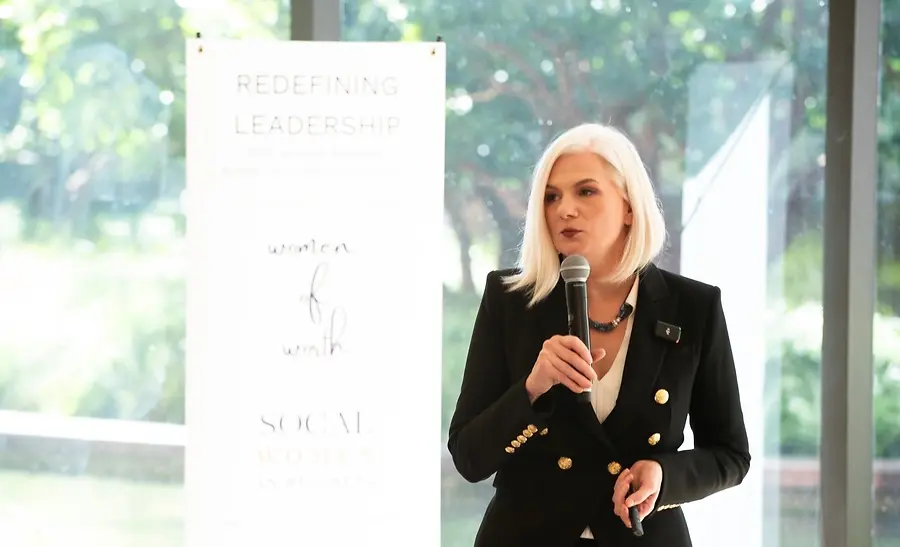
Once I decided to lead from my core, I stopped waiting for rooms to wake up and listen. I built my own. I founded SoCal Women in Business and continued building on the model I created with OC Women in Business — which grew 475% in under 75 days. I created OC CEO Collective and Women of Worth Global. I introduced “Uniting and Empowering Women in Business” and “Redefining Leadership,” first in Orange County and then on a global scale. I designed elevated experiences and created spaces where women leaders could finally breathe, strategize, and rise.
Unforeseen change and loss turned out to be the best things that could have happened to me. They prepared me to design the architecture for everything I have built since.
When change arrives uninvited, we have two choices: we can wait for the “leaders” to save us, or we can build our own.
The underworld does not have to be an ending. In fact, it can be the most powerful starting point — the place where a woman taps into her core, discovers her true gifts, develops her sovereign voice, and claims her throne.


