
The Rock in the Road: Knowing Which Problems to Solve and Which to Design Around
Why the obstacles you face may not be the problems you need to solve.

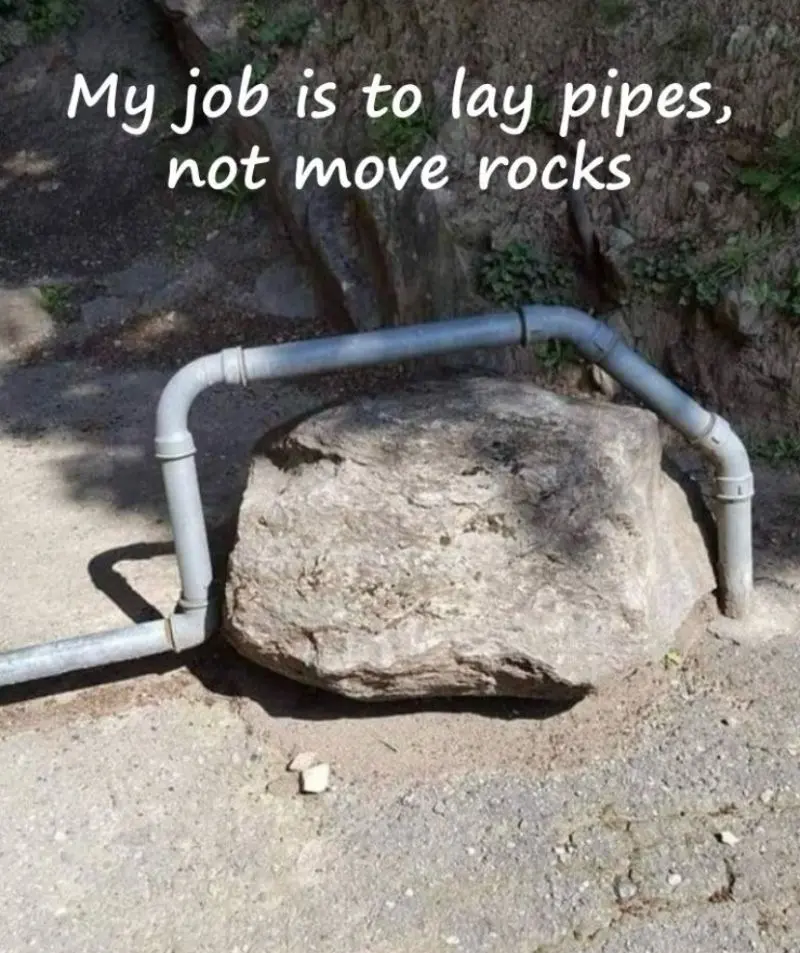
One of my favorite business images shows a pipeline routed around a large rock.
The caption reads:
"My job is to lay pipes, not move rocks."
At first glance, it seems like a simple lesson about working smarter, not harder.
The objective was clear. Water needed to move from Point A to Point B. The rock was an obstacle. Rather than investing time and resources in removing it, someone designed a path around it and accomplished the goal.
Efficient. Practical. Problem solved.
At least, that's what most people see.
The longer I looked at the image, the more I realized it represents one of the most important leadership decisions organizations face every day:
Do we remove the obstacle, or do we design around it?
Many people immediately take a side.
Some see operational excellence. The outcome was achieved. Why spend unnecessary effort moving a rock that doesn't need to be moved?
Others see a shortcut. They argue that the best solution would have been to remove the obstacle entirely and create the most direct and maintainable path possible.
The truth is that both viewpoints can be correct.
The real challenge is knowing which situation you're facing.
The Mistake Most Organizations Make
Throughout my career, I've worked with organizations managing supply chains, spend management programs, data governance initiatives, system implementations, process transformations, and operational excellence efforts.
What I've learned is that businesses rarely struggle because they lack smart people.
More often, they struggle because they fail to distinguish between symptoms, constraints, and root causes.
When that happens, organizations start building pipelines around every rock they encounter.
Another spreadsheet.
Another approval step.
Another manual review process.
Another exception.
Another report used to validate another report.
Another workaround.
Over time, these temporary solutions become permanent architecture.
The organization becomes exceptionally skilled at working around problems instead of solving them.
At that point, the rock is no longer the issue.
The pipeline is.
At that point, complexity becomes self-inflicted. The organization is no longer constrained by the original rock. It is constrained by years of decisions made to avoid moving it.
Three Types of Rocks
Not every obstacle should be treated the same.
Some Rocks Are Root Causes
Certain problems are genuinely root causes.
A data quality issue that undermines executive reporting.
A broken process creating compliance exposure.
A control weakness generating financial risk.
A system limitation that consistently disrupts operations.
These aren't opportunities for clever workarounds. These are problems that demand direct action.
The longer they remain in place, the more expensive they become.
Some Rocks Are Constraints
Not every constraint is worth eliminating.
Every organization operates within limitations:
- Budget constraints
- Resource constraints
- Legacy systems
- Regulatory requirements
- Market realities
Trying to remove every obstacle can consume significant time, energy, and money with very little business value to show for it.
Sometimes the smartest decision is learning how to operate effectively within the constraint.
Some Rocks Inspire Innovation
Innovation often begins the moment we stop accepting the problem statement as fact.
Many of the greatest improvements I've seen weren't the result of better solutions.
They were the result of better questions.
This is where transformation often begins.
Some of the most impactful improvements I've seen didn't come from removing obstacles.
They came from questioning assumptions.
The conversation shifts from:
"How do we fix this problem?"
To:
"How do we achieve the desired outcome?"
Those are not the same question.
When teams focus on outcomes instead of activities, entirely different possibilities emerge.
Sometimes innovation isn't about moving the rock.
It's about realizing the rock was never the real problem.
Efficiency, Optimization, and Transformation
One reason organizations struggle with these decisions is that they often confuse three different concepts.
Efficiency
Efficiency means doing the same thing faster. Move the rock more quickly. Use more resources. Reduce cycle times. Increase throughput. Efficiency improves execution.
Optimization
Optimization means achieving the same outcome with less effort. Route around the rock. Simplify the process. Reduce unnecessary work. Eliminate friction. Optimization improves performance.
Transformation
Transformation asks a different question altogether.
Should the pipe be here at all? Can the process be redesigned? Can automation eliminate the task? Can the requirement itself be challenged? Can the outcome be achieved in a completely different way?
Transformation improves the system.
Many organizations become trapped because they're working hard to become more efficient at processes that should have been transformed years ago.
Activity Is Not Progress
One of the reasons organizations struggle with these decisions is that activity feels productive.
Moving the rock feels productive.
Routing around the rock feels innovative.
Launching a project feels proactive.
Adding another control feels responsible.
Yet none of those actions guarantee progress.
Progress occurs only when outcomes improve in meaningful ways.
Too often, we reward visible effort because it is easier to observe than meaningful impact.
But organizations create value through results, not activity.
Some teams spend years becoming more efficient at activities that no longer serve the business. Others become experts at improving workarounds instead of addressing the underlying issue.
The goal is not movement.
The goal is progress.
The Location of the Problem Is Rarely the Location of the Symptom
One lesson I've learned repeatedly throughout my career is this: the location of the problem is rarely the location of the symptom.
Data governance taught me this lesson repeatedly.
The report isn't usually the problem. The report is where the problem became visible.
The same principle applies to operational bottlenecks, approval delays, compliance failures, and cost overruns.
Symptoms announce themselves. Root causes hide.
The reporting issue often isn't a reporting issue.
The invoice issue often isn't an invoice issue.
The approval issue often isn't an approval issue.
The operational pain point people see every day is usually where the problem surfaced, not where it originated.
That's why thoughtful leaders resist the temptation to solve only what's immediately visible.
They ask deeper questions.
Where did this begin? What assumption created this situation? What would happen if we redesigned the process rather than repairing it?
Those questions often reveal that the visible rock is simply pointing toward a larger issue hidden upstream.
The Cost of Elegant Solutions
There is one final lesson hidden in that image.
Sometimes the perfect solution is not the best solution.
A beautifully engineered answer that takes eighteen months, consumes significant resources, requires extensive change management, and disrupts operations may deliver less value than a practical solution that achieves most of the benefit in ninety days.
This is where judgment matters.
Business leaders frequently face a choice between elegance and outcomes.
The goal isn't perfection.
The goal is value.
The most effective solution is not always the most sophisticated solution.
Sometimes business value comes from precision.
Sometimes it comes from practicality.
Wisdom is knowing the difference.
The most successful leaders identify when a solution needs to be perfect and when it simply needs to be effective.
Seeing More Clearly
Some of the greatest opportunities I've uncovered throughout my career weren't hidden because they were complex.
They were hidden because everyone was looking at the wrong thing.
Just as clean data can reveal opportunities that were always present, thoughtful problem-solving often reveals that the obstacle we see isn't the problem we're actually trying to solve.
Sometimes the greatest business value comes not from working harder, but from seeing more clearly.
The Questions Matter More Than the Answers
Over time, I've come to believe that leadership is less about having answers and more about asking better questions.
Questions reveal assumptions.
Assumptions reveal constraints.
Constraints reveal opportunities.
The quality of our solutions is ultimately limited by the quality of the questions we ask.
Organizations often devote tremendous effort to solving problems.
Far fewer leaders spend time validating whether they're solving the right one.
Where Experience Creates Value
The best operational leaders, transformation professionals, and problem solvers I've worked with share a common characteristic.
They don't automatically remove every obstacle.
They don't automatically work around every obstacle.
They ask better questions.
What are we actually trying to accomplish?
What is the real problem?
Is this a root cause or a constraint?
What is the cost of removing it?
What is the cost of living with it?
What risks does the workaround create?
What would the process look like if we started from scratch?
The answers are rarely simple. But that's where leadership lives.
Not in moving every rock. Not in routing around every rock. But in understanding which rocks truly matter.
The challenge isn't finding obstacles.
Every organization has those.
The challenge is distinguishing between:
- Obstacles that must be removed
- Constraints that should be managed
- Conditions that can inspire innovation
The most impactful leaders I've worked with don't begin by asking how to solve the problem.
They begin by asking whether they're solving the right one.
In a world obsessed with speed, efficiency, and optimization, perhaps the most underrated leadership skill is judgment.
Because the real challenge isn't finding rocks.
The real challenge is knowing which ones matter.
That's where experience becomes value.
And where leadership becomes transformation.

Heather Durkin is a Business Consultant with over 15 years of experience advancing data integrity, governance, and operational excellence across the energy industry. She is known for strengthening decision‑making in complex organizations by aligning data, processes, and accountability at scale. Heather’s work sits at the intersection of systems thinking and leadership execution, where disciplined data management and…





